

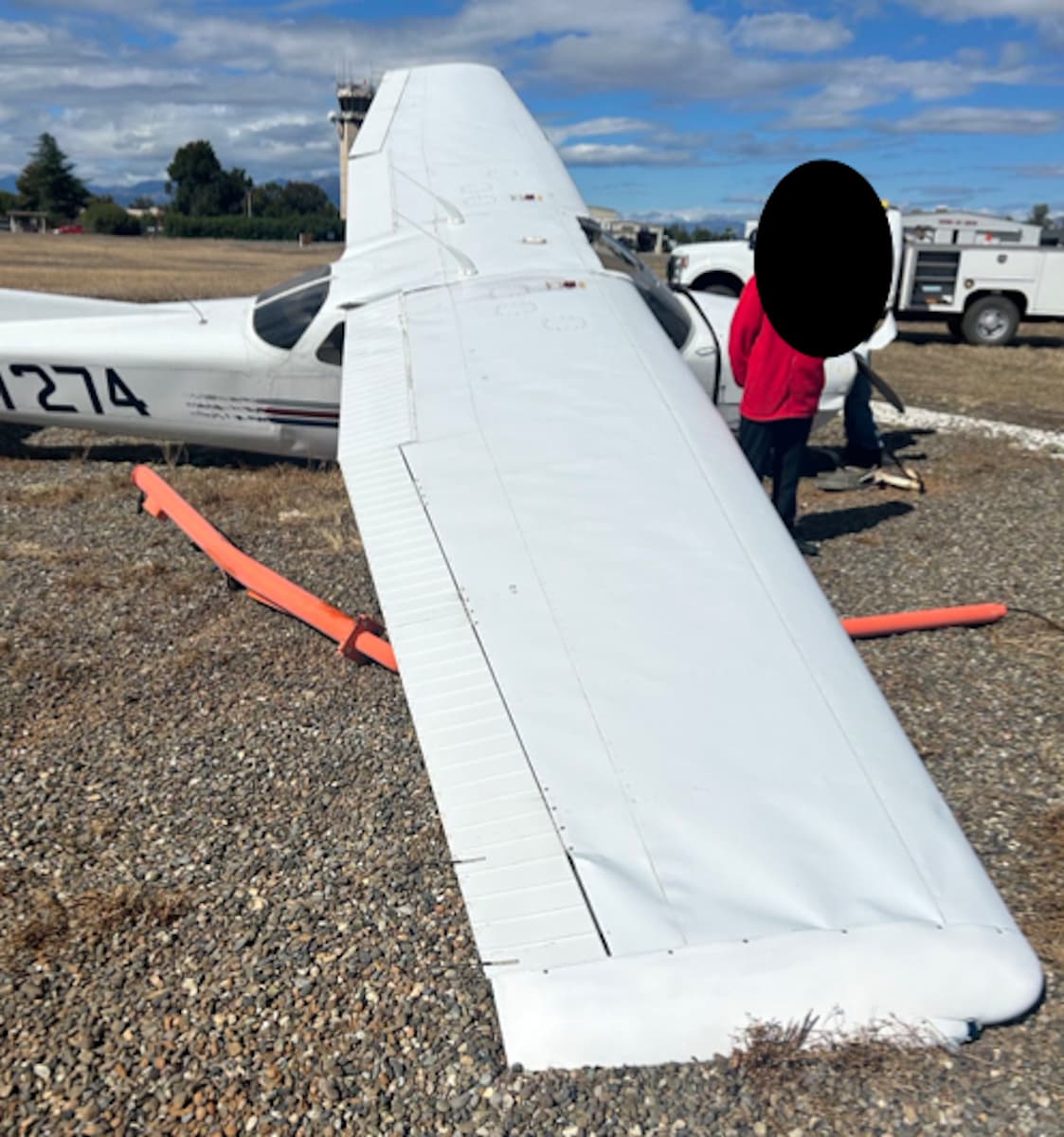
The solo student pilot reported that shortly after rotation, the Cessna 172 began to drift to the left of runway centerline at the airport in Redding, California.
He attempted to correct back to the runway centerline, but the plane continued to drift left, descended, and landed hard. It bounced back into the air and hit the windsock.
The airplane came to rest upright inside the windsock’s segmented circle.
The airplane sustained substantial damage to the right wing, aft fuselage, right horizontal stabilizer, and right elevator.
Probable Cause: The student pilot’s loss of airplane control during takeoff, which resulted in a bounced landing and impact with the airport’s windsock.
To download the final report. Click here. This will trigger a PDF download to your device.
This September 2023 accident report is provided by the National Transportation Safety Board. Published as an educational tool, it is intended to help pilots learn from the misfortunes of others.
Runway 34, wind 340, 6 – 11kts; 10 miles of visibility and clouds 6000 feet above? Glad that wasn’t my solo.
It’s the instructors failure to teach controlling the aircraft rather than just follow procedures and checklists.
“Pilot loss of control….” is so deeply descriptive of what went wrong. Not. Any idiot could say that. What really happened?
Regards/J
“Pilot loss of control”…. is so deeply descriptive of what went wrong. Not. Any idiot could say that. What really happened?
Well Mr. Potter …a couple points:
“Pilot loss of control” is the NTSB’s most succinct way of summarizing what they believe to be the “probable cause”.
I agree that despite their best efforts, my good friends at the NTSB don’t always get it exactly right, but I assure you …they are definitely not “idiots”.
“What really happened” …to the best of anyone’s recollection and the NTSB’s ability to ‘recreate’ the incident …is described in detail in the various documents found in NTSB’s investigation docket …which is always conveniently available to you via the link that GAN includes with each scenario.
I find the best place to start is the “Narrative History of Flight” section of the NTSB Form 6120.1 Pilot/Operator Aircraft Accident/Incident Report.
To save you the effort, I’ve reproduced it here for you, verbatim. I’ve redacted the student pilot’s (SP) name out of respect:
“SP(XXXXXX) was on his second takeoff of his initial solo at Redding Airport. SP received clearance from the tower to takeoff after holding short at Runway 34. SP applied full power, began to rotate, climbed about 50 ft and started drifting to the left shortly after takeoff. The airplane continued to drift left to the west, cleared taxiway Delta, and then made contact with the ground just east of the segmented circle. The airplane bounced off the ground and lifted up about 10 feet, and then pitched down and made contact with the ground again, striking the airport wind sock causing it to dislodge from the ground. Shortly after the airplane came to rest, the SP emerged from the plane uninjured. At the time of the SP’s second solo takeoff, the wind was 340 @ 6-11 kt, visibility 10 SM, clouds SCT 060 BK 100.”
I imagine this is written from the CFI’s perspective, as he/she was observing their student pilot survive what could have been a catastrophic event. It is not surprising that it lacks “First Person” narrative from the 22-year-old SP’s point of view. Personally, I can fill in the blanks.
Fortunately, the SP wasn’t hurt, and this CFI won’t send another SP up on their initial solo without ensuring they are better prepared to handle the ‘conditions’.
It may not be as “deeply descriptive” as you would like; I guess you can always look up the SP and ask him directly.
38 hours to solo
Yep…that is a bunch for sure.
OTOH, the following is from an article in AOPA’s “The Best of Flight Training Magazine”.
It is written by LeRoy Cook; the title is “When will I solo? Answers to the age-old question”:
“The amount of flight time accrued before solo is entirely an individual matter, influenced by frequency of lessons and luck with weather. I have sent students to fly solo in six hours and in 40 hours–it all depends. There was once a tacit understanding that a student would solo after eight hours of dual, or else someone wasn’t doing their job. In the days of Piper Cubs and Aeronca Champs, life was simpler, airspace was unembellished, and the pace of traffic slower. With only stick-and-rudder skills to be learned, eight hours was plenty of time. Not so today; either I’m not as good an instructor as I used to be, or there’s more to teach. I tend to think it is the latter.”
Have you flown to Redding ? A 7,000’, 150 feet wide runway on a day with a slight breeze. It’s a good thing it wasn’t Benton instead.
It wasn’t the instructor.