

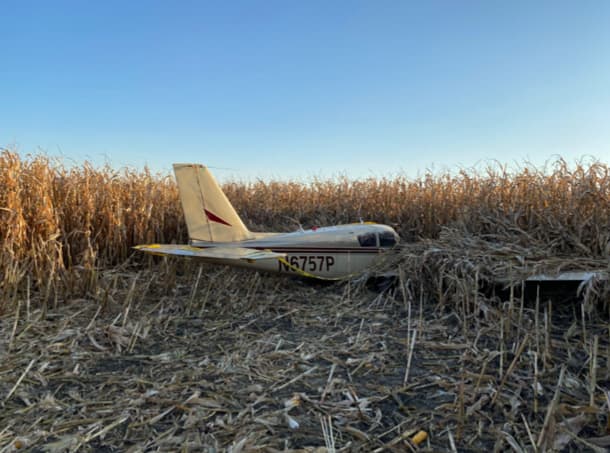
The pilot reported he was preparing for the flight from Abrams Municipal Airport (4D0) in Grand Ledge, Michigan, to Pompano Beach Airpark (KPMP) in Florida, after purchasing the Piper PA-25-250.
He conducted a full walk-around inspection and found no issues with the airplane. He departed from Runway 27 with full fuel tanks (about 60 gallons).
About five minutes after takeoff, he observed a few sporadic clouds overhead, so he applied carburetor heat for about 30 seconds, and the airplane “buffered a lot.”
About 40 minutes into the flight, at 6,700 feet MSL, he noticed a 5-inch drop in manifold pressure. He immediately applied carburetor heat for about 90 seconds. He stated that the airplane “buffered really hard.”
Between 1450 and 1506, he applied carburetor heat no less than four times for about 30 seconds each time while continuing to monitor the other engine indications.
About 1507, with the carburetor heat still on, he heard a bang and the airplane shuddered. There was no response from the propeller or the engine.
The engine lost all power and he began looking for a road to land the airplane on.
He discussed his intentions with air traffic control. Unable to find a road without powerlines or automobile traffic, he landed the airplane in a flat field near Ottawa, Ohio.
After touchdown, the airplane entered a cornfield and came to rest upright. Although sustaining minor injuries, he was able to get out of the airplane on his own and was met by first responders.
An inspector with the FAA responded to the accident site and examined the wreckage. The wreckage was found upright in the cornfield. There was no fire. The fuselage and wings were substantially damaged.
The wreckage was recovered to an aircraft storage facility where an examination was performed by the NTSB investigator-in-charge. The engine remained attached to the engine mount that was attached to the firewall. External examination of the engine did not reveal any evidence of case rupture or oil leakage. Control continuity was established from the cockpit controls to the carburetor and propeller. The fuel system gascolators were drained; one contained about two ounces of blue-colored fuel and the other contained about one ounce of blue-colored fuel. Both samples contained a trace amount of gray particulates that resembled sand.
The top spark plugs were removed. The electrodes exhibited normal wear and light gray, lean coloring as compared to a Champion Check-A-Plug inspection chart.
Internal engine continuity was confirmed by manually turning the propeller. Compression and suction were observed on all cylinders when the propeller was rotated. Valve action was correct. Both magnetos produced spark to all leads when rotated manually.
The carburetor was removed and partially disassembled. The bowl was dry and clean. The brass floats were undamaged. The inlet fuel screen was unobstructed and contained a trace amount of light gray particulates that resembled sand. The accelerator pump operated normally. The engine-driven fuel pump was unremarkable.
Examination of the engine and fuel system did not reveal an anomaly or malfunction that would have prevented normal operation.
FAA Special Airworthiness Information Bulletin (CE-09-35) – Carburetor Icing Prevention, stated that: “…pilots should be aware that carburetor icing doesn’t just occur in freezing conditions, it can occur at temperatures well above freezing temperatures when there is visible moisture or high humidity. Icing can occur in the carburetor at temperatures above freezing because vaporization of fuel, combined with the expansion of air as it flows through the carburetor, (Venturi Effect) causes sudden cooling, sometimes by a significant amount within a fraction of a second. Carburetor ice can be detected by a drop in rpm in fixed pitch propeller airplanes and a drop in manifold pressure in constant speed propeller airplanes. In both types, usually there will be a roughness in engine operation.”
A review of the CE-09-35 carburetor icing probability chart revealed the airplane was operated in conditions conducive to icing at glide and cruise power and serious icing at glide power.
Probable Cause: A total loss of engine power due to the formation of carburetor ice.
To download the final report. Click here. This will trigger a PDF download to your device.
This October 2023 accident report is provided by the National Transportation Safety Board. Published as an educational tool, it is intended to help pilots learn from the misfortunes of others.
So if the carb heat was applied several times, why still the engine failed due to carb ice?
Did anything explain the “bang?”
All the planes before 1960 had carb temp gages. They need to be in every carbureted plane. You can set the temp so carb ice doesn’t form. It’s amazing how we keep reinventing the wheel and don’t learn from the past.
ALL the planes before 1960 did NOT have carb temp gauges. Where did you get that idea?
The only temperature gauge for many was oil temp.
48 years flying a M20C Mooney out of Pueblo CO to Medford Or never once used carb heat. And the temp senders give a temp reading, they don’t heat the carb.