

Probable cause déjà vu: “Inadequate preflight inspection and inadequate fuel monitoring during the flight, which resulted in a total loss of engine power due to fuel exhaustion.”
That’s the bottom line from the National Transportation Safety Board (NTSB) on the nighttime crash of a Piper PA-28 Cherokee into the Georgia woods near Jonesboro in October 2023.
I know every time I write up one of these out-of-gas crashes we get complaints in the comments of “how can people be so stupid,” along with the demand that we cover other kinds of accidents instead.
I promise to stop writing about these accidents when pilots stop crashing empty-tank airplanes.
But in the meantime…
The Flight
A pair of commercial pilots were using the Cherokee, which one of them owned, to build hours towards airline careers.
According to the final report from the NTSB, the two pilots were flying a lot of night cross-country flights together and sharing the flying responsibilities to let them both log time. Apparently, the arrangement was that the owner sat in the left seat and did the takeoffs and landings, and the right seater — who had fewer hours — flew the en route legs.
On this night, they took off from Olive Branch Airport (KOLV) in Mississippi, flew to Waynesboro Municipal Airport (2R0) in Mississippi, then on to Destin Executive Airport (KDTS) in Florida, bound for Atlanta Speedway Airport (KHMP) south of Atlanta, Georgia. The total flight would be around 550 nautical miles.
They nearly — but not quite — made it.
When they landed at Destin Executive Airport they apparently had about a 50% fuel load, and before departing, they added 15 gallons of fuel — the minimum purchase to avoid a ramp fee.
Five gallons topped off the right tank, while the other 10 went into the left, bringing that tank up to between half and three-quarters full, with one pilot later reporting 13 gallons in the left tank, and the other pilot reporting 18 gallons.
Regardless, with either 38 or 43 total gallons on board, at a burn rate of 8 to 10 gallons an hour, and a less than two hour flight ahead, fuel should not have been a problem, even with the nighttime reserve requirement of a spare 45 minutes.
The airplane fueled up, the owner handled the takeoff, then at 1,000 feet, turned the controls over to the right-seater. The owner then settled in to handle the radios while the other pilot flew the airplane.
The Final Moments
As they neared their destination, passing through 3,500 feet, the owner pilot switched the fuel selector, which is on the left wall of the cabin, from the left tank to the right tank for the first time on the flight. The engine promptly died.
It’s not stated whether the owner switched it back, but NTSB investigators noted that by then — based on their calculations — the left tank would have been nearly dry.
The owner apparently ran the emergency checklist, but was unable to restart the engine.
They were unable to glide to the nearest airport and performed an emergency landing in trees, in the end coming to rest perfectly perpendicular to the ground, with the tail high above them.
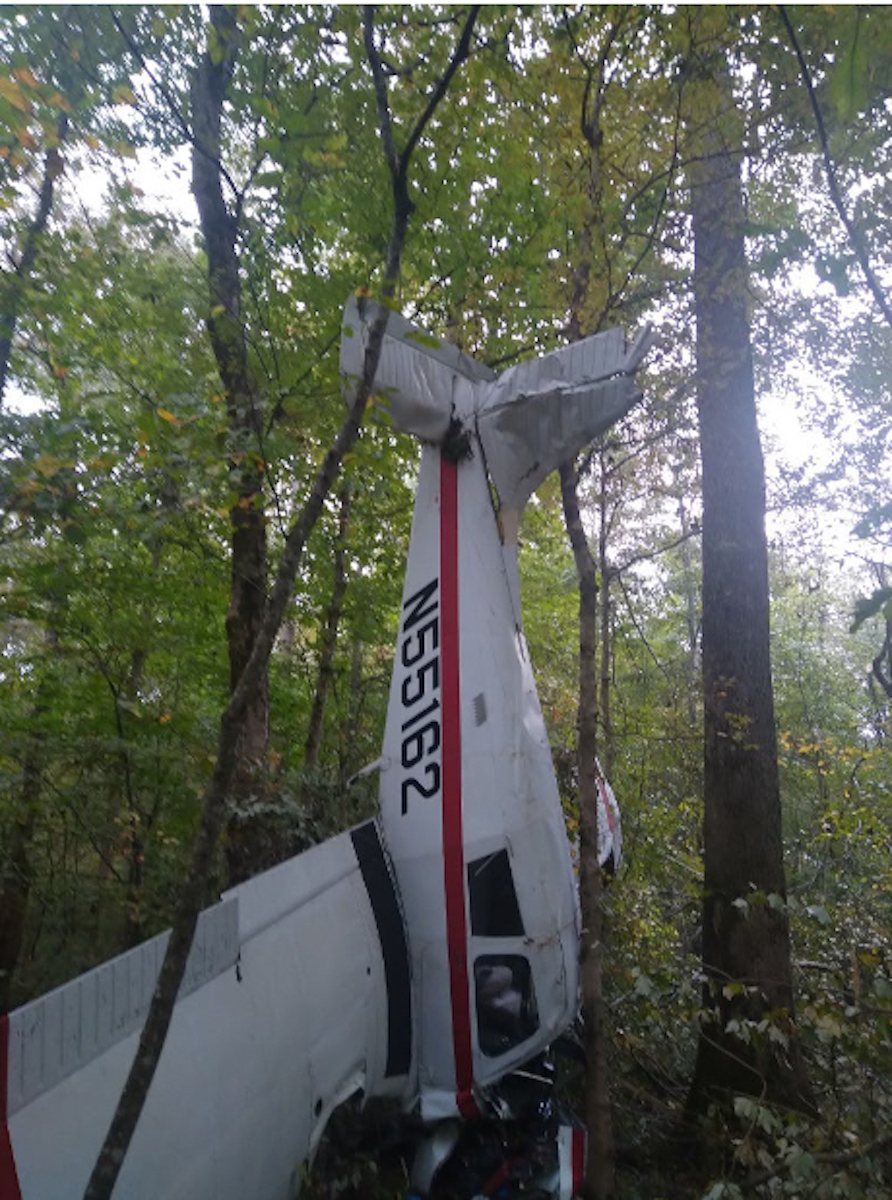
Both pilots were seriously injured, but survived.
The Investigation
An FAA inspector traveled to the site of the crash, arriving about three hours later, at 1:30 in the morning. He found both wing tanks breached, so there was no way to know if there was fuel in either tank when the airplane went down.
But the inspector noted that when he arrived there was no smell of fuel “and no browning of vegetation near the breached wings.”
He did note, however, that the right fuel cap was missing and could not be located.
Subsequent searching of the site failed to find any sign of the cap, and in the end the NTSB decided that the missing cap fit the bill when it came to explaining how an airplane that should have had enough fuel — and fuel to spare — could run out.
In its final report, the NTSB noted that, “Based on this information, it is likely that the right-wing fuel cap was not secured before departure and, during the accident flight, fuel siphoned from the right tank without either pilot noticing.”
The NTSB called out both pilots for not noticing the loose or missing fuel cap during the preflight inspection and for not noticing the resulting fuel imbalance during the flight.
The Pilots
Although the narrative of the report says in several places that the owner of the airplane held a private pilot certificate, both the pilot information section of the report and other documents on the docket indicate that both pilots held commercial certificates.
The pilot owner, in the left seat, was a 37-year-old female. She also had an instrument rating and held a Class 1 medical. She had 1,267 hours total time, with 600 in make and model. Her night hours were not reported to the NTSB.
The pilot flying in the right seat was a 34-year-old female with a commercial certificate, and both instrument and multi ratings. Her hours were 510 total time, with 60 in make and model, and 83 hours of night flight.
The narratives of the two pilots indicate a lack of clarity about who was acting as Pilot in Command (PIC), with each telling authorities that the other pilot was.
While many GA pilots get confused on the distinction between PIC and pilot flying, I would have expected a pair of pro-bound commercial pilots to be clear on the difference.
And this may, or may not have, contributed to the accident.
Analysis & Discussion
Considering that the airplane was crewed by two commercial pilots, there was a remarkable lack of crew resource management being demonstrated.
Both pilots reported to authorities that they performed walk-arounds and checked the fuel load, but frustratingly, they had different estimates of that fuel load. The owner estimated a total fuel load of 38 gallons while the right-seat pilot estimated 43.5. Did they not compare notes?
And how did two commercial pilots manage to miss the wayward fuel cap on the two walk-arounds, for crying out loud?
In flight, neither pilot detected the fuel imbalance, nor did either of them, apparently, pay any attention to the fuel gauges. Even though fuel gauges aren’t terribly reliable, at least some degree of fuel gauge monitoring is in order. If the needle’s moving on the tank you aren’t using, it should get your attention.
After the accident, the owner pilot told authorities that she “forgot” to switch fuel tanks throughout the accident flight, but why weren’t the two pilots communicating about tank switches?
The fact that they also had a fuel imbalance when landing at KDTS, based on how the refueling went with very little fuel fitting in the right tank and the left tank only filled between half and three-quarters, this suggests to me a pattern in the lack of rigor in maintaining fuel balance.
Were all these issues a side effect of the over-lapping and muddled lines of authority on the flight deck? Or is it something else altogether?
We know from the NTSB final report that the two pilots were flying a lot of night cross-counties to build hours. Were they flying at night because they also had day jobs? Was our old nemesis fatigue a player in this accident?
And in one final lack of attention to detail, fatigue, or over-work, the owner told the FAA that she “might not” have completed her insurance contract and was waiting to hear from the insurance company as to whether she was covered. Or not.
The Takeaway
Airlines like pilot teams as it’s a proven benefit to safety — at least in the major leagues.
In flight training, on the other hand, research has proven otherwise: There are more accidents training certificated learners than student pilots.
But what about in GA? Is a pair of GA pilots flying together more dangerous than one pilot with non-pilot passengers?
Perhaps the answer is in how the doubling of talent is deployed.
At a minimum we should not get too relaxed about having another pilot along “for safety.” The line between relaxed and complacent is probably a fuzzy one.
And I wonder if having two pilots checking things like the fuel doubles the risk of things like leaving a gas cap unsecured.
So there’s a mini takeaway: Make sure you fully secure the caps after checking fuel, even if you “know” someone else is about to double check right behind you.
The big takeaway is clearly that flying as a crew requires good communication and a clear discussion of who is responsible for each aspect of the flight.
And if we really want to take a page from airline crew resource management, duties should be divided up, rather than duplicated.
Perhaps the safest approach, for two pilots flying GA together, is to “divide and conquer” rather than “double up.”
The Numbers
Want to read more? Download the NTSB’s final report here or view the items on docket here.

What strikes me is the lack of looking outside. The fuel caps are only about 6 feet away, on a low wing airplane. Even at night it seems they should have been able to see a fuel cap was missing.
I guess if their not checking the fuel gauges, their not looking outside (for traffic) either.
Well,, had the left tank been selected inflight, even if the tank was ‘nearly dry’, one would think any attempt at restart would’ve had a high probability of success and even a couple of gallons may have gotten them to an airport.
Poor preparation, poor judgment, really nothing to commend either of these two for. Glad they survived. Hope they e moved on to other careers. We don’t need that kind of airmanship flying airliners.
Ha ha ha ha, very funny story, these two women are comics and they don’t know it !!! Another nice airplane in the trash can, who cares ? the women flying it didn’t !! I have to agree with Mr. Smith, they both need to have their tickets taken away and start all over again and maybe this time they will learn what the fuel valve is for !!! No rime or reason !!!
My worst landing was when returning from completing my check-ride for my Commercial License
“Aviation in itself is not inherently dangerous. But to an even greater degree than the sea, it is terribly unforgiving of any carelessness, incapacity or neglect.” ~ Captain Alfred G. Lamplaugh
I’m reading about a a fuel-starvation incident that happened in January, 1940. Fascinating. A German Luftwaffe pilot accidentally turned off the fuel (with his knee), killed the engine, had to crash-land. Tore both wings off between two trees. No injuries. The guy in the back seat had the top-secret France invasion plans. The “Mechelen incident,” it’s called, I believe, after the name of the area in Belgium where he crashed. Fuel starvation, but the reason he hit the fuel selector with his knee was he boosted himself up in the cockpit to look out the window to try to see where he was at because he got lost in the fog.
Yet another fuel exhaustion accident!….I hope they recovered okay and we all will live and learn to try and prevent it from happening again.
Scratch another legacy aircraft unfortunately and life goes on.
You can get away with leaving the gas station in your car without your gas cap affixed (I’ve done this) but not in a flying machine. At the top of the list is the apex rule: attention to detail. Because one slip-up can kill you.
Regards/J
Just plain stupid running out of gas. If they live through the accident, they should loose all their licenses and have to start over!!! Evident they missed something in class!!!
Am i ‘blocked; ????