

According to the pilot, before takeoff from the Pierre Regional Airport (KPIR) in South Dakota, the Piper PA-46-350P was fueled with 10 gallons of fuel for a total of 100 gallons on board for the planned flight to Steamboat Springs, Colorado.
The pilot told investigators that before takeoff, the header fuel tank contained 11 gallons of fuel, fuel boost pump No. 1 was selected, the fuel transfer switch was in the AUTO position, and the fuel selector was in the right fuel tank position. No anomalies were noted during the engine start, takeoff, and initial climb.
About 11,000 feet mean sea level (MSL), air traffic control cleared the pilot to flight level 220. While climbing through 12,000 feet MSL, the engine sustained an abrupt loss of power that was confirmed by the loss of torque and engine compressor turbine rpm (Ng) speed. The pilot noted no cockpit warning or abnormal indications before the loss of engine power.
He declared an emergency and then executed a 180° turn back to KPIR.
During the emergency descent, he attempted to restart the engine by switching boost pumps, switching the fuel tank selector, and activating the emergency header tank pump, but the restart was unsuccessful.
He attempted another engine restart procedure with the fuel at cutoff, boost pump on, igniters at AUTO, generator off, and starter on. At this time, Ng was about 15%, the fuel condition lever was advanced, and a “pop” was heard with a puff of smoke from the right exhaust.
The engine torque did not increase, so the pilot closed the fuel condition lever. He told investigators he did not use the manual override fuel switch during the emergency descent.
He also reported that while maneuvering back toward KPIR, the airplane lost electrical power, which resulted in a loss of the primary flight display, both GPS displays, and annunciator panel. This resulted in the pilot becoming disoriented in the descent to the airport.
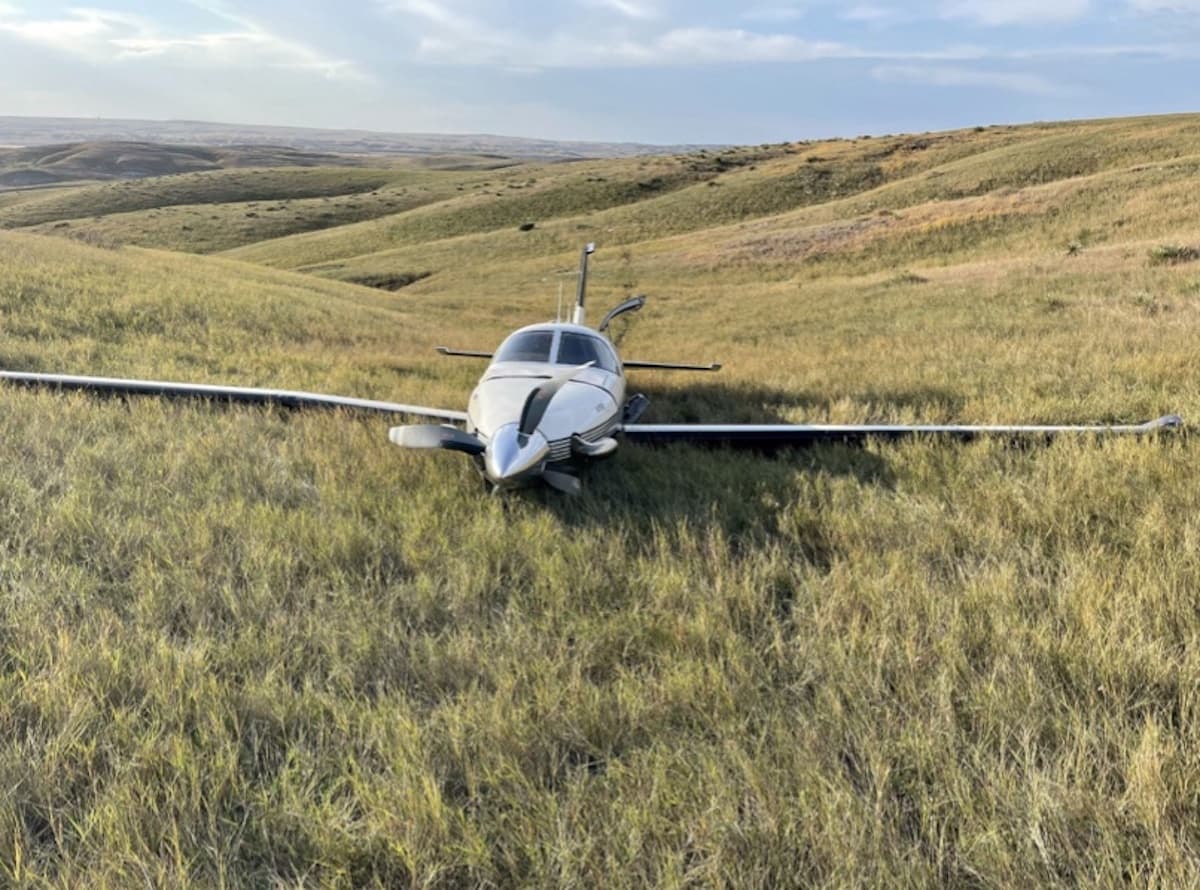
He realized he was going to be unable to make KPIR and attempted a forced landing to bluffs and rolling terrain.
The airplane impacted the terrain, came to rest upright, and sustained substantial damage to the fuselage and both wings.
After the accident, the pilot, who sustained serious injuries in the crash, saw that the passenger, who was seated in a rear forward-facing seat, was barely conscious. After checking the passenger’s vital signs, he performed cardiopulmonary resuscitation until first responders arrived on scene. The passenger passed away later from injuries sustained in the crash.
Initial post-accident examination of the airplane at the accident site revealed no pre-impact external anomalies or malfunctions, and the airplane was retained for further examination.
Examination of the airframe revealed the cockpit battery display indicated 24.7 volts, the fuel selector was in the right tank position, the fuel transfer pump switch was in the manual position, and the emergency fuel transfer switch was off. The header tank contained about 2.4 gallons of fuel consistent with Jet A.
The fuel line between the oil/fuel heater and the engine fuel pump was opened and no fuel drained from the fuel line. The airframe fuel filter and bowl contained about 1 pint of fuel that was clear of contaminants.
The airframe fuel system, including the right-wing fuel transfer pump, fuel selector valve, emergency transfer fuel pump, header tank Nos. 1 and 2 boost pumps, header tank float switch, header tank pressure transducer, firewall shutoff valve, and annunciator panel lights were tested, and no anomalies were noted. The fuel lines, from the wings to the engine fuel pump, were clear of obstructions when blown with compressed air.
The left-wing fuel transfer pump wiring was damaged during the recovery process, and the pump was removed for further examination. The transfer pump was bench tested at Piper Aircraft in Vero Beach, Florida, and no anomalies were noted.
Following an airframe examination, the engine was removed from the airframe and shipped to PWC for a functional test. The engine was installed in the test cell and serviced with oil. The engine was functionally tested, which included a dry motoring check, engine start, engine warm up at ground idle setting, normal acceleration, normal deceleration, and shut down. A second engine start was done to perform engine handling tests, slam acceleration, and slam deceleration checks.
According to PWC, during both engine functional test runs, the engine performance and behavior was within specifications with no limits exceeded.
The Garmin G500 TXi system primary flight display was removed and sent to the NTSB’s Recorders Laboratory for data extraction. According to the data, about 7 minutes after takeoff, the engine sustained a loss of fuel flow, engine torque, and Ng, consistent with the reported loss of engine power.
Before takeoff, the header fuel tank quantity indicated 10.8 gallons, and during the flight, the header tank fuel quantity continually decreased to 5.7 gallons until the engine power loss. About 1 minute after the power loss, the header fuel tank quantity began to increase, and about 4 minutes later, the header tank fuel quantity reached 11.1 gallons and remained at that quantity until the accident.
Probable Cause: The total loss of engine power due to fuel starvation as a result of the pilot’s improper configuration of the automatic fuel transfer system. Contributing to the accident was the pilot’s failure to adequately monitor the header tank’s fuel quantity.
To download the final report. Click here. This will trigger a PDF download to your device.
This October 2023 accident report is provided by the National Transportation Safety Board. Published as an educational tool, it is intended to help pilots learn from the misfortunes of others.
It is over two years now since the McSpadden/LAKE PLACID accident, are we ever going to get an accident report from the NTSB/FAA.
A link to the NTSB Final Report is included at the end.
https://generalaviationnews.com/2025/10/03/new-aopa-video-examines-crash-that-killed-one-of-its-own/
If the fuel system was automatic, would the pilot have needed to ‘configure’ it at all? A turbine aircraft isn’t a ‘buy it and fly it’ purchase. Insurance would require a training program before underwriting the airplane. Apparently the pilot missed the
fuel system part of training.
Another tragic loss, seemingly preventable.