

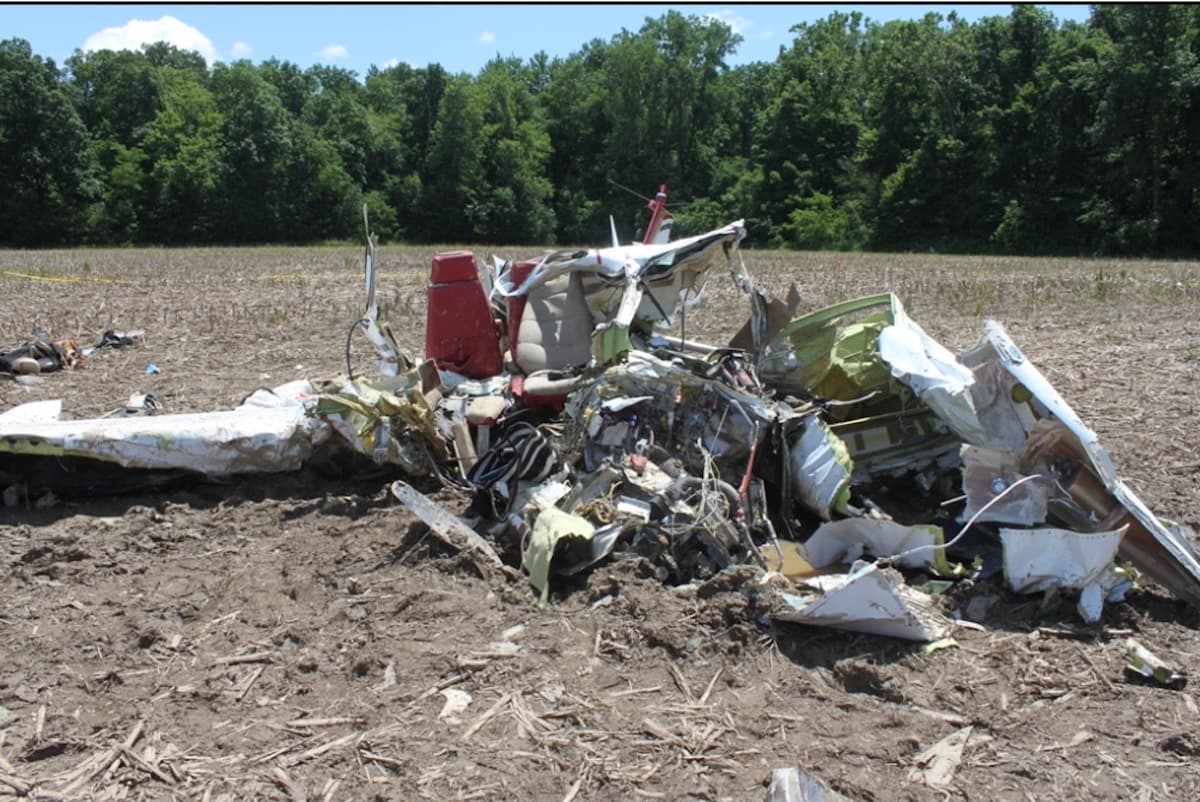
A new review of research into general aviation accidents unearthed a startling statistic: Pilots without an instrument rating lose control of their aircraft within 178 seconds of entering IMC.
That’s from a 2003 study from researchers at the University of Illinois, which was included in “a systematic review of general aviation accident factors, effects, and prevention” published in 2025.
Conducted by researchers at the University of South Australia, the review looked at 46 studies across the world, with an emphasis on general aviation in the United States.
The idea behind the research was to consolidate existing research on the factors that cause general aviation accidents, according to the researchers.
“This method allows for gaps in the literature to be identified, thereby creating a roadmap for future research direction,” the researchers noted.
“Understanding the causal factors of accidents within GA is essential for developing targeted safety interventions,” the researchers continued. “This also allows for a shift from a reactive approach to a proactive approach, as understanding the causal factors enables the anticipation and mitigation of potential risks before an accident occurs.”
The analysis found five “themes” related to the causes of general aviation accidents:
- Human Factors, including physical environment, personal readiness, adverse physiological state, adverse mental state, skill-based errors, decision errors, and perception errors
- Training Deficiencies
- Aircraft Characteristics, including age, number of engines, and safety features
- Pilot Characteristics, including number of flight hours, age, gender, and prior accident history
- Phase of Flight, including takeoff, landing, go-arounds, cruise, maneuvering, and on the ground.
But it’s the top two — human factors, especially physical environment in the form of bad weather, and training deficiencies — that take up a majority of the nine-page paper.
The researchers note that adverse weather is deadly for GA pilots, resulting in almost 100 fatalities each year, according to the review, which advises that “preflight weather planning is a must, but pilots must continually assess the weather conditions along their route to avoid adverse weather wherever possible.”
A 2007 study found that flights conducted in poor visual conditions carry a sevenfold increase in the risk of fatality. This is reinforced by the fact that while only 9% of general aviation accidents occur within IMC, these accidents account for 28% of general aviation fatalities, according to a 2017 study.
A 2014 study found that the leading causes of accidents occurring in IMC were instrument approach deficiencies, spatial disorientation, and failure to maintain adequate clearance from obstacles and terrain.
Another 2014 study found that pilots flying in IMC were 14 times more likely to be involved in a fatal accident, compared to flights in VMC.
“The interaction between human factors and training deficiencies is evident in both intended and unintended IMC operations, as inadequate instrument training can reduce a pilot’s ability to manage workload and maintain situational awareness under pressure,” the researchers said.
According to 2025 statistics from the FAA, pilots with less than 500 hours of flight time are particularly susceptible to spatial disorientation.
“The prevalence of spatial disorientation-related accidents in IMC suggests that emphasis needs to be placed on training pilots to recover from unusual attitudes using instruments,” the researchers noted.
VFR into IMC encounters are among the most dangerous situations a VFR pilot can face, according to the Australian researchers.
“Without the skills to interpret and rely on flight instruments, the sudden loss of visual reference can lead to spatial disorientation and subsequent loss of control,” they said.
They illustrate this by pointing to a 2019 NTSB report about a non-instrument-rated pilot on a VFR flight who encountered fog shortly after takeoff and attempted to climb above the cloud layer to divert.
The aircraft entered two spiraling turns, followed by a rapid descent consistent with spatial disorientation in instrument conditions, resulting in a fatal accident.
That goes back to the first study mentioned that says a pilot without an instrument rating has just 178 seconds — less than three minutes — before they lose control of the aircraft.
To prevent VFR into IMC occurrences, the Australian researchers emphasize that training is the key.
“Educating pilots on the dangers of flying into adverse weather conditions for which they are not rated is critical. This includes thorough training on weather assessment, flight planning practices, and decision-making processes. Detailed pre-flight planning, including a thorough check of current and forecast weather, is essential. Establishing and adhering to personal minima that exceed the minimum legal requirements can also significantly enhance safety by providing a buffer against unexpected weather changes. Pilots should also avoid operating in marginal VFR conditions, as the reduced visibility and lower cloud ceilings increase the likelihood of inadvertently entering IMC.”
The review highlights that training deficiencies are a “recurring factor in general aviation accidents.”
“To address these concerns, there is a need to enhance existing initial and recurrent training programs in a variety of areas, including flight in low visibility conditions, complex maneuvers, and emergency procedure execution in both single and twin-engine aircraft,” they advised.
They also say that further research should be conducted to assess the effectiveness of current training methods.
“Aviation theory has remained largely unchanged and is still primarily delivered through passive, instructor-led methods,” they said. “There is a clear need to explore more effective and engaging approaches, including the use of emerging technologies, and updated teaching practices that better connect theory with practical application.
“Emerging technologies, such as virtual reality (VR) and augmented reality (AR), present new opportunities for making training content more interactive with the potential to enhance learner engagement and knowledge retention, thereby improving training outcomes,” the researchers continued.
They added that a 2023 study found that VR-based flight simulators have demonstrated benefits including improved spatial awareness, cognitive learning, and reduced time required for familiarization with cockpit procedures compared to traditional methods.
“However, further research is needed to evaluate the transferability of skills from immersive training environments to real-world aviation operations,” the researchers said.
“Ultimately, this study seeks to increase awareness amongst the general aviation community, thereby improving safety practices, and guiding policy making,” the researchers concluded. “It is hoped that the outcomes from this paper, combined with ongoing research in the areas of concern identified, contribute to a reduction in the occurrence of accidents within general aviation.”
You can read the full research paper, which was published in July 2025 in the Journal of Air Transport Management, at ScienceDirect.com.

This headline underscores one of the most persistent and lethal risks in general aviation: the transition from VFR into IMC (Visual Flight Rules into Instrument Meteorological Conditions). The statistic that spatial disorientation can become deadly in under three minutes is a stark, crucial reminder of how rapidly sensory input fails when visual references are lost. This danger highlights the absolute necessity of rigorous instrument training and discipline for all general aviation pilots, regardless of their intended flight rules. Safety must always be the first priority in the cockpit.
Visit US, Unissula
What are the key findings of a recent study regarding the average time it takes for non-instrument rated pilots to lose control after entering IMC conditions while flying VFR?
During my initial ppl training my instructor always made us do hood time almost every session.
Using steam gauges some 65+ years ago students needed to have mastered them to a level where they could survive inadvertent excursions into IFR conditions before qualifying for a PPL. However this was overseas not USA. Maybe this should be added to the USA PPL syllabus.
Paul.
Years ago, when I was perusing an instrument rating, the flight school where I was, started telling beginning students that if the 180 turn doesn’t get you out of the clouds, push the yoke to unload the wings and then let go of the yoke, get your feet off the rudder peddles, pull power, and start adding flaps. The plane will start seeking the airspeed it is trimmed for. So you will end up in a nose down attitude, probably in a slow spiral, at a relatively slow speed and come out of the clouds under control. Note: we were using all high wing Cessnas with the exception of a Seminole at that school.
Several years later, I had, effectively, a full loss of vacuum just after entering the clouds on an instrument departure flying a Piper Cherokee 180. I realized I was in an unusual attitude, and so I pulled power, punched the yoke to unload the wings, and added flaps. Told ATC I had a vacuum failure. I ended up right on the center line of the runway I had taken off from, about 2 miles out. I think this kind of thing needs to be practiced and taught. It might save lives like it did for me. BTW the ceiling was 2000 AGL. That is always my minimum for instrument departures just for this kind of problem.
The title of this “study” is “A systematic review of general aviation accident factors, effects and prevention”.
It is a “systematic literature review“ of 46 existing studies that already reviewed “general aviation accident factors, effects and prevention”.
I appreciate any and all efforts intended to make flying safer. However, even though the researchers noted their methodology “allows for gaps in the literature to be identified, thereby creating a roadmap for future research direction,” …there’s no NEW information, recommendations, revelations, insights…in this study. (I’ll read it again.)
Not to make light of an important topic, but
several statements in this study would almost be silly if the subject itself wasn’t so serious. One of my favorites: “Due to the lack of existing literature on general aviation safety…”. Really?
In their “Summary”, they state: “However, further research is needed to evaluate the transferability of skills from immersive training environments to real-world aviation operations”.
I’m surprised they didn’t conclude with “Only time will tell…”
Does “178 Seconds to Live” sound familiar?
The original version: https://youtu.be/b7t4IR-3mSo?si=9O_GejKl1NAYOEWw
Simply text book pilots, low or high hours, who are not in command of their aircraft. Often what you need to do next is not on a checklist.
This research actually dates back to 1954 [see Bryan, L. A., Stonecipher, J. W., & Aron, K. (1954). 180-Degree Turn Experiment. University of Illinois, Aeronautics Bulletin No. 11]. Twenty non-instrument pilots flew into simulated IMC, and all got into “incipient dangerous attitude” within 20sec – 8 mins. The average across pilots was 178 seconds.