

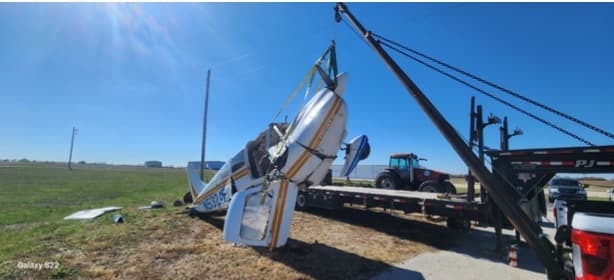
The pilot reported that he had 48 gallons of fuel on board the Piper PA-28-181 and assumed that he would be able to fly for about 5 hours.
After about 4 hours and 20 minutes of flying, he began his descent for landing at his destination, turned the fuel pump on, and checked the fuel gauges. The gauges read about 3 or 4 gallons of fuel remaining in each fuel tank. Shortly after, the engine quit.
He switched fuel tanks and the engine started again momentarily and then quit again.
He landed the airplane on a gravel road about 1.5 miles northeast of the airport in Iola, Kansas.
After touchdown, the right wing hit a tree and separated from the fuselage resulting in substantial damage.
The pilot told investigators that he believes the airplane ran out fuel, which resulted in the loss of engine power.
Probable Cause: The pilot’s inadequate fuel planning, which resulted in a total loss of engine power due to fuel exhaustion.
To download the final report. Click here. This will trigger a PDF download to your device.
This October 2023 accident report is provided by the National Transportation Safety Board. Published as an educational tool, it is intended to help pilots learn from the misfortunes of others.
He hit a tree after landing? Take a good look at the provided image of the recovery and you will not see a bush, let alone a tree that could rip a wing off. He had bad luck with getting the fuel right but was doing great at finding the only tree around to hit.
Unlike a lot of these over-two-years-old accident reports …there’s more to this one than just “he ran out of gas and crashed because he was dumb. Next…”.
Read the pilot’s ‘Narrative History of Flight’ and ‘Operator/Owner Safety Recommendation’ sections of the Form 6120.1: There are a ton of unanswered questions and lessons learned buried in them.
He was acutely aware of his fuel state, based on an expected fuel burn rate, and he knew how the Piper’s fuel load should be managed, given there’s no “Both Tanks” option in a PA-28.
He considered the impact of adverse winds on his fuel situation and had identified possible diverts along his route. We don’t know why he didn’t use one when it became clear he was going to be low on gas when (and if) he reached his destination…
He unequivocally states the tanks were ‘full’ (50 gallons) at engine start, and all his subsequent planning was based on having 48 gallons ‘useable’. Unfortunately, his planning resulted in a “measure with a micrometer, cut with an axe” outcome.
Despite his initial flight plan, poor ADM, and questionable in-fight actions: I think he still had a chance to make it to the airport …even if it ended up being “dead stick”.
He believed that by “Using a conservative 9.5 gph burn rate, the 48 gal of fuel would last 5 hours.” Basic pilot math might indicate that’s true (actually 5 hours + 3 minutes), but that doesn’t account for the myriad of “-ism’s” he’d likely encounter.
The fuel burn data in the PA-28-181 POH is pretty thin; it shows specific burn rates for six “conditions” ranging from Best Economy to Best Power. Anything else ‘in between’ requires interpolating Piper’s charts with a really sharp pencil.
Even though he mentions his leaning ‘technique’: His O-360-A4M is not a “lean of peak” engine. We don’t know if this plane had an EGT gauge …or did he just lean it until it barked and then adjusted it from there? We also don’t know if he planned to actually FLY at “9.5 gph” (approximately 70 % power), or was he flying at something less, like 55 or 65%, but used the 9.5 gph number as his ‘conservative’ planning factor. The NTSB never states how much fuel they actually accounted for in the wreckage. The single FAA ‘Fuel Drained from Left Fuel Tank’ photo doesn’t tell the whole story.
So, yes, “If this accident was caused by fuel starvation, using more conservative fuel burn estimates during pre-flight planning” …is probably a good idea. But regardless of the fuel burn rate you plan for, figuring how much fuel is actually used, based on that ONE burn rate, is going to be difficult. Since the fuel flows vary widely during flight conditions with idle, cruise, and full throttle settings, etc., applying one fixed rate to a static “engine run time” is going to be inaccurate.
In this case, that technique left him a tad short: “Around the same time as I began my decent, I looked at the engine run time, which was just over 4:20, and my fuel gauges which both read about one needle-width below the 5-gallon mark (indicating roughly 3 or 4 gallons left in each tank.)”
I wonder what he considers “minimum fuel”? Regardless, if the gauges were even remotely accurate, that means roughly 2 to 3 useable gallons still available in each tank. We don’t know why the engine quit with that much fuel left. (I doubt he was maneuvering aggressively during a night cross country.)
His descent from 6,500’ MSL to 500’ AGL (@1,500’ MSL) is described as a series of “moments” during which he terminated flight following, completed his pre-landing checklist, and started talking on CTAF. Did he have any idea how far a PA-28 can glide from that altitude? He was ’10 miles out’ from K88. If he stayed at 6,500 feet a bit longer, and descended closer to the airport, with 4-6 gallons of useable gas …I think he probably could’ve landed with power available.
When his engine did quit, he ran through an abbreviated checklist, got a momentary re-light, attempted another restart, and then switched frequencies back to KC Center to declare an emergency.
He thought “Additional training in engine restart procedures may have helped as my typical hot-start procedure was not successful after switching tanks after the failure.” I wonder what his “typical” procedure is? There is no in-flight “hot-start procedure” for a PA-28-181. There’s a checklist for “Hot Starts” and “Cold Starts” …on the ground; the only difference between those two is how much the Throttle is opened.
Then …finally …he admits, “Moments later while pitching for best glide, I heard the audible 500′ call out and then saw a road running north and south.” Sounds like he shed a lot of altitude before he focused on Task Number One: Establish Best Glide.
He landed 1.5 NM short of airport. It’s not hard to imagine he could’ve made it if he focused on establishing Best Glide immediately, stayed higher longer, and at least tried the actual “Engine Power Loss In Flight” checklist. It’s not surprising that he locked onto a road as his only option: It was the only thing visible in the dark.
I do give him credit though, for launching out of Chicago Midway, at night, and doing a downtown ‘scenic tour’ by himself…gutsy move.
He stated 9,5 GPH would give him 5 hours of flight time. Math was never my strong point, but even I know that 9.5 X 5 = 47.5; he was planning on landing a 5 hour flight – at night, no less – with a half a gallon in the tank??
OK, so he only got to 4 hours and twenty minutes (if his time calculation is even right, maybe he can’t tell time either), but even at that his fuel use was going to be 41 gallons (based on the erroneous 9.5GPH figure), so he would have only had in a best case scenario 7 gallons of fuel left of which two gallons he can’t use.
This wasn’t a fuel gauge problem, it was a pilot gauge problem.
Always best to calculate at ‘fat’ numbers, if the POH says; ‘11.5’ calculate burn at 11.9 or round up to ’12 gph’ and then frequently check yourself on your flight path vs the takeoff / departure time enroute, and always always leave yourself a margin for weather deviations and or unfavorable winds on the nose of the plane. Proper pre-flight planning and absolutely knowing how much fuel is in those tanks (not by the gauges but by the fuel levels in the tanks!) is best! An old instructor friend of mine, Bill G. Bearden, always said; “three things which won’t do you much good are: FUEL NOT IN YOUR TANKS, RUNWAY BEHIND YOU, and ALTITUDE ABOVE YOU..” and he, rest his soul, was always right. Same with Xavier Villaneuva, who said those same things. Always better to not do the flight if the margins are too ‘narrow’ and the possibility of weather you’re not ready for (NOT IFR CURRENT) at the filed destination airport. Always always always be aware of airports near your path and if you’re smart, you’ll keep an eye on them on the GPS displays every step of the flight for that ’emergency’ you had no idea could happen, like oil lines coming off as happened to me after asking the mechanic; “did you do a RUN UP after you changed that OIL COOLER?” and got the; “OH YEAH!!” (LIE!!!) Always a bad idea to presume the airplane won’t malfunction, like in flight STARTER ENGAGEMENT without having anything to do with that, causing an INFLIGHT FIRE AT NIGHT and a plan to get down and land immediately. Even as a B-727 S.O., never did I ever just stare at the panel without paying close attention to temperatures and pressure levels and ‘abnormal’ indications every single trip. Saved a lot of lives by being both vigilant and attentive.
We’ve all been there to ‘complacency land’ and it’s more often we survive, but sometimes we get humbled. And one last thought; “if you didn’t SAMPLE FUEL after fueling at any pump, to look for H20 in that fuel..you’d be ‘surprised’ perhaps from water contamination. Last but not least, switching tanks every 30 minutes is not a bad idea, nor is it a bad idea to, during taxii operations, to check both because some Cessna high wing planes like the C-205’s and others had ‘ribs’ that would block ‘water’ until ‘upset’ by pitch changes, and again, give a nice ugly surprise you didn’t see because when sampling the water wasn’t at the lowest part of the tank and you didn’t see it on sampling. Just some thoughts..
and yeah, in the three holer’s, always would supervise the fueling whenever possible so that once again, the proper amount and location was ‘certain’ and not a ‘guess’ either.
Sorry to go so long but I stayed alive over 45 years by also paying attention to Bill Bearden’s advice, IFR, as; “If you’re just sitting there doing nothing….you’re not doing your job…” (meaning, keep tabs on fuel burn, waypoint times, and winds aloft changes and even using the other COM to talk to FSS or tune of AWOS at the earliest possible reception range of one on a long X/C flight at night or in inclement weather. Back in the day, GPS was not there so cross radial position checking enroute was always a good plan to be ‘sure’ at night where the plane actually was if it didn’t have DME.
best wishes,
The pilot said “HE ASSUMED” it would fly for 5-hours. NEVER ASSUME ANYTHING! Always, always, refer to the POH (Pilot Operating Manual) with all the specs for taxi, takeoff, climb, enroute cruise, descent, landing, etc., and winds enroute. This flight was DOOMED from when he used the word “ASSUMED”… too bad. Nice legacy bird destroyed. Pretty soon, GA aircraft will have reached the point of NO ACQUISITION because of liability. Cessna already cranks-on over $100,000 into the price just to break even!
48 gallons less unuseable at 10.5 gph gets you just about to the scene of the crash. And who plans to land with zero fuel anyway? What happened to required reserves? Who relies on fuel gauges like that? This flight was doomed at engine start. I don’t think a 709 ride will fix this guy.
He is going to loose his ticket, right ?? Great !! We definitely don’t need this kind of dangerous individuals flying airplanes and then crashing them because they are not worthy pilots. End of story.
I believe with previous comments…FUEL EXHAUSTION ….SURRENDER TICKET…
“ From the pilot’s perspective having more precise fuel gauges than the original ones from the manufacturer could have prevented this accident. “
This sentence from the accident report confirms my observation – The peepul who should be reading these reports don’t.
A prudent man learns from the mistakes of others. Fools … are fools.
Fuel starvation is making GA pilots look stupid (and killing some) and it makes me wonder why no one wants to stop and fuel up. It’s healthier all the way around.
Another clueless pilot who should loose his/her license for running out of gas. Can’t do simple math. You would cut the accident rate in half if dumb pilots would stop running out of gas!!! If fuel gages don’t work correctly, fix them, no excuse for running out of gas! Another thing, land in a field, roads are dangerous.
We see aircraft destroyed almost every single week due to fuel exhaustion. We rapidly are running out of airplanes. Trouble is, there are a bunch of dumb pilots to help out.
He used the wrong number for fuel use.
The O-360 series will use 10.5 to 11.5 gph at 75% power. So at 11 gph he had 4.5 hrs of fuel.
Also, he indicated that he ‘leaned it a bit more’, vs lean to rough, then richen to smooth ops. So, his calcs were off for a 2nd error.
Another low time pilot that doesn’t know the performance data., and destroyed an aircraft. What instructors are not teaching fuel use calculations.?
He noted low fuel, but didn’t divert for fuel….stupid pilot tricks.!
And no accounting for fuel used in ground operations (taxi, warm-up, run-up, etc.)
This is what I was thinking. Failure to include taxi to run up area, mag check, etc. and then take-off. And then not considering how much is un-usable fuel. If I remember correctly PA28-180s the wing tanks hold 25 gallons on each side for a total of 50. Assuming one has 48 gallons usable I think is about 2 gallons more than is actually usable.
This is what the regs require:
14 CFR § 91.151, for VFR (Visual Flight Rules) operations in general aviation (GA) the required fuel reserve is 30 minutes for VFR:
No person may begin a flight in an airplane under VFR conditions unless (considering wind and forecast weather conditions) there is enough fuel to fly to the first point of intended landing and, assuming normal cruising speed—
(1) During the day, to fly after that for at least 30 minutes; or
(2) At night, to fly after that for at least 45 minutes.
———————————————
With the number of these type of crashes, I am becoming more convinced that CFI’s are not spending enough time teaching this and/or are not speaking to this during BFRs.
I also think, that no one is watching the ETA (tablet and/or panel mounted GPS) to the airport of intended landing and doing any calculations to see if they have the fuel to make it. Back under paper charts we use to mark off check points and time so if we didn’t make a check point within 2-3 minutes, we would know we had an unforcast head wind (or stronger headwind than forecast).
I suggest that any time one is flying where they get to within 1hr of being out of fuel, that they include a fuel stop.