


By MACK McKINNEY
Moonshine and flying don’t mix — but not like you think.
I learned that lesson years ago as a student pilot flying in Tennessee.
Tennessee is a wonderful state. The people where we lived were super friendly and the little airport where I learned to fly was something Norman Rockwell should have painted: A few dozen airplanes, a well-kept grass strip, no encroaching houses to force noise-abatement departures or approaches, and plenty of undeveloped land to practice over.
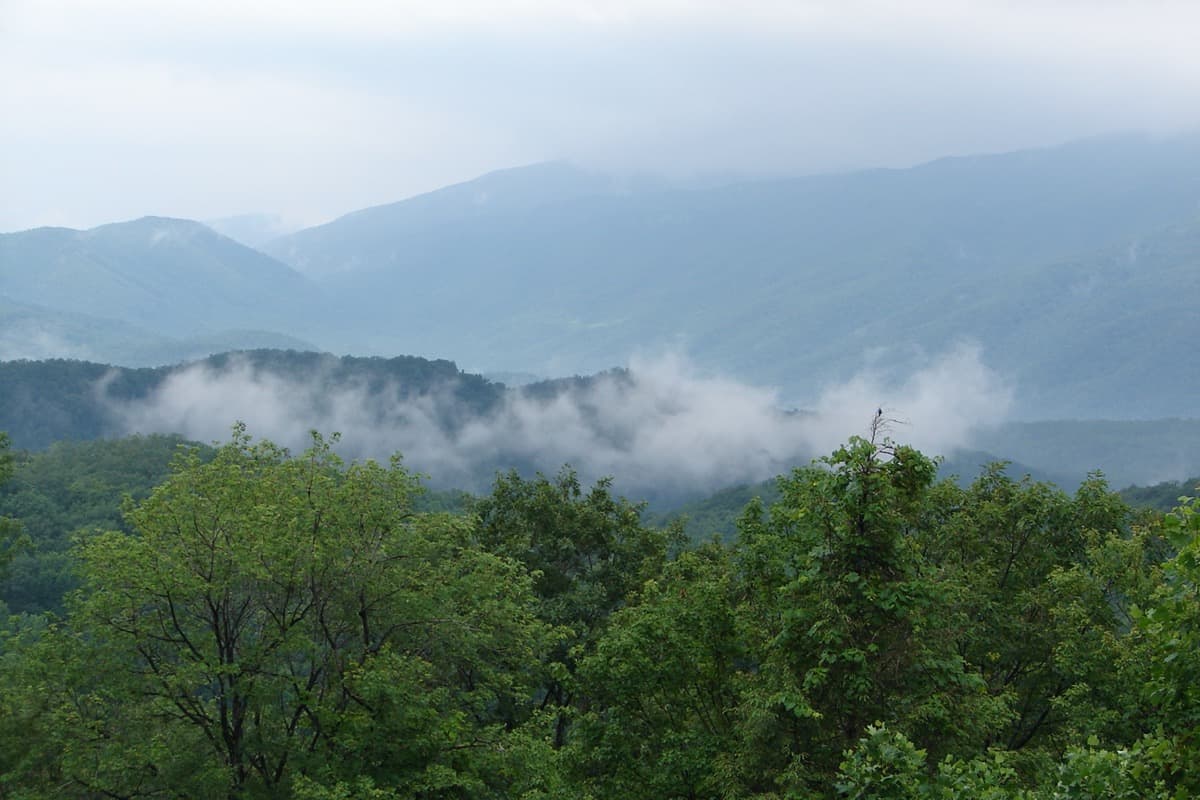
The Great Smoky Mountains are a wonder to behold and the best place to see them is from the air. I recall one cool October Saturday morning when I flew over them, VFR, in my rented Cessna 172, with my noise-canceling headset muffling the engine and wind noises. I remember smiling to myself at the peaceful, slightly foggy Smokies and thinking how blessed I was to fly there.
I also remembered the few key points my excellent flight instructor had given me about local area procedures, mainly just staying clear of the towered military airfield south of our little airstrip and watching for its traffic.
But he also shared:
- As you turn base for Runway 2, you should be overhead the water tower by the school.
- Watch for medical helicopters taking off from the hospital. They take off in all directions and sometimes forget to transmit positions and headings after takeoff.
- Be careful when flying within five miles of that private airstrip. They fly gliders on the weekend and you will see parachutists occasionally, once a month or so, usually on Saturdays. And that activity is not always specifically NOTAM’d.
- Etcetera.
It is the “etcetera” that almost killed me.
Nobody told me about a significant, hidden threat lurking in those mountains.
First, what the problem was not:
- It was not mountain winds: I was warned about the mountain waves that can occur downwind of mountains, with strong downdrafts and unpredictable turbulence.
- It was not flying into IMC conditions: I knew that adiabatic cooling can be dangerous for unwary VFR pilots. When the wind moves against mountain ranges, the mountains “herd” the wind up their windward slopes and pilots are trained to be wary of both the updrafts and the downdrafts. And those same winds can rapidly form clouds.
- It was not rapid formation of fog in valleys. Pilots learn how to avoid fog, caused when the air carries significant moisture and the air temperature drops to within a few degrees of the dewpoint. The moisture can become visible as fog or clouds. The Smoky Mountains got their name from the fog that forms in the valleys and sometimes gets lofted up into smoke-like wisps.
So, what the heck WAS the problem? What almost brought me and the C-172 down that day?
It goes back to those wisps of fog over the Smoky Mountains that day: They were not fog.
I learned that after landing back at the airfield. As I was shutting down the engine, the pilot scheduled to fly the C-172 after me walked up to my window. After some small talk he asked “Was this here before you took off?”
It took a full five seconds for me to realize what he was showing me — his pinky finger had disappeared into the lower skin of the aircraft’s wing! He was showing me a hole remarkably close to my left wing’s internal fuel tank.
Not sure what we were looking at, we walked into the little “Flight Ops” trailer and asked the three old-timers there what that hole could be.
One grizzled guy tilted his head and a wry smile crept across his face as he said, “Let me guess. You were flying below 5,000 AGL and above 3,000 AGL. And you were over the foothills of the Smokies. And in that white Skyhawk out there.”
“Did you see those white wisps spiraling up from the valleys and mountains?” he continued. “That was smoke, not fog. Those are moonshine stills and those boys thought you were a fed (US federal agent of the Bureau of Alcohol, Tobacco and Firearms), looking to locate moonshiners so ground crews could shut ‘em down.”
Another pilot standing with us at the airplane looked at the top of the wing and sagely explained like Sherlock Holmes or Detective Olivia Benson from Law and Order: “From the looks of that hole, you were shot with a handgun, probably .45 caliber. Any lower than about 3,000 feet and the bullet would have clipped through the top skin too. And any higher than 5,000 feet and they wouldn’t have tried to shoot you with a pistol. The bullet was tumbling when it hit you because the hole isn’t round and it didn’t have enough oomph to also go through that wing’s upper skin.”
“If the old boy had used a rifle, the round would have popped through the upper wing surface too, instead of just causing that up there,” he added as he pointed to a bump in the upper surface above the hole.
We looked for the bullet but it had rolled out, probably through the flap opening.
So while I was practicing turns around a point, someone on the ground was practicing marksmanship on an 80 mph target.
Three things caused this dangerous situation:
- I knew too much and got complacent: I knew about fog in the Smokies and that led me to conclude that every mountain wisp was fog. The idea of smoke wisps, not fog, scattered in that heavy forest, never occurred to me.
- I didn’t know enough: I lacked local knowledge about flying over those foothills and the moonshiner danger associated with such flying. Better local area training would have warned me to do those flight maneuvers someplace else.
- My noise-canceling headset worked too well. It canceled too much sound. I never heard the thwack of the bullet hitting my wing a few feet from my left ear. But maybe it wasn’t audible anyway.
A bullet in a wing tank might not have caused a fire or explosion. But it would have emptied that fuel tank quickly and, had I missed that situation, I would have had only half the fuel I thought I had.
And even if the fuel tank had not been penetrated, an aileron cable or flap actuation control rod, motor, or cable could have been rendered inoperable. The former could have made the aircraft uncontrollable and the latter, at the very least, would have made for an exciting full-flap approach back at the home ‘drome.
This is when the old test pilot adage comes into play “if doing something causes the airplane to misbehave, undo whatever you just did.”
Asymmetric (one side only) flap extensions have killed people when they happened too near the ground for the pilot to regain control.

You may have already thought of another possible damage scenario: The obvious damage that could have been done not to the airplane but to me!
A rifle round slamming into my human bottom could have ruined my day. And even a slower .45 or .357 caliber round that punches through one layer of aluminum and still has enough momentum to deeply dent another layer, could have rearranged key parts of my anatomy. That could have given a whole new meaning to “flying by seat of your pants.”
The incident taught me some invaluable lessons I remember to this day:
- Some things cannot be learned from flight manuals.
- Have a questioning mind: I had seen those smoke trails before and wondered what they were.
- Tell the old-timers at the airport where you plan to fly. Local knowledge is priceless to flying safely, no matter where you are.
When I told the story that evening, my wife Cindy said I should use black tape to put foot-wide letters on the aircraft’s belly saying “NOT A FED.”
Fly safely out there, people.
Mack McKinney is a USAF veteran, pilot, and author of books and aviation safety articles. As a business development expert and motivational speaker, he shares success stories and resilience strategies. He can be reached at [email protected] and MackMcKinney.com.
So I guess the rule of “ don’t circle stills and drug operations “ applies here?
A c-150 came back to our airport in Indiana several years ago with a bullet hole through the elevator.
NO idea what prompted that.
i was transferred to a new location which meant a new airport as my home base. After settling in to the new hanger and a few Saturday morning flights, the local pilots warned me about flying low and around Island “xx” on the Mississippi River. It seemed to be common knowledge that “crops” were grown on that island.
we were flying a Decathlon over a national park of sand dunes/dried vegetation and green clusters of green. I was looking for a hard packed sand runway . A number of sharp turns were done and then the left wing shuddered and holes appeared on the undersurface ..
It was a return back to the home airport . It was very obvious what caused the damage .The owner of the aircraft was very upset . I then left for work else where. The owner then returned to the scene with plastic drink bottles filled with AVGAS and a wick. It appears we had been circling over a hidden marijuana crop. The news that night. told a story of a massive fire in the national park burning hundreds of acres.
A bullet in one tank in a 172 or 152 wouldn’t result in losing 1/2 your fuel, you would lose it all through the fuel valve.
only if you don’t switch to the tank with no hole in it.!!
Losing fuel due to a hole in a tank in a C172/152 would be easily seen.
A small caliber round would make a small hole, so the loss may be less than 1 gal in 5-10 minutes.[ or 6-12 gph..]
But, some fuel may drain into the wing, and who know where it will go then ?
Jim H
C152 fuel is either on or off, so a hole in one tank results in eventual loss of all fuel. C172 normally is selected to BOTH so you can switch to one tank to stop loss of one tank fuel, or switch to the leaking tank first to use the fuel before it leaks out, then switch to te remaining tank.
Thanks. I haven’t flown a C152 in 30 years….so I forgot to remember.!!
My first reaction would have been to get some Molotov cocktails or bricks and attack! Maybe with a flight of four to overwhelm their their defenses!😱😎 I doubt hand grenades are really available🙃
But on second thought, that’s probably not a good idea!😁
Check 6
18 U.S. Code §32 – Destruction of aircraft or aircraft facilities
(a) Whoever willfully—
(1) sets fire to, damages, destroys, disables, or wrecks any aircraft in the special aircraft jurisdiction of the United States or any civil aircraft used, operated, or employed in interstate, overseas, or foreign air commerce;
. . . .
(8) attempts or conspires to do anything prohibited under paragraphs (1) through (7) of this subsection;
shall be fined under this title or imprisoned not more than twenty years or both.
There are likely state laws which would apply.
Years ago, I was with the now former Allegheny County Department of Aviation (Pittsburgh International). A regular noise complainer threatened to shoot down a commercial jet. Clearly a violation. However, for “community relations,” he was not prosecuted. Rather, a special phone number was set up just for him to call to complain about aircraft noise.
Detective Olivia Benson? Seriously? She is never that calm and logical. And she would never waste her time on a case where a grown man – empasize man – was targeted and could have been shot down. Her shtick is alleged sex offenses, on the time-honored legal principle of guilty until proven innocent beyond all doubt.
The lesson is “Watch out for people doing illegal activities?” I think the lesson would be go back with the cops and find out who shot at you.
Agreed! Shooting at his plane certainly did not sound “wonderful” and “super friendly.”
I had survived my year in Nam as a Dustoff pilot. I had lots of experience with bullet holes in various HUEYs but with no vital damage to me or any of my crew. It was probably late Oct or early November. I was enjoying being a HUEY instructor flying out of “Mother Rucker” in lovely mid Alabama. It was an early morning hop with two good students but the sound of that pissed hunters round coming up through the front battery compartment was a lesson I hadn’t planned on teaching…. Perhaps we had spooked his trophy buck or maybe he just hadn’t seen anything to shoot at after a long cold vigil. After all, it was huntin’ season.
Hi Mack! Being a part of the Knoxville flying scene for over 50 years, I’ve heard this folk tale often. Great to hear is from the source. Glad you didn’t get shot down!