

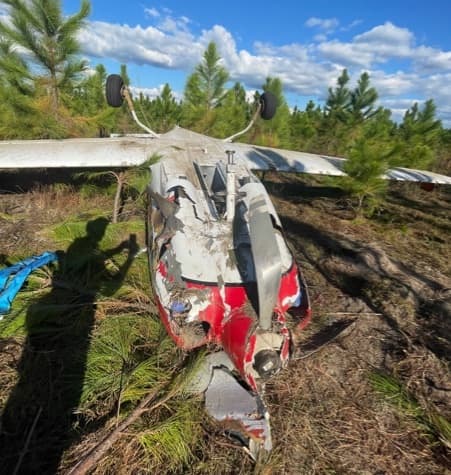
The pilot was ferrying himself and his Lancair IV-P from his vacation home in New Mexico to his home base near Tampa, Florida.
After stopping at Coulter Field Airport (KCFD) in Bryan, Texas, for fuel, he was now near Perry, Florida — about midway between Tallahassee and Gainesville — at 11,500 feet MSL. It was late in the afternoon in mid-November 2023, about half an hour before sunset.
The trip had been largely uneventful except for a glitch in the airplane’s pressurization system. The pilot had been hearing a funny noise in the vicinity of the pressure control unit and he cycled the pressurization system to attempt to resolve it.
The noise did go away but so, too, did the cabin pressurization — not a huge deal at the altitude he was at, but certainly a distraction.
The Accident
About 40 minutes short of his destination, a solid ceiling formed beneath him, so he started scouting for a hole to get down through. He deviated from his course and initiated a descent.
Finally, he spied an opening. But it was small and fast-approaching.
He shut off his autopilot, throttled waaaaay back — nearly to idle — and dove through at a steep angle. He popped out the bottom, leveled off at 2,000 MSL, and throttled up again. But the engine remained at low RPM. He worked the throttle back and forth, but still the RPM stayed the same.
Realizing that he lost power, he switched the fuel tanks. No dice. He enriched the mixture. Still no joy. He was decelerating rapidly and there wasn’t a whole lot of sky left, so he abandoned the troubleshooting and focused on choosing a place for an emergency landing.
Initially, he lined up on a narrow dirt road. He got the gear down, but he was moving too fast to make the road. There was a small grove of sapling pine trees below. He dumped full flaps, pulled the mixture out, feathered the prop, slowed, and put it down in the trees.
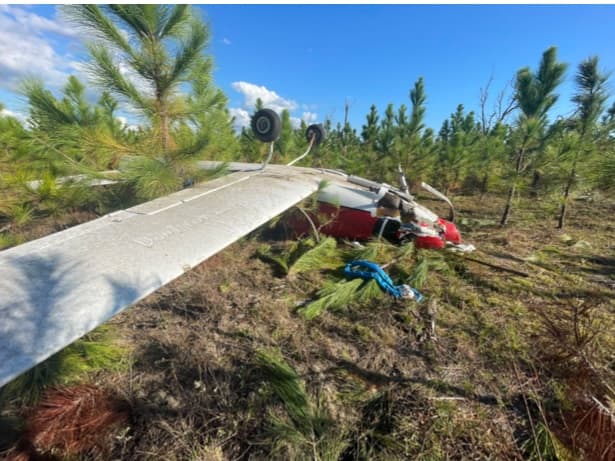
His next memory is sitting right-side-up on the ceiling above the passenger seat, even though he’d been belted in at the pilot’s station. The airplane was inverted and — in the lingo of the NTSB — substantially damaged.
He could smell fuel, so he kicked out the broken passenger window and wriggled out of the wreck. Fortunately, he sustained only minor injuries. He walked to the dirt road he first shot for and flagged down a passing truck.
The Pilot
The pilot held a private certificate with a third class medical. He was either 35 years old or 45 years old at the time of the accident, with both ages showing up on different documents in the investigative docket.
Either way, he was a pilot who clearly loved flying machines. While his hours aren’t huge, they are widely diversified. He had a total time of 311 hours, with nearly half in helicopters. He had also logged 17 hours of twin time and had an endorsement for sport pilot privileges in weight-shift-control land. His ratio of dual to PIC indicates that he was a quick study.
That said, he wasn’t cocky about it, as some pilots with that logbook and range of experience might be. In a conversation with an NTSB Air Safety Investigator, the pilot identified himself as “a fairly low-time pilot.”
He had 64 hours in make and model, and had clocked up 25 hours in the last quarter, with 16 of those hours in the most recent month. All of his recent time was in the Lancair.
He also had a very small amount of simulated instrument time, suggesting he might have been starting out on his instrument rating.
The NTSB
The pilot told the NTSB that he’d “never experienced” a windmilling propeller so, at first, he didn’t even realize that his engine had stopped.
That engine on the snout of his Lancair was a Continental TSIO-550, a dual turbo, 9-liter 6-cylinder, fuel-injected beast that generated 350 horsepower. It had about 1,000 hours on the clock.
With the TBO on this engine family between 1,800 hours and 2,200 hours, according to a Continental Aerospace spec sheet, this one was comfortably middle-aged, probably the most reliable portion of a well-cared-for engine’s life.
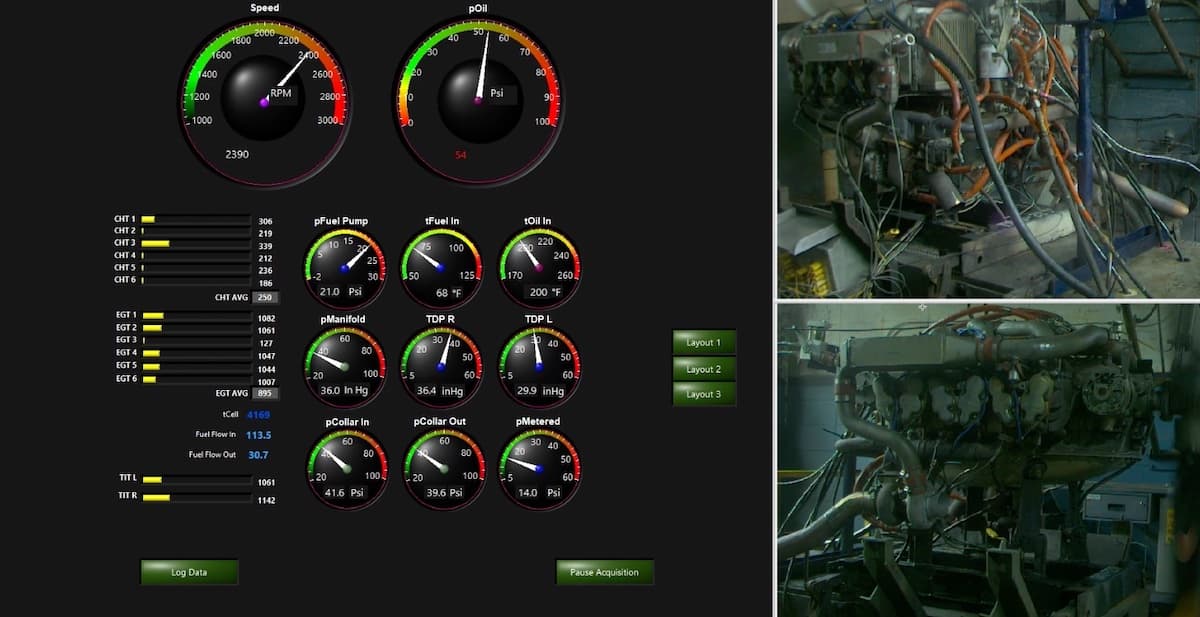
The engine was retrieved from the crash site and shipped to Continental in Mobile, Alabama, for an inspection. On the test stand, the engine “started without hesitation.” It purred like a kitten at low RPM and roared like a lion at high RPM. The only thing out of whack was that the fuel system was set too lean.
Next, the team at Continental ran a series of tests where the throttle was brought to idle and then “rapidly advanced.” This resulted in the engine “faltering” from running too rich. It belched black exhaust smoke, and if left balls-to-the-wall, lost power completely. If the throttle was quickly retarded and held at idle, however, the engine recovered.
The results of these tests led the NTSB to conclude that the cause of the engine stoppage was the pilot advancing the throttle too rapidly after his glide, which flooded the engine, stalling it.
Analysis & Discussion
One thing that isn’t clear in the reports is whether the pilot attempted a restart of the engine, although a conventional restart would have been unlikely to succeed in this case. After all, his mags were already on and the prop was spinning. If the engine had un-flooded itself enough to be inclined to start, I imagine it would have restarted on its own.
Now, I can’t speak for this engine specifically, but generally, the un-flooding procedure for a fuel-injected engine is mixture full idle, throttle to the firewall, and spin the prop. This starves the cylinders of fuel while pumping more air through them to dry them out. Of course, this is generally done on the ground during startup, as that’s where most flooded engines happen, but it can work in flight too.
That said, I’m not sure how fair it is to expect someone to put two and two together and attempt this procedure at less than 2,000 AGL with the altimeter unwinding.
And, in fact, the pilot ironically made the situation worse by enriching the mixture — a perfectly reasonable thing to attempt when troubleshooting an engine failure in flight — but exactly the opposite of what this engine needed at the time.
But kudos to the pilot for switching tanks. A surprising number of pilots don’t have the presence of mind to do this, and while it didn’t make a difference in this particular case, there are many accidents that this simple procedure could have prevented.
The Takeaway
To be honest, before reading this accident report, I didn’t realize that you could stall a fuel-injected engine by being aggressive with the throttle, although I certainly knew that you can do so with a carbureted engine.
In fact, the hair on the back of my neck still stands up every time I overhear a CFI teaching go-arounds with “Cram, Climb, Clean, Call” as I worry that one of those poor little eaglets getting flight training will cram a carbureted airplane on a go-around someday and end up with a forced landing on their hands.
But now it appears that in the wrong circumstances a fuel-injected engine can act much the same.
So one takeaway from this accident is to concentrate on deliberate, smooth application of throttle — of any lever, dial, or knob on the flight deck, for that matter. We really don’t have anything in our play book that needs to be done at the speed of light and the strength of Superman.
Why are many pilots ham-fisted on the throttle? I’m not sure, but I have been guilty of that in the past myself.
I can still recall my multiengine instructor — decades ago — berating me for being too aggressive on the throttles. I think that I just liked the feel of all that power (compared to my rubberband-powered single engine trainers) kicking in quickly. That berating, followed by many years of ultimately flying behind a Stromberg carb — a particularly acceleration-sensitive device — has taught me a degree of finesse in throttle application.
Still, a reminder of the importance of flying gently is one takeaway from this accident.
And I think that there are two more.
One is power awareness. Unless something really catastrophic has happened inside the engine, the prop will still spin — with or without the powerplant operating.
And with today’s ANR headsets, the audio clue of an engine taking a break is harder to detect than it was in the old days, when things getting quiet always spelled trouble.
So all of that being said, in today’s world, the EGT gauge, or gauges, should be a routine part of your scan as they are basically combustion meters.
And the last takeaway is that if you have a power problem following the application of throttle, a flooded engine needs to be considered, should be part of your decision tree, and integrated into your restart attempt flow.
Again, that’s not to be taken as a critique of this pilot. Prior to reading this report I don’t know if facing a power loss in flight in a fuel-injected airplane, it would have occurred to me that the engine might be flooded. In fact, the resiliency of the design to rough throttle inputs is why many flight schools use fuel-injected aircraft in the first place. But now, we all have another arrow in our engine emergency procedures quiver.
And that’s why we talk about other pilot’s bad days: To find ways to prevent history repeating itself with a new cast of characters.
The Numbers
Want to read more? Download the NTSB’s final report here or view the items on docket here.

Older Continental C85 engines stumble nearly every time, but that has built up my hearing skills as far as correct interpretation of the engine’s actual needs. Nothing is instantaneous, even with all sorts of new technology apparently.
When I learned to fly in the 50’s my instructor told me to baby the engine, it’s your best friend in the air. Throttle movements were always nice and smooth. Saw a demonstration of a throttle slam when a Howard checkout turned into disaster. The Howard hop (bouncing down the rwy) was in progress when the throttle was firewalled, at about 300’ the master rod let go and the pilot flying attempted a return to the airport which resulted in a stall/spin and death of both pilots, also destroying a beautiful airplane.
The moral of that story is nice, easy, smooth throttle movements every time!
Great article. We all learned a lot today. Never knew that…. i always try to be smooth on all controls.
Just thank God he’s still around to talk about it!
Great article. I learn something new, or I’m reminded of something important, every time I read this author’s articles (thank you for that.)
Yes, absolutely agree Mr. Dortch no matter make or model.
In this case, the engine driven fuel pump is scheduling fuel based on RPM and turbocharger deck pressures, among other things. Both of these rise rapidly with a rapid increase in throttle. If the turbocharger and fuel injection systems are properly adjusted, rapid throttle increase should not provide and overly lean or overly rich condition, at least not enough to cause the engine to stumble or quit. But normal wear and tear can cause these adjustments to drift and the balance between system influences can stray outside published specs.
Normally aspirated engines can get away with some adjustment float, but high performance, boosted engines, demand a routine shop check of all critical pressures and settings to ensure proper operation throughout the envelope, including rapid throttle movement.
Yikes! I have the same aircraft, same engine.
Find the error here: “Now, I can’t speak for this engine specifically, but generally, the un-flooding procedure for a fuel-injected engine is mixture full idle, throttle to the firewall, and spin the prop.”
Hint: You can pull a throttle to full idle.
Double hint: full lean
Fully agree about CFIs teaching the cram method rather than controlled responces.
But 60+ years of professional carburetor and fuel injection systems service says if “cramming” the throttle causes a hesitation, much less a flooded condition, you have equipment misapplication issues…whether by design or not.
Excellent article.
I would like to add one suggestion.
I have several thousand hours behind the Continental 520; both normally aspirated and turbo-charged. I have a nominal amount of time with the 550. I have flown, and taught, these engines for almost 40 years. One thing I teach my pilots is, “Listen to your airplane, it talks to you.” Even with ANR headsets, you need to, and can, listen to your airplane.
Thank you for listening.