

The Aircraft Owners and Pilots Association Air Safety Institute (ASI) has released the 35th Richard G. McSpadden Report — formerly the Joseph T. Nall Report — which analyzes general aviation accidents in 2023, the most recent year for which full data is available.
The report provides the most comprehensive review of general aviation safety, with accident data updated on a rolling 30-day cycle allowing for the most current snapshot of safety trends, according to ASI officials.
“Overall, the news from this year’s report is positive: We observed declining general aviation accident rates with few exceptions, amid a strong increase in flight hours,” officials noted.
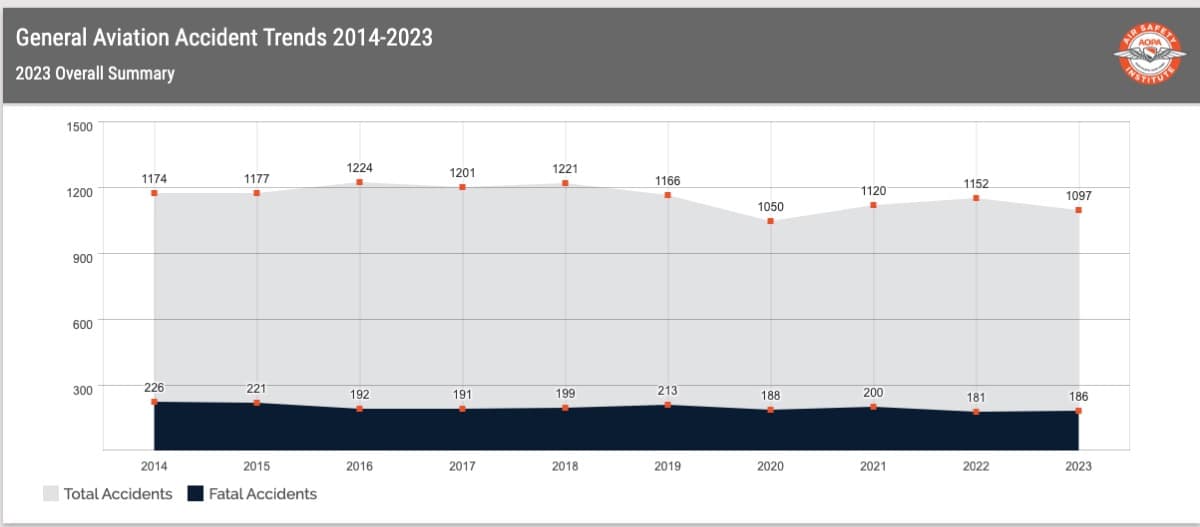
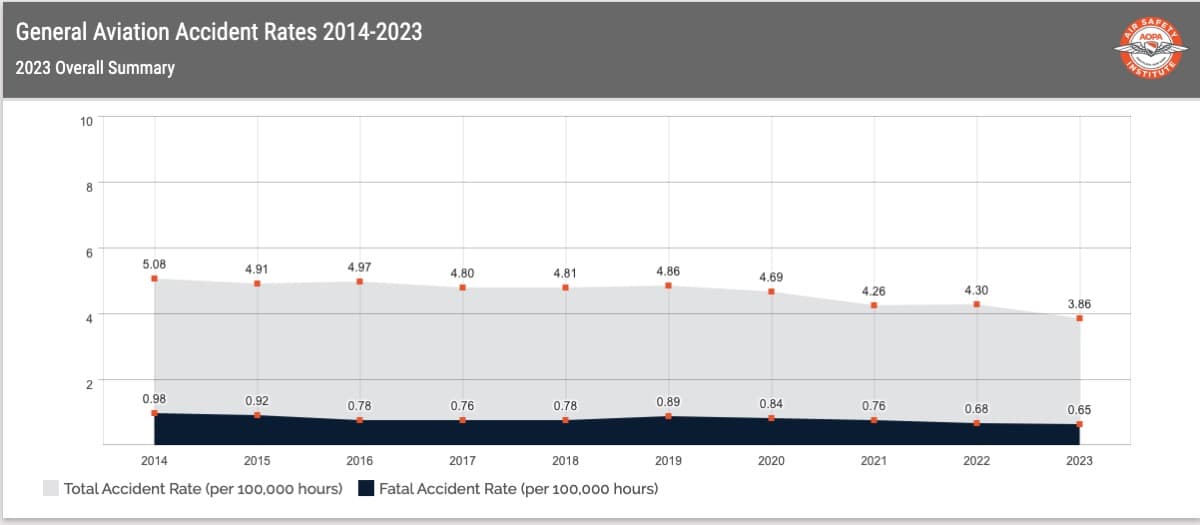
Key takeaways include that in 2023, there were 1,097 general aviation accidents in the United States, including 186 that were fatal. The overall accident rate fell to 3.86 per 100,000 flight hours, down from 4.3 in 2022, and the fatal accident rate declined to 0.65 from 0.68 the year before.
“A significant increase in flight activity helped drive these rates lower,” said Robert Geske, AOPA Air Safety Institute senior manager of aviation safety analysis.
Overall, flight activity increased by more than 1.6 million hours — about 6% — in 2023 to 28.4 million hours, from 26.8 million hours in 2022.
Non-commercial fixed-wing aircraft accounted for 929 accidents, about 70% of which were pilot-related. Of those, 156 were fatal.
“Loss of control on the ground and inflight are still the leading categories of both fatal and non-fatal aviation accidents,” Geske said. “We saw an uptick in the number of accidents due to fuel management issues while descent and approach accidents declined sharply. Accidents due to weather, as well as during preflight and taxi phases, trended downward as well.”
Landing accidents continue to account for the largest number, with 329 but thankfully suffered few fatal accidents. Loss of control on the ground (LOC-G) continued to dominate as the leading cause of landing accidents. The number of accidents during the takeoff and climb phase of flight rose to 223 from the previous year.
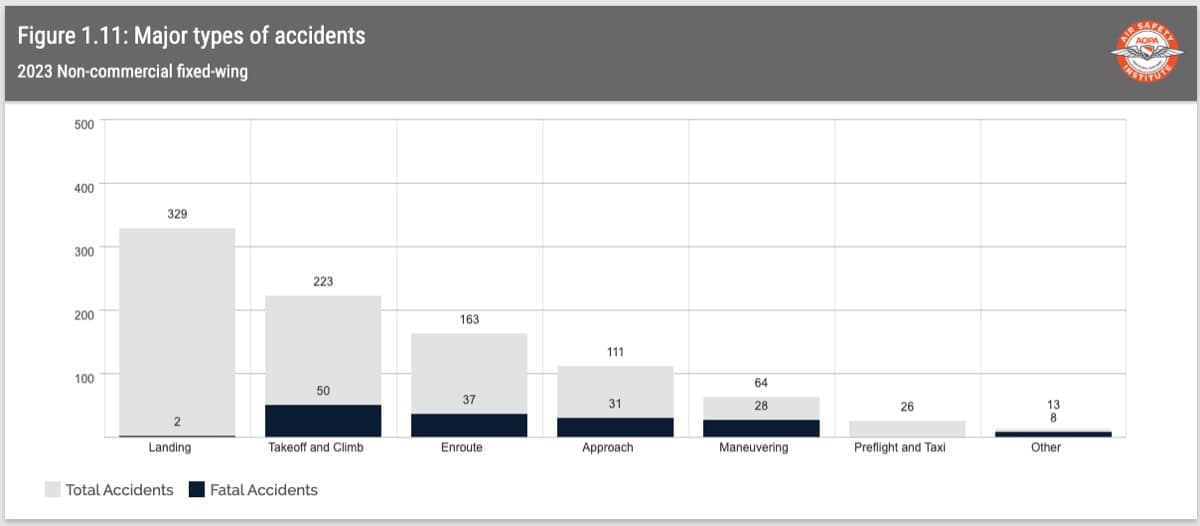
The leading causes were loss of control in flight (LOC-I), followed by engine powerplant failure. Fuel management mishaps rose slightly to 108 from the previous year with 43 starvation causes slightly ahead of the 41 exhaustion accidents. There were 64 maneuvering accidents of which 28 were fatal.
LOC-I made up the majority of the maneuvering phase with 16 accidents of which 10 were fatal.
Descent and approach accidents fell sharply to 111, with LOC-I and other as the largest causes.
Weather accidents decreased to 15 in total with 11 fatal. VFR into IMC led the cause category with 10 accidents of which all were fatal. En route accidents increased to 163, with engine powerplant failure as the leading cause.
Preflight and taxi accident figures trended downward with no fatal accidents.
The number of mechanical-related accidents rose slightly to 187, with fatal accidents spiking to 33 from 21 the year before.
Loss of engine power continued to lead as the cause, followed by partial power loss and system component failure non-powerplant, which accounted for the majority of mechanical accidents.
“Interestingly, partial engine power loss saw a higher lethality compared to total engine failure, suggesting that pilots struggle to properly address and adapt to a partial power failure,” Geske said.
Non-commercial fixed wing accidents that could not be attributed to any specific cause and were categorized as “other and unknown” rose to 91.
In 2023, there were a total of 59 commercial fixed-wing accidents, 12 of which were fatal.
Non-commercial helicopter operations experienced 70 accidents, 10 of them fatal, while commercial helicopter operations suffered 39 accidents, including eight that were fatal.
The McSpadden Report provides detailed analysis and year-over-year comparisons across non-commercial and commercial fixed-wing operations, non-commercial and commercial helicopter operations, and sport/experimental operations.
You can see the full report at AOPA.org
Leave a Reply