

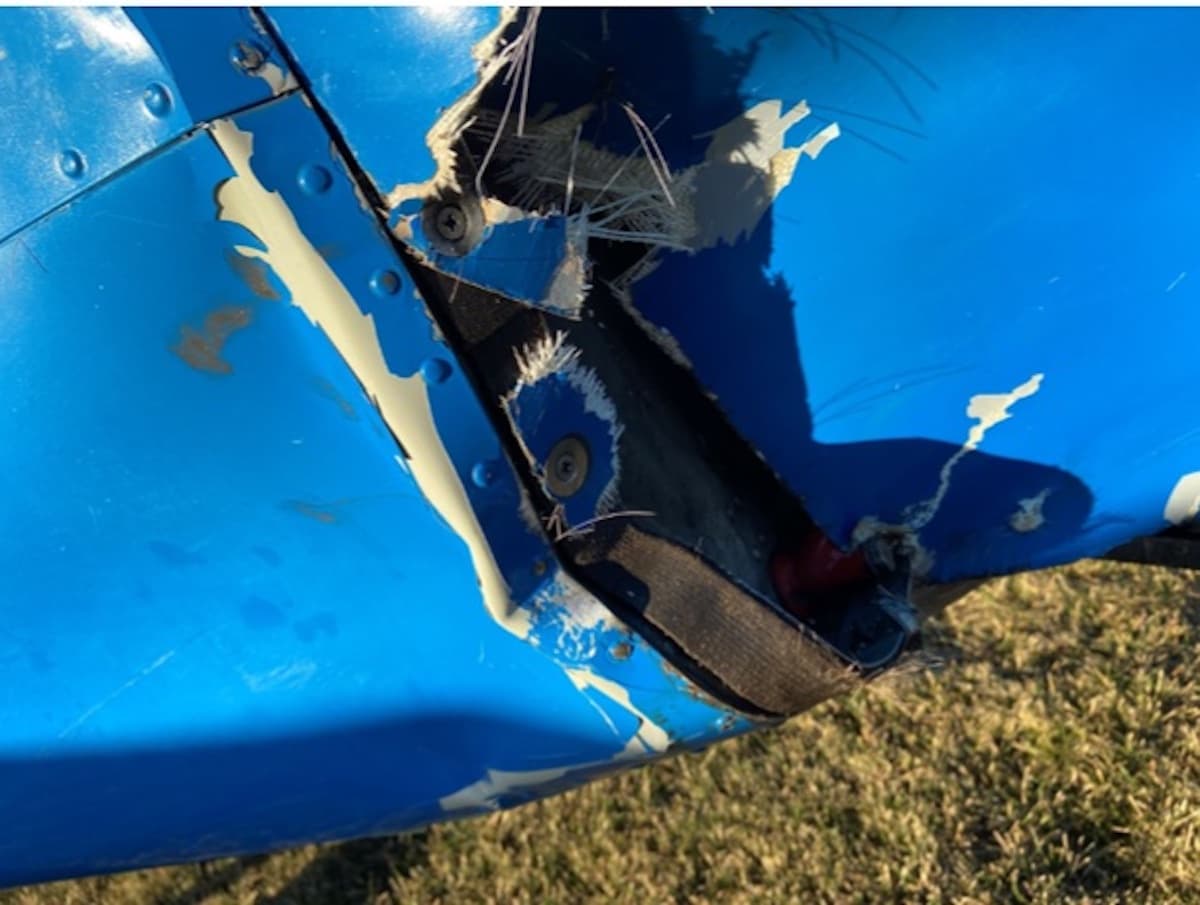
During the landing roll on an airport in Glencoe, Minnesota, at dusk, three or four deer ran out across the runway traveling right to left.
The Piper PA-28 collided with two of the deer and the engine lost power as one of the propellers struck a deer.
Substantial damage was sustained to the engine mount, firewall, and right forward fuselage.
The flight instructor reported there were no pre-impact mechanical malfunctions or failures with the airframe or the engine that would have precluded normal operation.
The FAA Airport Directory information for the airport listed a warning for deer on and in the vicinity of the airport.
A review of the NTSB accident database and FAA wildlife strike database did not locate other incidents of wildlife strikes at this airport.
The flight instructor further reported that the accident could have been prevented if deer fencing was installed at the airport.
Probable Cause: The collision with deer during the landing rollout.
To download the final report. Click here. This will trigger a PDF download to your device.
This November 2023 accident report is provided by the National Transportation Safety Board. Published as an educational tool, it is intended to help pilots learn from the misfortunes of others.
I was an Aviation Safety Specialist in the US Navy and I researched deer and fences. In order for a fence to be effective, It would have to be at least 12 feet tall. If the deer do get over the fence they have to have a doorway to get out. When they are inside a fence they walk along the fence and have to have way out. There is a revolving fence door , like a security entrance and exit fence door. These doors have a scoop out from the fence that guide the deer to the door.so that when they hit the door it opens one way, ou. They are an expensive proposition to install. The whistles work to an extent. If a doe is running from a buck during rutting season the whistles don’t stop them. Like driving a car if you see deer wait.
As I was back taxiing to the departure end of the runway at my base airport, I noticed two young bucks standing next to the fence paralleling the runway about 75 feet away. They were about 2000 feet from the departure end of the runway. They were alert and watched me taxi by. I figured they were far enough down the runway that if they did move to the runway, I would have time to abort the takeoff plus they were 75 feet from the runway. I rotated just past their position. After arriving at my destination, I got a call from a pilot who was standing down the runway about 1000 feet. He witnessed my takeoff and wanted to know how much damage I had to the plane from the deer strike. I was dumbfounded! My grandson was in the back seat. When asked, he said the deer did indeed bolted toward the runway and slipped on the asphalt sliding under the tail of the plane. The deer didn’t run till they were out of my peripheral vision. Lesson learned is that deer can cover 75 feet in a blink of the eye.
Pretty cut-and-dried scenario (no offense meant to the deer), and yet, there is still something to pick apart.
In his Narrative History of the Flight, the CFI states a preceding plane performed a touch and go, and then “departed the upwind leg”.
Another CFI spreading incorrect information.
The “upwind leg” is not the same as the “departure leg”: Do some homework & stop the madness!!!
So, there’s that….
Tom – it looks like the upwind leg (the one that parallels the runway) no longer exists. Here’s a recent change to the definition of ‘upwind leg’ – “a. Upwind Leg− A flight path that begins after departure and continues straight ahead along the extended runway centerline. Upwind leg is an extension of departure and is used when issuing control instructions for separation, spacing or sequencing.” Old definition – “a. Upwind Leg− A flight path parallel to the landing runway in the direction of landing.”
Yow…You are right! I forgot the brand-new change in the AIM. I was still going by 2021’s Airplane Flying Handbook, FAA-H-8083-3С, Chapter 8 Airport Traffic Patterns, Page 8-4. Disregard my rant…
Thanks Warren!
Deer Alerts or Deer Whistles – I’m convinced they work! Simple little plastic whistles that you can mount anywhere, as long as there’s airflow. 30 mph is all it takes, the animals hear a high pitched sound they don’t recognize and stand still. We lived in the mountains in CO and I drove a lot at night so I had some driving lights hooked up with the hi beams. There were areas where you could see the deer and elk moving about. After I put the deer alerts on, I then noticed they were standing still and looking where I’d just come from. Now that we fly to a lot of small airstrips in the Northwest, I’ve put them on the plane. Less than $10 for a pair, they work together, high and low pitch that you can’t hear. They mount with a stick on shoe. I replace a fairing screw with a counter sunk screw that worked in the shoe. One on each wing tip.
I love it when the official Probable Cause states the obvious.
Regards/J
At least they didn’t try to blame the pilot … this time!