

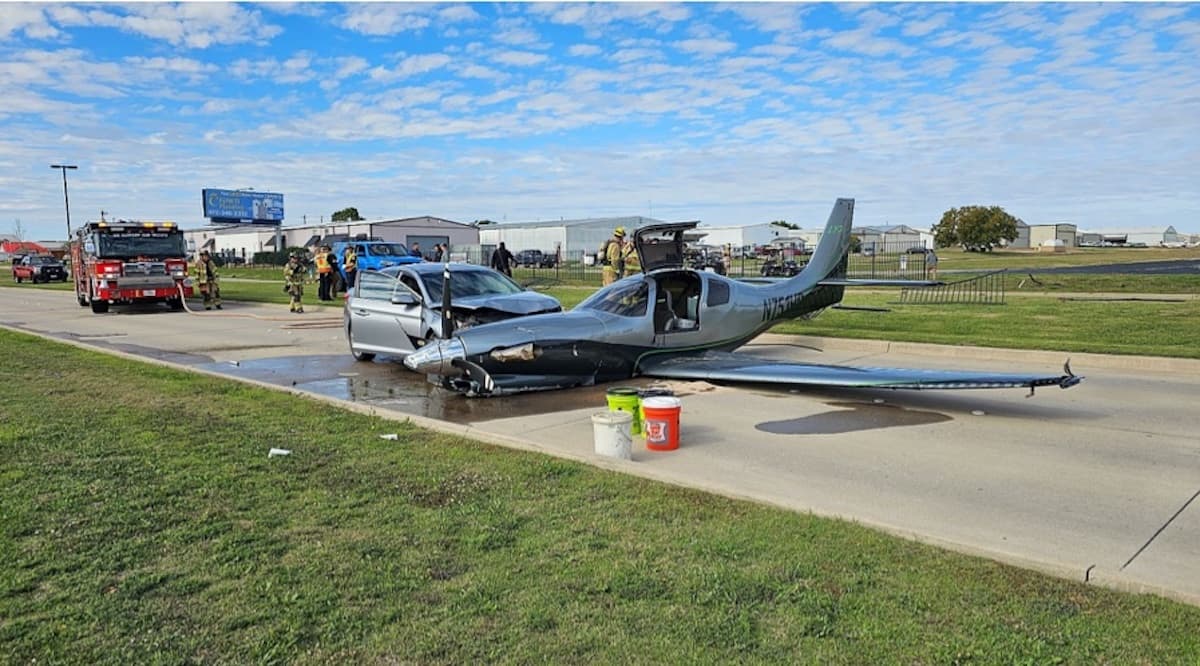
According to the pilot, while at FL 250 west of Abilene, Texas, the cockpit door seal failed, and the Lancair IVP sustained a sudden loss of pressurization.
The pilot contacted air traffic control for an immediate descent.
He descended to 10,000 feet MSL and continued the flight to Aero Country Airport (T31) in McKinney, Texas.
Following the emergency descent, he noted no aircraft systems anomalies.
About five minutes after establishing cruise flight at 10,000 feet to T31, he noted an amber caution light for the propeller rpm which was indicating 1,920 rpm. The pilot reduced the propeller rpm to 1,800 and the caution light turned off. The pilot continued the flight to T31.
He told investigators that he had not previously landed at T31 and performed a touch and go landing on Runway 17 “to see the field.”
He climbed to traffic pattern altitude and flew a normal traffic pattern to land on Runway 17.
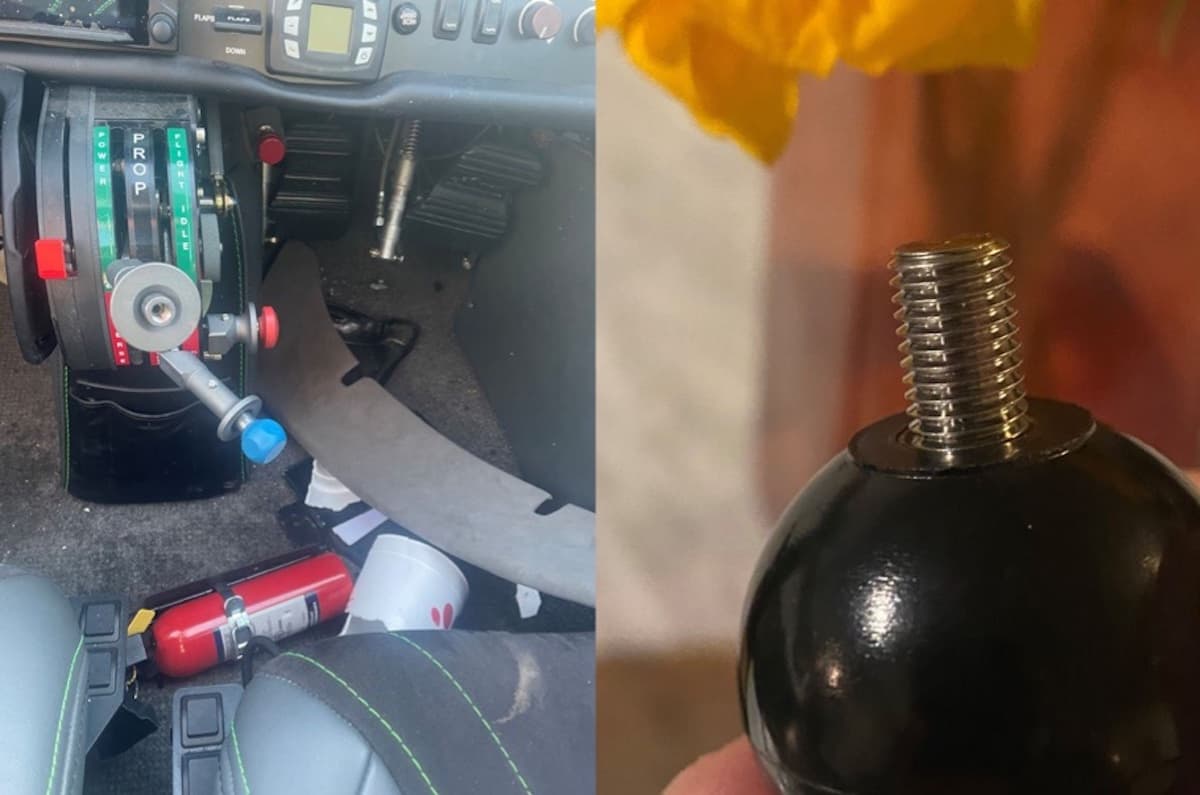
During the downwind leg, he pulled back the power lever and the ball on top of the lever came off in his hand. The pilot handed the ball to the passenger and continued the landing at the flight idle power position.
The pilot told investigators the airplane touched down in the first 500 feet of the runway without a float or a bounce in ground effect. He told them he immediately “hit the brakes gently” and maintained the runway centerline.
For about five to 10 seconds, he unsuccessfully attempted to move the power lever into beta-reverse.
He applied maximum braking, however the brakes faded, and the stopping power decreased.
The airplane exited the end of the runway, went through an airport perimeter fence, and hit a moving vehicle on a road.
The airplane sustained substantial damage to the fuselage and right wing.
While the pilot and passenger were not injured, an occupant in an automobile sustained minor injuries.
ADS-B and avionics data showed the airplane’s groundspeed was between 96 and 99 knots and the flaps were extended to 40° during the final approach.
A witness, located on a general aviation ramp on the east side of T31, video recorded the airplane’s landing on his cell telephone. The video showed the airplane touch down, bounce, and touch down again near the midpoint of the 3,002-foot asphalt runway and evidence of braking action (smoke from main landing gear wheels/tires) occurred about three seconds later. The wheel/tire smoke continued until the airplane exited the runway surface.
According to the T31 airport manager who examined the runway surface after the accident, the first visible tire skid marks were about 200 feet past the midpoint of the runway. The skid marks remained visible for about 1,300 feet until the airplane departed the end of the asphalt surface. The airplane continued 14 feet to the perimeter fence and then traveled 93 feet to the spot where it collided with a moving automobile.
Post-accident examination of the airplane revealed cable continuity from the cockpit power lever to the propeller governor. The cockpit control lever, without the ball top, was actuated between full power and the reverse positions with no anomalies noted. The cockpit door seal was intact, and no damage was noted to the seal adhesive or materials.
A review of the aircraft maintenance records revealed that on March 29, 2022, the original Hayes IVP Turbine experimental airplane was modified with an RDD Enterprises LX7 kit, which included major modifications to the fuselage, wings, empennage, and turbine engine.
After the completion of the modifications, the airplane was placed back into the airplane’s Phase 1 operating limitations flight test program for purposes of testing the LX7 conversion. Per the airplane maintenance records, on Aug. 26, 2022, and 11.3 hours since the completion of the modifications, the airplane completed the Phase 1 flight test hour requirements.
According to RDD Enterprises, the landing roll distance is 800 feet (at maximum landing weight), and the landing distance over a 50 foot obstacle is 1,800 feet.
The pilot also reported that before delivery and after he acquired the airplane, the airplane sustained several discrepancies and issues, including a door seal that failed during pre-delivery flight testing.
Probable Cause: The pilot’s failure to attain the proper touchdown point during landing, which resulted in a runway excursion and collision with terrain and a vehicle.
To download the final report. Click here. This will trigger a PDF download to your device.
This November 2023 accident report is provided by the National Transportation Safety Board. Published as an educational tool, it is intended to help pilots learn from the misfortunes of others.
If a pilot ever asks you to hold a ball…..
With a functioning airplane, add power, climb to a safe altitude and calmly decide on the appropriate action
Loose nut behind the wheel.
What a beautiful airplane! Glad he’s still alive!
Bad decisions and executions galore. No mention of pilot experience either total or in type. But it sounds like a 172 would be a more appropriate choice.
The plane is awesome, unfortunately the pilot is not. Didn’t understand the systems. You need the ball to help bring the power lever into reverse, get over the gate. With system knowledge, the back up is to shut the fuel off with the condition lever. That would have stopped the engine from pulling him down the runway. Another case where the pilot has more money than skill. The LANCAIR’s are awesome planes, but require training and understanding. Will never sell mine for any amount of money!
The pilot’s version and the video evidence are contradictory, and the post accident inspection shows an intact cockpit door seal. What is the pilot playing at with his bogus story?
“Watch me land this hot plane on a short runway.”
The post of the throttle is threaded…. I wonder if screwing it back in occurred to him.
I wonder if a longer runway occurred to him.
I wonder if buying an airplane more in line with his abilities occurred to him.
I wonder….
There is an airport close to T31 (TKI) with a 7,000 ft runway. I don’t understand a pilot making an emergency landing on a relatively short runway.
I like this part: “ During the downwind leg, he pulled back the power lever and the ball on top of the lever came off in his hand. The pilot handed the ball to the passenger and continued the landing at the flight idle power position.”
Not only it was it useless information, but it’s funny. I think all pilots who read this are releved to know that the pilot handed the ball to the passenger.
An article written by committee. Or AI. Or an AI committee.