


Staci, a student pilot in Arizona, asks: Why are airplanes less strong when it comes to negative Gs than positive Gs? Our “normal” trainers are said to be OK to 3.8 positive but only 1.52 negative. Even aerobatic airplanes, while stronger on both sides of the scale, are still weaker in the negative G area. It would seem to me you’d just build an airplane to be the same strength all the way around. I’m hoping you can tell me why there is a difference in strength between positive and negative.
As with all things related to airplanes, it comes down to the need for making compromises in the design process. Anything — engineering-wise or aerodynamically — that you do to an airplane comes at a cost to something else.
If you want an analogy, it’s sort of like buying a house. You look at your income and figure out how much you can afford to pay and that sets the overall budget. But within that budget you have all kinds of options that interrelate to each other, typically in an inverse manner. Want large square footage? You might need to sacrifice location for that. Want luxury finishings? You might have to look at a place with fewer bathrooms. And so forth.
When it comes to building airplanes, it isn’t really so much about the money — they all are 15% more than you can afford — the concept is the same. Strength means structure. Structure means weight. Weight is the enemy when it comes to other various desirable flight characteristics.
So a designer’s “budget” is a complex weight and balance equation that weighs features vs. capabilities (along with complexity of construction and, yeah, actual money to some degree as well).
Now, when it comes to GA airplanes, in simple terms, we basically have three categories: Normal, utility, and acrobatic. Each has sequentially higher G limits. And as you pointed out, the capacity to withstand negative Gs is less than the capability to withstand positive Gs, but as you’ll soon learn, the difference is functionally less than it appears on the surface.
In considering those three categories, the first thing an aircraft design team needs to ask is: What is this airplane going to be used for?
If it is intended for typical GA use, then it makes sense to design for the normal category. The G loads in that category are well above what you’d sustain in any normal GA operation. Making it stronger, just for the sake of strength it arguably doesn’t need, will sacrifice some other desirable feature.
If, on the other hand, you are building an airplane for the World Aerobatic Championships, strength becomes a required feature, and something else will “have to go” to make room for it.
As to how the “normal,” “utility,” and “acro” G-load numbers themselves were selected, I don’t honestly know, but they’ve been with us a very long time. The categories were added to the Civil Air Regulations way back in November 1945.
Let’s look more closely at the beguiling difference between positive and negative Gs, of which I got a rather humorous reminder of just yesterday.
After coming back from my morning workout routine in my Ercoupe, affectionately known as Race 53, I was tidying up the cockpit and making sure I’d shut everything down properly. When I got to the G-meter, I pressed the button to “zero” it, and the hands went to the 1-G mark on the scale. In a momentary lapse of recollection about how the universe works, I pressed the button twice more — trying to zero it — before remembering that, unlike many instruments, a G-meter doesn’t zero to… well, zero… but to 1-G instead. That’s because, sitting on the ramp, just as in straight and level flight, an airplane “pulls” 1-G.
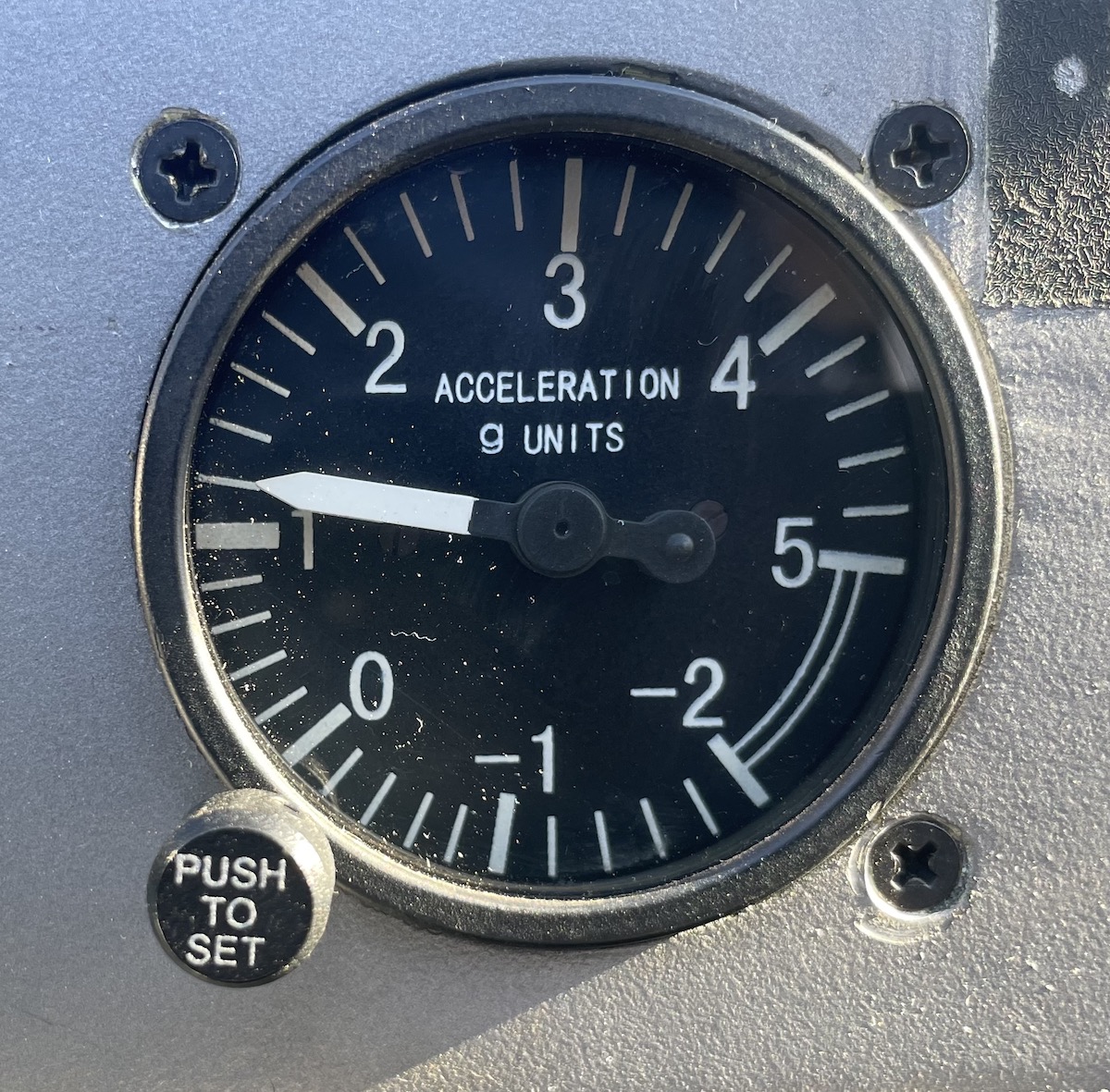
And it’s this fact that makes the difference between positive and negative G-loading less than it appears at first glance.
We are used to zero being the starting point on a number line. That’s what we learned in high school math. Above zero is positive one. Below zero is negative one. That same logic applies to other things in aviation. Airspeed indicators, for instance. Or fuel quantity gauges.
But that isn’t true of G-forces. The baseline isn’t zero. It’s one.
What this means is that the difference between +3.8 and -1.52 is not as great as it first appears, as the middle ground isn’t zero, like we are used to it being in so many other realms. The normal category 3.8 positive G is 2.8Gs above the 1-G baseline. At the same time, the negative 1.52 is 2.52 below that same baseline.
This means that there is really only a 0.28G difference between what a normal category airplane can handle in positive vs. negative forces. So the difference between the two, while real, is not so much as it appears at first glance. The ratio of this difference is pretty much the same going up the scale into the other categories, they are just more globally robust.
But why are airplanes slightly less strong in the negative regime? Because they can be. In normal flight operations, airplanes are rarely in negative territory and that tiny bit of savings in 0.28G leaves the design “budget” with some extra “money” to spend on some other great feature.
Like more square footage, a better location, or an extra bathroom.

Great answer as we often forget just sitting on the ground is 1-G
Thanks
Thank you! I had always wondered that as well, and your explanation makes it clear.
Rusty