

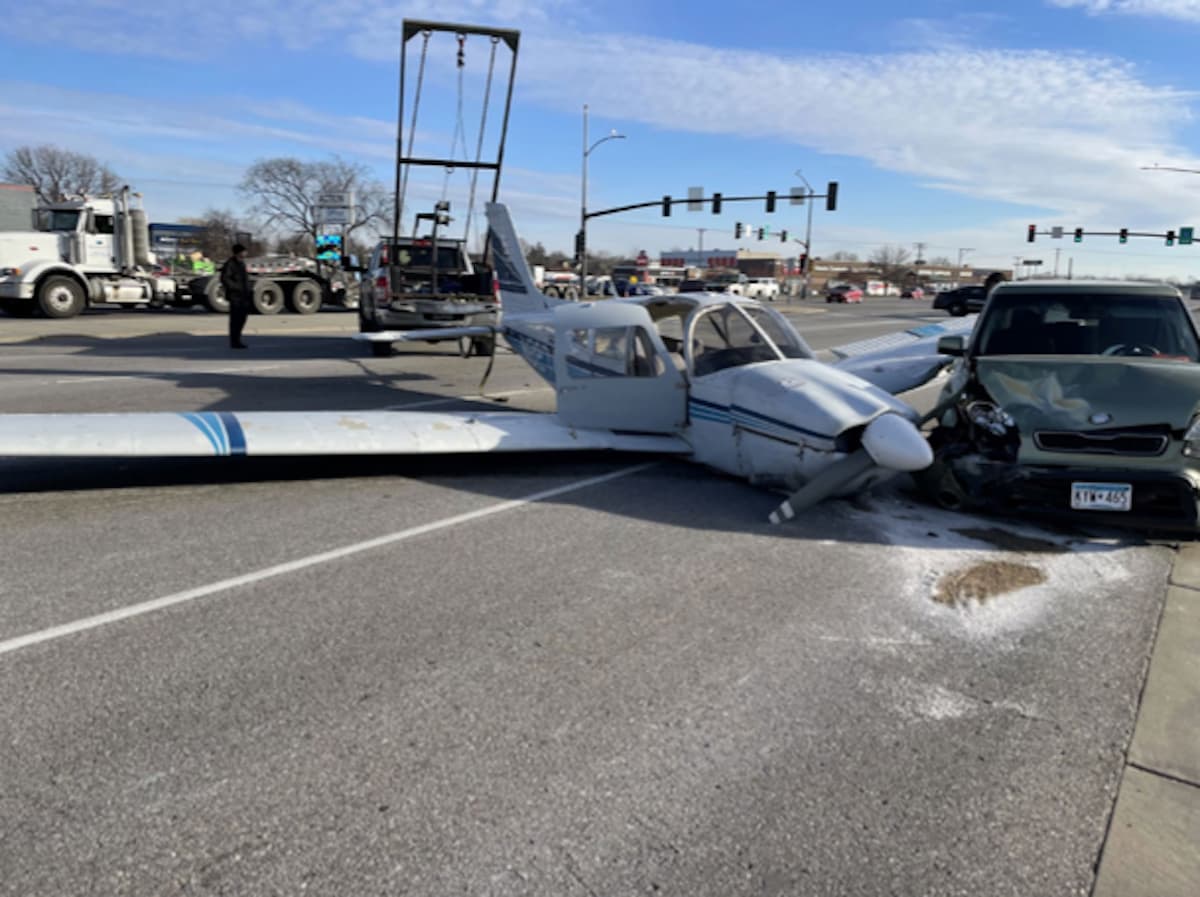
The pilot departed from Crystal Airport (KMIC), near Minneapolis, Minnesota, with full fuel (48 gallons) on board the Piper PA-28-181.
He then flew the airplane to Watertown Regional Airport (KATY), near Watertown, South Dakota, a flight which he said took about two hours due to a headwind encountered along the route. He performed a touch-and-go landing at KATY and then proceeded back toward KMIC, which he said took about one hour and 15 minutes due to a tailwind.
Automatic Dependent Surveillance-Broadcast (ADS-B) data confirmed that the flight lasted three hours and 26 minutes.
According to the pilot, during the flight he switched the selected fuel tank every 30 minutes and noted that the airplane was equipped with a fuel timer to remind him when to switch the fuel tanks.
As he approached KMIC, he contacted the control tower and was given instructions for sequencing to land on Runway 14.
When he turned onto a right base for Runway 14, the engine lost partial power momentarily. He pushed the throttle control forward and the engine power was restored.
He then started the turn to the final approach for Runway 14 and the engine lost all power.
The pilot told investigators that the engine had remained under power for 30 seconds to one minute following the momentary power loss before it lost all power.
The pilot notified the tower controller of his engine issues and began emergency procedures, which included switching fuel tanks, turning the magnetos off and back on, checking that the primer was locked, checking the throttle was full forward and the mixture was rich, turning on the fuel pump, and applying carburetor heat.
These procedures were unsuccessful in restoring engine power and he executed a forced landing to a road.
During the forced landing the airplane struck a powerline and a vehicle, which resulted in substantial damage to the wing and fuselage. The driver of the vehicle received minor injuries, as did the pilot.
Post-accident examination of the airplane shortly after the accident revealed that the left fuel tank was not compromised, but the tank drain was leaking fuel. The left fuel tank did not contain any usable fuel. The leakage rate from the left fuel tank drain was not determined.
Removal of the fuel tank drain revealed that the o-ring seal was deformed and gouged.
The right fuel tank contained an undetermined amount of usable fuel.
Subsequent examination revealed no other anomalies that would have prevented normal engine operation.
When queried after the accident, the pilot reported that the airplane was operating on the right fuel tank when the power losses occurred. He stated that he switched from the right fuel tank to the left fuel tank during the troubleshooting procedures he attempted.
He noted that the engine did not continue windmilling and the propeller stopped.
He added that he attempted to restart the engine by engaging the starter once and the propeller turned but then stopped again. At that point, he focused on the forced landing.
Probable Cause: Loss of engine power due to fuel starvation that was the result of a leaking fuel drain.
To download the final report. Click here. This will trigger a PDF download to your device.
This November 2023 accident report is provided by the National Transportation Safety Board. Published as an educational tool, it is intended to help pilots learn from the misfortunes of others.
Why was the pattern so wide that he couldn’t make the runway when turning final. Keep it tight, practice engine outs from the downwind.
Were the fuel gauges tested post-flight? Did the pilot monitor them during the flight? At lower altitude the first priority is to go straight to the runway or other selected landing area.
If the pilot was switching fuel tanks every 30 minutes (as he stated) then yes, he was most probably also “monitoring” the fuel gauges.