

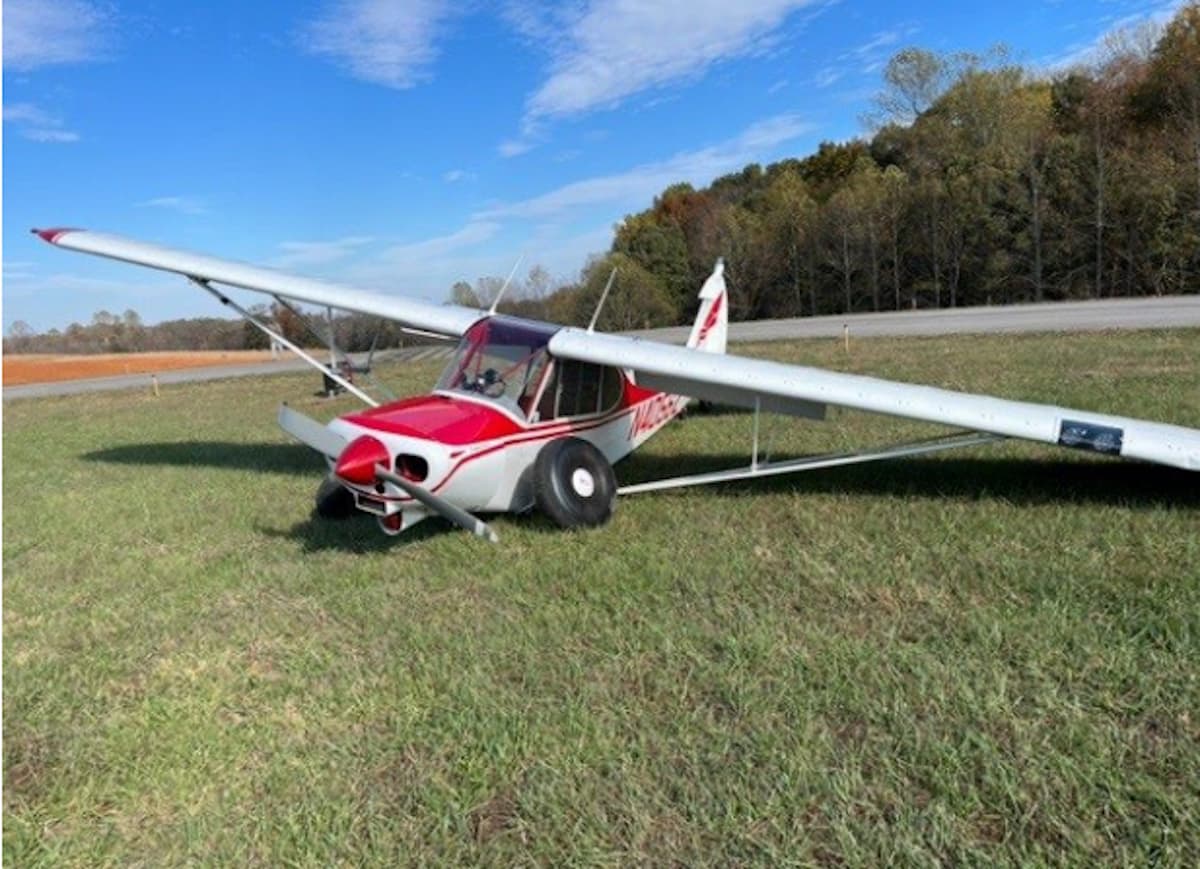
The pilot was practicing an emergency descent and landing when he deployed full wing flaps and descended to the touchdown point at the airport in Tompkinsville, Kentucky.
About 10 to 15 feet above ground level, the Piper PA-18 encountered a rapid sink rate that he failed to arrest.
The airplane touched down hard and the fuselage was substantially damaged.
The pilot stated that, upon reflection, if he had added power and extended the airplane’s glide path, he might have been in a better position for landing. However, he allowed the airplane to get “too slow.”
Probable Cause: The pilot’s failure to maintain adequate airspeed during the approach, which resulted in a hard landing.
To download the final report. Click here. This will trigger a PDF download to your device.
This November 2023 accident report is provided by the National Transportation Safety Board. Published as an educational tool, it is intended to help pilots learn from the misfortunes of others.
I’m glad he backed away from the “blame a downdraft” defense.
He states he “flared too high and was too slow”… at 60 MPH.
Here’s my theory: He’s using the threshold as his aim point from 2,000 AGL. I’ll bet he was actually slipping the beejeezus out of this Super Cub on final, with flaps, and was generating an extremely high rate of descent, even at his “too slow” airspeed.
He doesn’t mention when he started to round out & level off, but at “10-15 feet above the runway”, with a high rate of descent, he was too late coming out of his forward slip and transitioning to what I hope was supposed to be a full stall, three-point landing.
Leaving the power in idle throughout was the coup de grace.
I thought those oversized tires would bounce on down the runway like a rubber ball …
“Oh, but now I can go to Alaska, land on a gravel bar and hunt bear.” Yeah right. All you’re doing is making it hard to afford insurance for us sane pilots …
Sounds like something one of my old CFIs did years ago in a leased back 152. My landings had been a work in progress-more along the lines of “take that, runway!” He told me I had what he called “ground shyness,” I was flaring too high.
One day we were in the pattern and had been cleared for the option, he took the airplane and proceeded to fly down the runway, leveling probably 6-7 feet off the ground, and announced “this is why we flare…” and chopped the power. We dropped like the proverbial rock and hit the runway HARD.. I sat there a little shocked and angry as he told me “now, if the guy who owns this airplane saw us do that, he’d shoot us!”
My only response was “US.?? No, not us! YOU!”
We flew back to SYR, and I had a new found respect for the rugged landing gear on Cessnas. But what bothered me was wondering about unseen, or not so obvious damage, and if there was any, that it would be attributed to ME. I mentioned it to the chief instructor at the FBO, and he just blew it off “it’ll be fine.” After that, I went so far as to look up the owner of that 152, and explained in detail what had happened that day-that I was raised to not treat someone else’s property like that, and felt he had a right to know. He was extremely appreciative, and said he’d handle it. The next time I went in the FBO, the chief instructor proceeded to come out and chew me out for contacting the plane’s owner.
After that I went to the neighboring FBO and flew with them. After that I swore if I ever bought an airplane I’d never put it on leaseback!
Ouch. One of the basic skills pointed out in the handbook is the ability to visual the aiming point – “During instruction in landings, one of the important skills a pilot acquires is how to use visual cues to discern the true aiming point from any distance out on final approach. From this, the pilot determines if the current glide path will result in either an under or overshoot.” If practicing emergency descents (no power), this tells the pilot from the point where the power is reduced what path is needed to the runway (i.e. widen out or turn directly to the runway), and when to lower flaps if ever. And contrary to what’s sometimes believed, raising the flaps and adjusting the pitch to best glide speed before the speed and altitude get too low will re-establish maximum gliding performance increasing the gliding distance. Unfortunately, as the pilot said, he let it get too slow. And he had an engine that was running normally.