

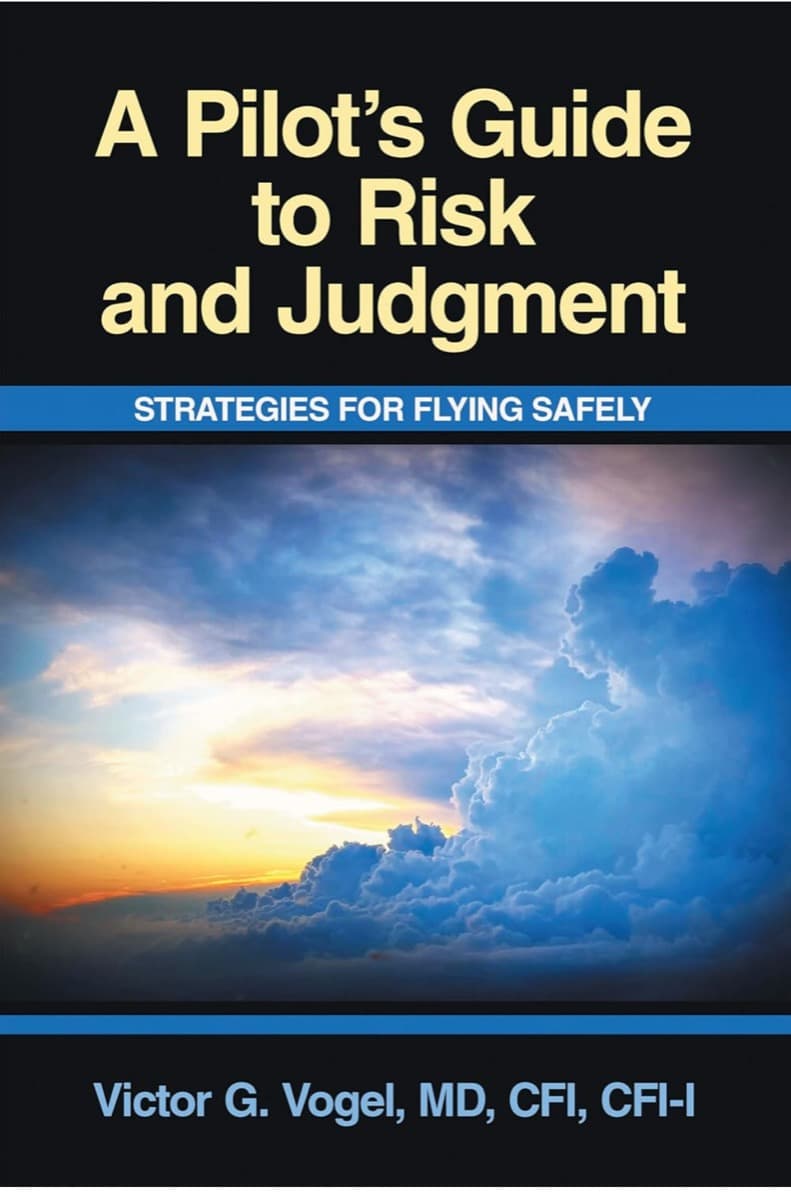
A new book, “A Pilot’s Guide to Risk and Judgment,” has just been published.
The book was written by Victor Vogel, a retired physician and a CFI/CFI-I who is a member of the board of directors of the National Association of Flight Instructors (NAFI), a FAASTeam representative, and founder and president of Susquehanna STEM to the Skies, an educational public charity in Selinsgrove, Pennsylvania, seeking to improve STEM education in public schools.
The new book examines how judgment can be developed in a general aviation pilot through experience, and how combining risk assessment, applied situational awareness, and scenario-based training can enhance general aviation safety.
It outlines a plan to improve proficiency and determine if the risk is justified, leading to consistently safer flight operations, according to Vogel.
“Pilots who employ the procedures and techniques described in this book will have the tools to identify potential flight hazards and successfully mitigate the associated risks,” he said. “All pilots should practice risk management in all operations, from recreational flying to using an aircraft for business purposes. This book explains how to do that productively and safely.”
A Pilot’s Guide to Risk and Judgment can be purchased in hardcover, paperback, and e-book formats from your favorite bookseller. It is available for $46.18 in hardcover, $24.99 in paperback, and $3.99 in the Kindle edition on Amazon.
Victor G. Vogel MD CFI CFI-I, LSMFT, has provided a re-hash of the Air Force’s Operations Risk Management (ORM) program. ORM is summed-up by: If you don’t need to go, then don’t and train the way you intend to fly.
This latter point is exemplified by, if for instance you plan to fly with three passengers, then you should train with dummy loads for three passengers and their gear in preparation for those flights. Too many pilots train in an otherwise empty plane and then are surprised by their aircraft’s poor performance with a full load on a high, hot and heavy day.