

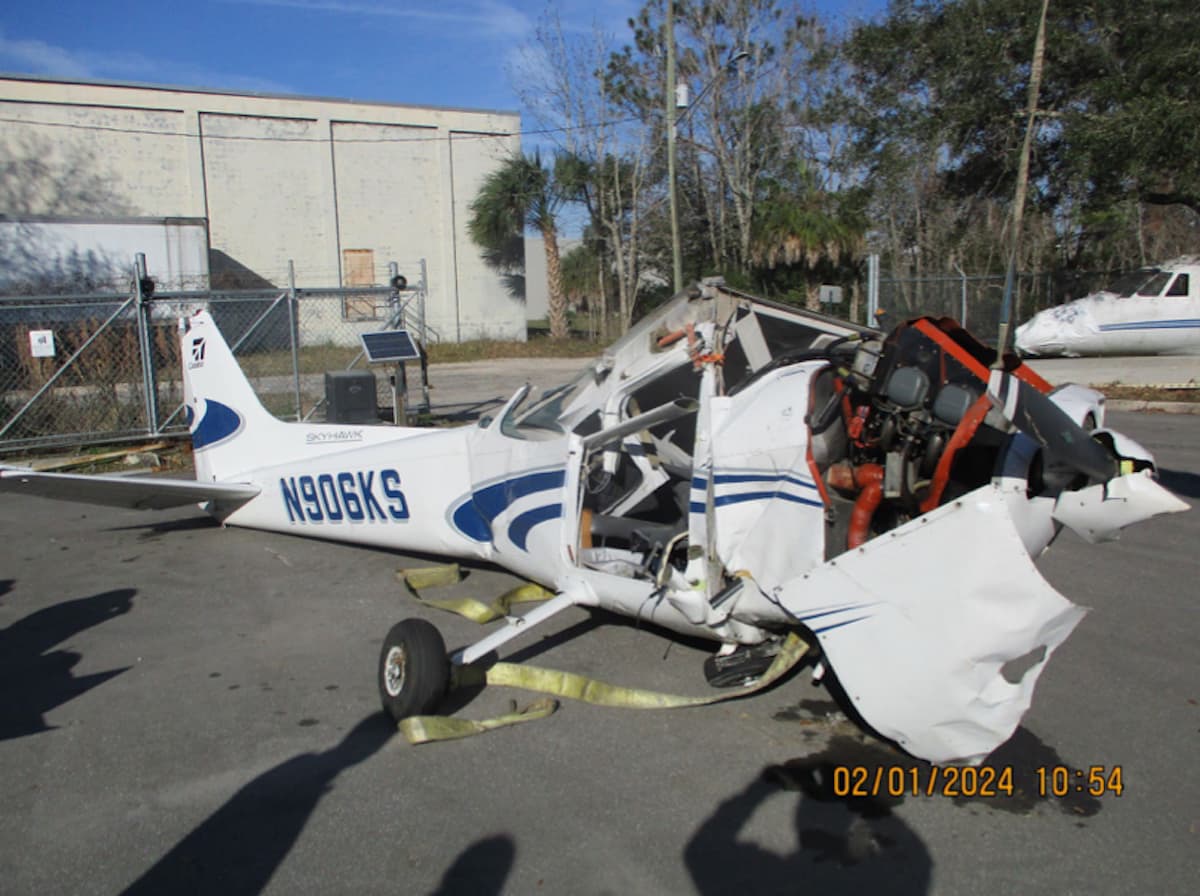
According to the student pilot, who had about 11 hours of total flight experience, he and the flight instructor flew the Cessna 172 from Lakeland Linder International Airport (KLAL), in Lakeland, Florida, to Zephyrhills Municipal Airport (KZPH), in Zephyrhills, Florida, to practice some touch-and-go landings on Runway 5.
The flight instructor demonstrated the first touch-and-go landing. The student pilot recalled performing the second touch-and-go landing but did not remember what occurred during the third touch-and-go landing. He recalled waking up in the hospital.
Due to his injuries, the flight instructor was unable to provide a statement.
An airport surveillance video showed the airplane flying about 50 feet above ground level in a nose high, left wing low attitude. The left bank continued to steepen, the airplane’s nose pitched downward, and the airplane began descending steeply toward the ground.
Initial examination of the wreckage by an FAA inspector revealed that it came to rest on the left side of Runway 5. The left wing and engine mounts sustained substantial damage.
The airplane was subsequently examined after it was recovered from the accident site. Continuity of the flight control cables was traced through separations that were consistent with overload or cuts that were made by recovery personnel to facilitate transportation of the wreckage. All of the primary flight controls were free to move by hand, and felt smooth through those movements.
The top spark plugs of the engine were removed and the propeller was rotated by hand. Thumb compression was established on all cylinders. Engine powertrain and valvetrain continuity were verified to the rear accessory section of the engine. Both magnetos produced spark on all leads when their input drives were rotated by an electric drill. The carburetor was opened for examination. It was clean and clear of debris. No anomalies were noted with either the airframe or engine that would have precluded normal operation.
Probable Cause: An aerodynamic stall from which the pilots did not recover while maneuvering in the airport traffic pattern.
To download the final report. Click here. This will trigger a PDF download to your device.
This December 2023 accident report is provided by the National Transportation Safety Board. Published as an educational tool, it is intended to help pilots learn from the misfortunes of others.
Retired Aerobatics, Bush Pilots and 5 kinds of EFATO CFI, M Engine too..
You have to be careful with students or pilots that have a tendency to either pull too much elevator when nervous, or freeze when nervous doing slow flight near MCA or and stalls. Or cannot push nose down on stalls.. Big defects those are..
Also do high winds GRM, not easy mild winds. See if the above. Do Vglide 45 degree banks stalls, not just mild easy ones, Go arounds with full flaps turning right, hard maneuvers before take off and landings. If they do the above defects, go up to do those maneuves again well. Otherwise no T & Goes ever. Mild maneuvers make mild maneuvering pilots that will crash on the above hard maneuvers.. J. Vega trilingual CFI, ret..
The very first thing to MASTER is the up and the second is the down! The third thing is to be honest with yourself and your endeavors. You WILL be involved in things where life will be at risk. It seems to me a miracle that most of us make it to oldness. Whenever you decide to leave the hard dry place for adventurous purposes, honesty is the last thing to save lives. We, the adventurous have built a huge system of safety requirements that must be employed honestly. The CFI is required to understand that the student’s skill is the last thing that honestly can’t be dismissed. It took a small thing like failure to apply an altitude setting to bring down an airliner and helicopter in a training mission.
Paul stated that “doing T&Gs at 11 hrs. is a little soon”. What has happened to people’s abilities?
In 1972 I had just turned 17 and never had been in an airplane before my first lesson and soloed at 4.5hrs TT. in a C150. Yes that’s four and one half hours.
I made the mistake of going with an instructor and his student once but never again. I had to change my underwear afterwards.
Doing touch and goes at 11 hours was a little to soon…………….IMO
I hope they are okay…….a shame and it keeps happening and life goes on!?
This accident is more like the actions of an instructor not worthy of the title. He should have been monitoring the airspeed closely. The throttle should have gone to full power as soon as the plane approached stall speed to enable an overshoot. This was only the student’s second T 7G ! ! The instructor should have been “on the ball”. What was the instructors age & hours as an instructor ? This accident strongly suggests that incompetence played a part in this accident. There is no way that the student should be blamed for the accident.
THAT WAS NOT AN ATTEMPTED TOUCH AND GO, RATHER IT WAS AN ATTEMPTED CRASH AND DASH. PILOT WANNABE’S WERE HALFWAY THERE!
“ Mr. Gwanggyu Lee was interviewed by telephone.
Mr. Lee stated that he has no recall of the events with the airplane accident on 12/7/2023.
Daniel Boggs
Air Safety Investigator “
What the heck, it worked for the Director of the FBI.
Are you talking about the Director of the FBI that just caught the guy with the pipe bombs? Are you talking about that guy?
Why don’t you take your politics and go to some other website
I was talking about the Director of the FBI ( former ) who testified in closed door – so much for their democracy – hearing that he could not recall over 270 times.
Some people notice things like that and decide it could be a useful method … even non political flight instructors.