

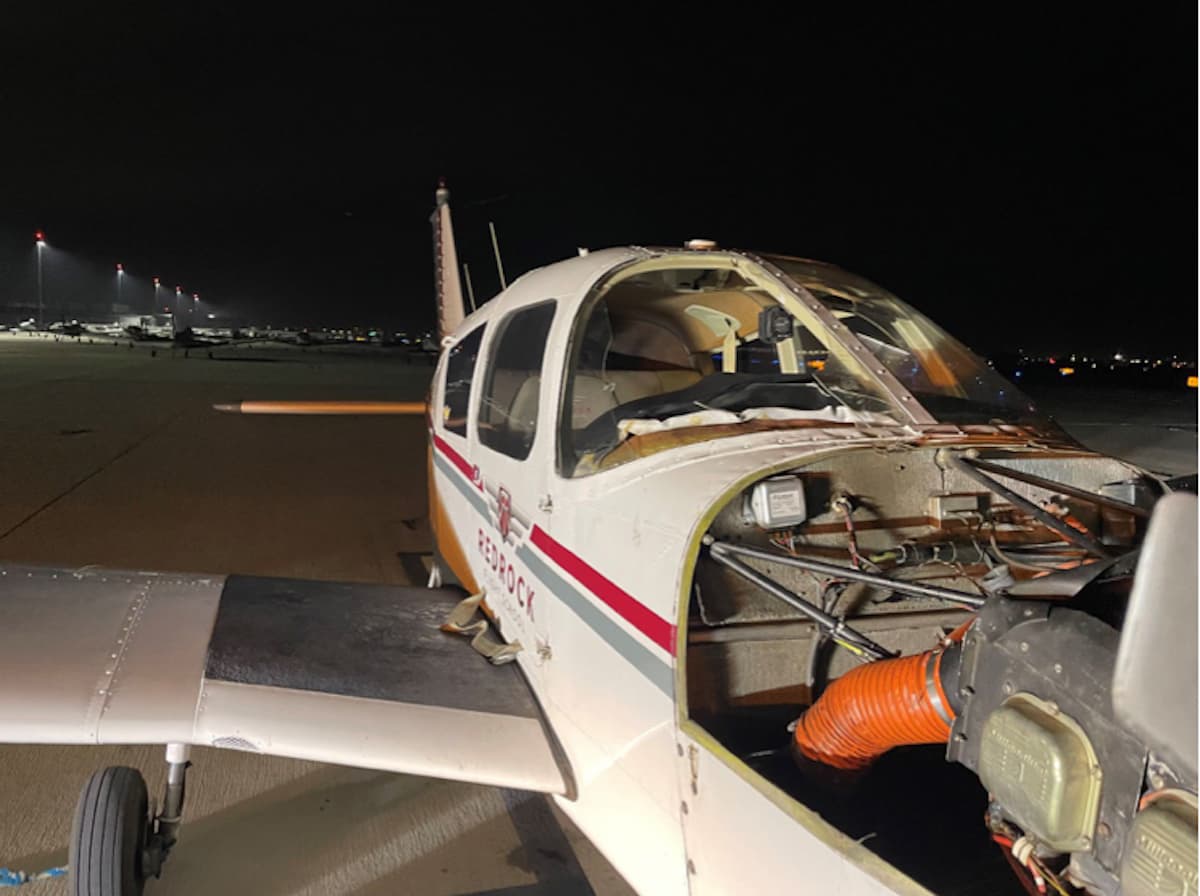
According to the flight instructor, while in cruise flight transitioning between airports, the right side of the Piper PA-28-180’s engine upper cowling came unlatched and struck the windshield.
The left side of the upper cowling remained attached, and the pilot landed without further incident at the airport in Mesa, Arizona.
The airplane sustained substantial damage to the windshield.
Post-accident examination of the airplane revealed that the right front fastener pin, which secures the front of the upper cowling adjacent to the air intake, had separated from the cowling structure. This likely allowed the forward right side of the upper cowling to separate from the lower cowling and move up into the airstream, resulting in the overload failure of the right side cowling latches.
Probable Cause: A failure of the engine cowling right side latch pin and fasteners, which resulted in the partial separation of the engine cowling during flight.
To download the final report. Click here. This will trigger a PDF download to your device.
This December 2023 accident report is provided by the National Transportation Safety Board. Published as an educational tool, it is intended to help pilots learn from the misfortunes of others.
When I was a student pilot many years ago, I was asked by a CFI what would happen to the engine if the cowl blew off for some reason. I thought that it would cool off. The CFI told me that the engine would start to over heat because it is the baffles that force the air between the cylinders for cooling. No cowl, no air being forced for cooling.
He said: first reduce your power, look at the oil temp, trim to hold altitude, monitor the oil temp, while finding a runway to land on as soon as you can.
Why? If that oil temp crosses into the red, that engine isn’t going to run much longer. Something to keep in mind should this problem ever happen to you.
When the was a student pilot my Cfi would make me unlatch the cowling on the piper Cherokee every time on the preflight walk around. I was always concerned that the fasteners were not always locked. Never saw the need for doing that every time.
If you ever saw how quickly birds can make a nest inside a nacelle you’d understand.
Right I found a nest in my piper arrow since the I use cowl plugs
The need as such is that if the aircraft is sitting for just a few hours birds can start building a nest in there. Also it allows you to see the hoses and wires. The cowl latches and pins need to be checked and compared to each other, does one seem different? As this account shows a cowl can fail dramatically. Airplanes will fly with a loose or missing cowl. Will the pilot maintain composure and thereby control is the question. In my career I have replaced many cowl latches, some cracked to the point of almost total failure. The pressure on a top cowl is immense, a worn or cracked fastener may hold in normal flight, get close to VNE in a dive it may not.