

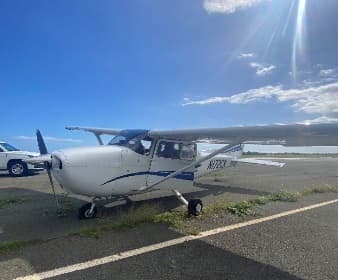
The first pilot, seated in the left seat of the Cessna 172, and the second pilot, seated in the right seat, were both flight instructors. They told investigators that the purpose of the flight was to accumulate additional flight time and practice various flight maneuvers.
The first pilot reported that while she was performing a simulated, power-off, 180° landing to Runway 4L at an airport in Kapolei, Hawaii, she was adjacent to a large military airplane operating in the traffic pattern of a parallel runway.
The 172 began a rapid descent while on short final. To arrest the rapid descent, she initiated a go-around by applying full engine power, but the descent continued, and the airplane touched down hard before becoming airborne again.
Airport wind conditions at the time of the accident were reported to be 120° at 10 knots, with peak gusts to 17 knots, which translates to a quartering, right tailwind.
The second pilot reported that, prior to the accident, as the approach to Runway 4L continued, the first pilot decided to lower the nose to gain airspeed and enter ground effect. The second pilot stated that, as the airplane passed through 75 to 50 feet above the runway, it encountered an unusual sink rate, and he reacted by pulling back on the yoke as he yelled “flare” just before the airplane touched down hard.
The second pilot told investigators that the airplane touched down hard, bounced back into the air, and the first pilot then initiated a go-around.
After establishing a climb on the go-around, the first pilot transferred control to the second pilot, who subsequently performed a precautionary full-stop landing to check for damage. During the landing roll, the nose wheel deflated, and the airplane came to a stop on the runway, disabled.
A post-flight inspection revealed that the airplane sustained substantial damage to the firewall and fuselage.
Probable Cause: The first pilot’s failure to maintain a stabilized approach, in gusty crosswind conditions, in an environment favoring wake turbulence.
To download the final report. Click here. This will trigger a PDF download to your device.
This December 2023 accident report is provided by the National Transportation Safety Board. Published as an educational tool, it is intended to help pilots learn from the misfortunes of others.
Anything wrong with this picture?
The 20-year-old First Pilot/CFI: “425 hours in last 90 days”. That’s an average of 4.72222…hours/day, every day, for 3 months.
Or, her “89 hours in last 30 days” for an average of only 2.9666…hours/day for a month.
And that’s Hobbs time only; doesn’t include planning, briefing, preflight, post-flight, debriefing, etc., etc., etc.
I’m assuming all/most of these hours were ‘dual’, where she was providing instruction.
Anybody think that’s “healthy”? Is she really proficient, or a burned-out zombie?
The idea of “lowering the nose to enter ground effect” seems like a troubling idea, and coming from two CFI’s, makes me wonder what they are teaching.
Both young instructors had good amount of time in the last 30 and 90 days time frames. A power off 180 landing with a 70 degree gusting cross wind and a KC-135 to the right ( no mention of how recently it did it’s last pass ) seems like complacency might have been a factor. Or perhaps something else, maybe showing an expanded personal limit ? The challenge of another instructor in the other seat ?
From now on each will have a more acute sense for the ever present question up there in the wild blue yonder, as well as elsewhere.
What could possibly go wrong ? It’s a long list.
A bent firewall wasn’t too bad, it’s a 172. The bent ego hurt more. They both grew up a little faster that day : )
Won’t look good on the resume.
While winds from 120 & landing runway 4 is a crosswind , it’s not a quartering tailwind, as stated in the article.
Sometimes 2 CFI = 1/2 pilot brain
Major flaw in present day instruction is instructors and students not understanding how and being able to land in crosswinds correctly. Part of the problem is most flight schools have a 10kt limit.
The centerlines for 4L and 4R are only 627ft apart (as measured with the distance tool on Google maps). With a nearly perpendicular wind bringing the large airplane’s wake, it’s about the same hazard as following a large airplane too closely with the wind straight down the runway.
Yelling Flare at 50-75 feet!! Two instructors can’t handle a 10-15 knot crosswind! I’m worried about their students. I’m amazed, but at least they didn’t run out of gas, yet.
So much for two heads being better than one.