

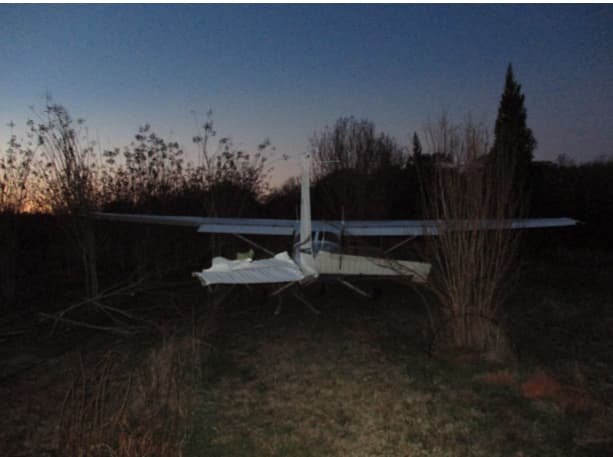
According to the flight instructor, he was simulating an engine failure with the student pilot. He selected a field near Social Circle, Georgia, to approach and proceeded to reduce the Cessna 172’s engine RPM to simulate the engine failure.
They continued the maneuver until they were approximately 100 feet above the ground, at which point he instructed the student pilot to add full power and climb out.
The student pilot complied, but right at that moment, the flight instructor felt a heavy gust of wind. He described it as a downdraft, and despite the engine producing full power, it would not climb.
The flight instructor took control of the airplane and attempted to recover it from the descent. The airplane continued to descend until it hit a fence and touched down in the field.
During the landing roll, the airplane hit a tree, resulting in substantial damage to the horizontal stabilizer.
Probable Cause: An encounter with a downdraft while maneuvering at low altitude, which resulted in a collision with a fence.
To download the final report. Click here. This will trigger a PDF download to your device.
This December 2023 accident report is provided by the National Transportation Safety Board. Published as an educational tool, it is intended to help pilots learn from the misfortunes of others.
Immediately to the left of the runway is a large wooded area and lake. These features are known to create downdrafts. With the wind coming toward the runway from that area, maybe like a vertical column of descending air who knows from what altitude moving over the runway, seems reasonably plausible that they unknowingly entered into some conditions which were beyond the limits of the airplane.
I’m kind of in agreement with DA. I think they got hit by a sudden tail wind. As I recall in the Cessnas that I’ve flown (C15x, C172, C172RG), that on a balked landing (go around), it is terminate sink rate, establish positive rate, then retract the flaps bit by bit until Vy (if I remember correctly) and then clean up and climb out. The RGs also require gear up during clean up.
I read the weather report, and sky was clear. So I don’t see how they could have had a “micro burst” that would push them into the ground.
This wasn’t a brand new student pilot paired with a neophyte CFI on Lesson One. It was a Private Pilot practical test; the applicant had 121 hours total time, all of it in the same make/model, and the “instructor” was a DPE.
I’m not sure about the applicant’s “2 hours” as PIC. If that’s all she had listed in her log book, the checkride wouldn’t have happened in the first place.
It was a lightly-loaded 180 HP C-172S, the flaps were at 10 degrees, not “full”…and they were on short final to an actual airport’s runway, not a ‘field’.
Being manhandled and driven into the ground from ‘100-200´feet AGL by winds at 09G18 is a bit of a stretch..it must’ve been one heckuva downdraft.
Regardless, the NTSB believed it; there’s no mention of pilot error in the “Probable Cause and Findings“.
CFI/DPE intervention too late! Why?
Your reply is better than the article.
I don’t think it was a downdraft at all. I think the crash happened because of a lack of altitude, airspeed, and the fact that the flaps were still in. Flying to 100 feet to practice an emergency situation actually creates an emergency for no reason, unless there is a runway under it. Outside of the airport environment, 500 feet should be the lowest to practice an engine out. From there, the decision can be made by the CFI to determine whether the student would be able to land, and the student should have that sight picture in mind. It should be practiced often.
This is akin to the instructor who shuts the engine off to force the student to perform a dead stick landing. That’s also a poor practice, because idle power accomplishes the same goal without a no power limitation, and it can make recovery impossible if the engine fails to restart – a scenario that has happened too many times.
I speak from experience ! During an abort/go-round, 172’s (especially older ones) will always climb better when the flaps are retracted,, check the photo !!
My 1961 Cessna 175 poh specifies short field takeoffs are with 10 or 20 degrees of flaps.
However the rate of climb is reduced, so the flaps are slowly retracted after takeoff.
The Johnson bar flaps allows instant changes in flaps.!!
Yet another chapter in the on-going saga of wrecks due to simulated engine failure. Can’t this learning exercise be handled using PC simulation software? Definition of insanity attributed to Al Einstein: “Doing the same thing over and over and expecting a different result.” Perhaps if the insurance companies refused to pay out when this cause of the crash is discovered would discourage this training exercise. It would save airplanes, insurance rates and potentially lives.
Regards/J