


By David Anderson
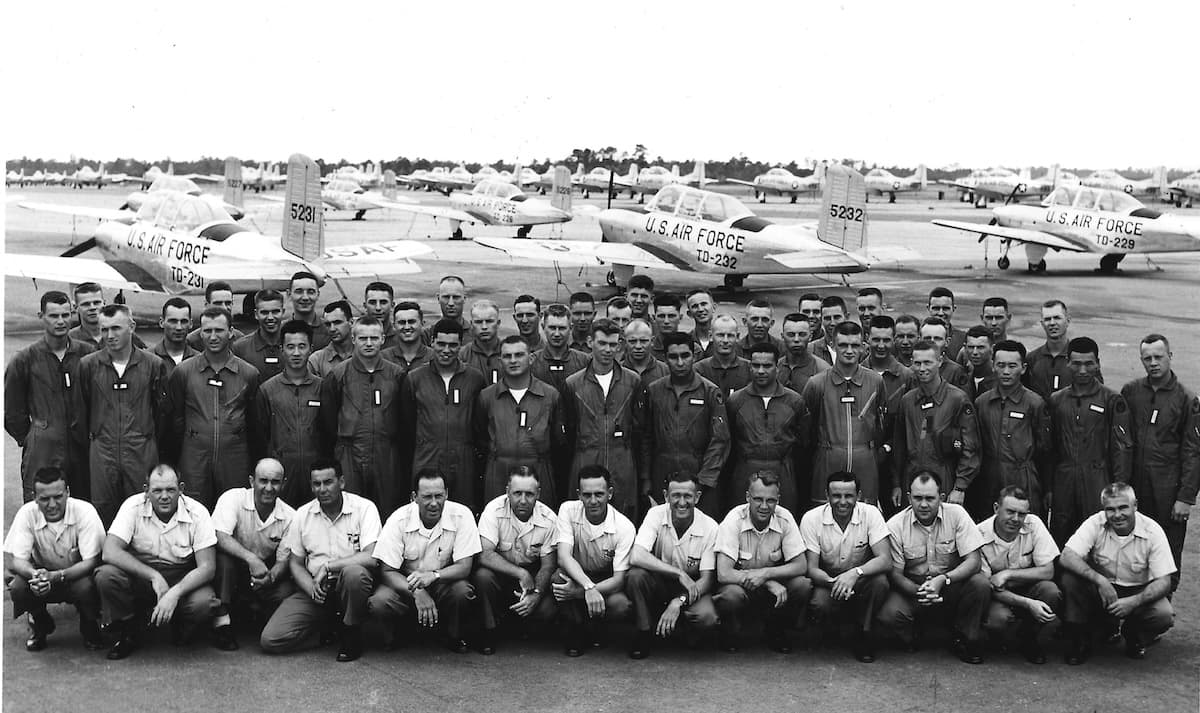
I drove my 1954 Ford to my next post, Stallings Air Base near Kinston in eastern North Carolina, as part of a class of 80 ROTC grads (58-M).
It was 1957 and here we would learn the basics of flying in the T-34. The plane had dual controls with the student pilot up front and the instructor behind. It was powered by an in-line 250-hp engine and had retractable landing gear.
Our ground and flight instructors were civilians. My flight instructor, Norman Huggins, had been a pilot in the Korean war.
To hear Huggins tell it, I was the most inept student he ever had. I heard these words repeatedly: “Why, oh why, do I always draw the worst students? Can’t you remember anything? How the hell did you get a diploma from an engineering college? Use the damn rudder pedals when you make a turn! Can’t you feel the plane slipping? How will I ever make a pilot out of you?”
Despite the torment from Huggins, my flight training followed the normal schedule, I did well in the ground school work, and he finally let me solo.
That wonderful day was June 12, 1957. After my lesson of the day, Huggins ordered me to land and pull off the main runway. He opened the canopy and began his exit.
“I’m getting out of this bird before you kill us both!” Then he turned with a big smile and said, “It’s time, Anderson, take her up and shoot me three perfect landings. You can do it!”
Those were the most charitable words I had ever heard!
I took off solo, made three perfect landings, then taxied the plane to my parking spot. Huggins sat there in a lawn chair with a big grin on his face. He allowed me a compliment: “You are going to be a good pilot!”
He signed my documents for graduation to the next phase, but only after I paid him “the price” a fifth of Old Overholt rye whiskey.
I never saw Huggins after graduation day at Stallings, but he was a real hero, making a pilot out of me!
My flight instructor was Captain Vernon “Egg” Bothwell, USN. My name is Duane, but in the Aeronca Chief it was “Dammit”. “Dammit are you trying to kill us?!”, “Dammit, the pedals are next to your feet for a reason!” When he hopped out on that magical day, he just looked back and said “Don’t crash!” with that maniacal smile he loved to use. The echo of his voice has saved my bacon countless times. Fair winds and following seas, sir…
UPT Class 72-06 – one of the most challenging and rewarding years of my life!
Went on to fly the F-4, F-111 and F-16! And amazingly they paid me for doing it!
Great story! Your instructor sounds like the typical cantankerous old guy prevalent back in the day!
Pretty sure the T354 was never built with an “inline 250 horsepower engine”.
Otherwise, good story.
Point of accuracy. The first T34s used the Continental E225 engine. Flat, opposed, not inline.
David,
That’s a wonderful story and great photo of your class. Glad you made it through! Would love to hear more tales from your career.
Air Force, UPT Class 87-07, Vance Air Force Base. There was a fair amount of fear, sarcasm, and ridicule in my training, but also some very patient, knowledgeable competent IPs (instructor pilots). I was willing to crawl over a broken glass to graduate so the bad instructor pilot?. I got past them. It’s hard to be a good instructor pilot.
I was a 26-year-old CFI when I joined the USAF. My assigned Tweet IP (Laughlin AFB) was a wonderful, calm, well-seasonal O-4 “gray-beard”, re-branded helicopter pilot.
My T-38 IP was a 1Lt FAIP, younger than me & with fewer hours TT, albeit all in USAF jets. He was also a screamer. Big time. I landed from every dual ride assuming I had busted…only to have him turn from Mr. Hyde in the jet, to Dr. Jeckyl in the debrief.
Otherwise, we got along well. But I wonder if learned more in spite of him than because of him. Regardless, his teaching method must have worked: I ended up a DG, with an F-15 to Kadena.
The old military teaching style works well when you have more students than places, but in the civilian world excludes people who could, with an adaptive teaching style, go on to be excellent pilots.
Great ‘old school’ story. Back in that day, that’s how it was done. How many of today’s alleged CFIs do it this way? How about training new CFIs this way to avoid the chronic stories of crashes with a CFI in the cockpit who failed to grab the controls and land the machine without death and destruction.? Guess the schools are scared such demanding instruction would frighten tuition-paying students away. Alas.
Regards/J