

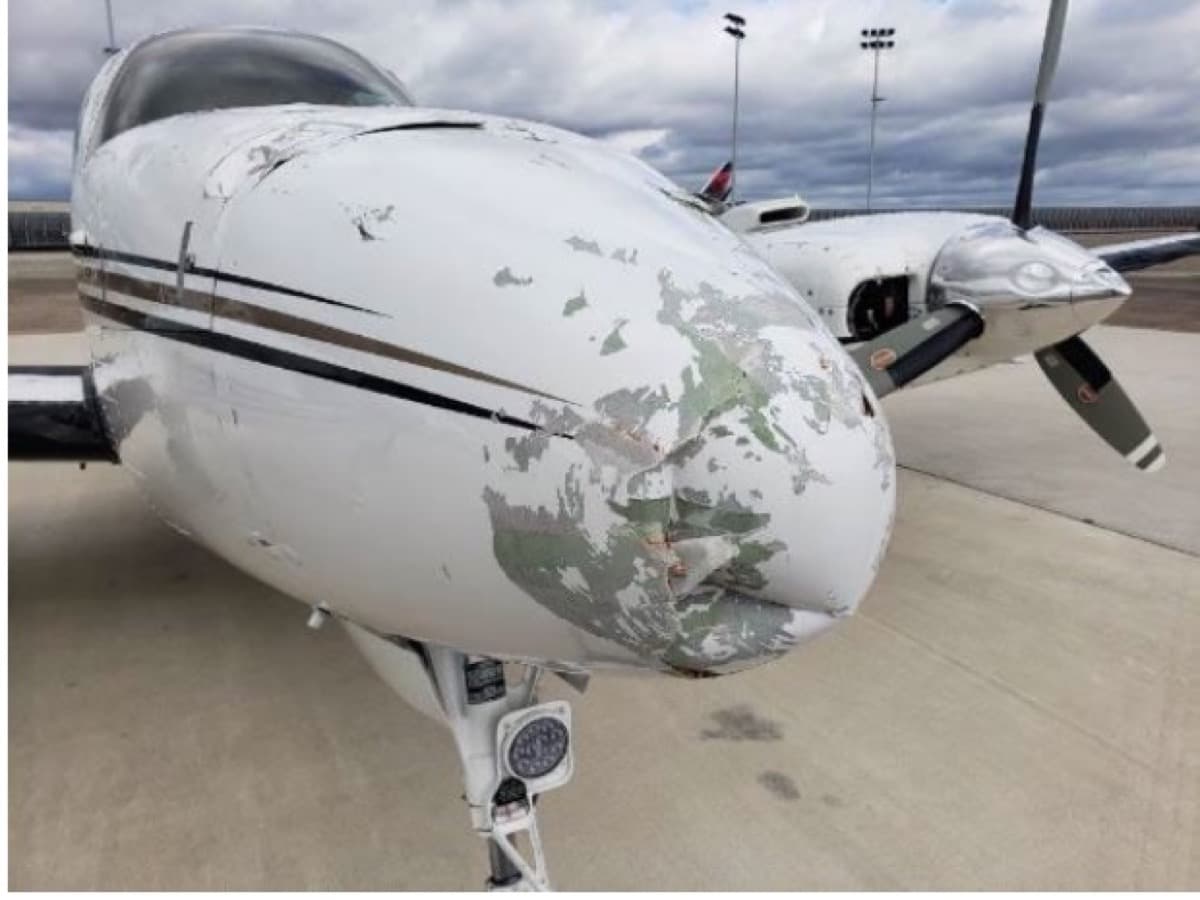
When I saw the photos of the airplane, my first thought was: Holy crap! My second thought was: The pilot is lucky to be alive. Perhaps followed by Boy, Beech sure built some good airplanes…
The photos were of an airplane that had what the National Transportation Safety Board (NTSB) calls an “encounter” with a thunderstorm.
A very experienced pilot, flying hard IMC at night, had — for reasons we will cover — flown his Beechcraft Baron into a thunderstorm containing heavy rain, severe turbulence, and hail. Following an emergency landing, the twin-engine airplane looked more like a car driven in a demolition derby than an aircraft.
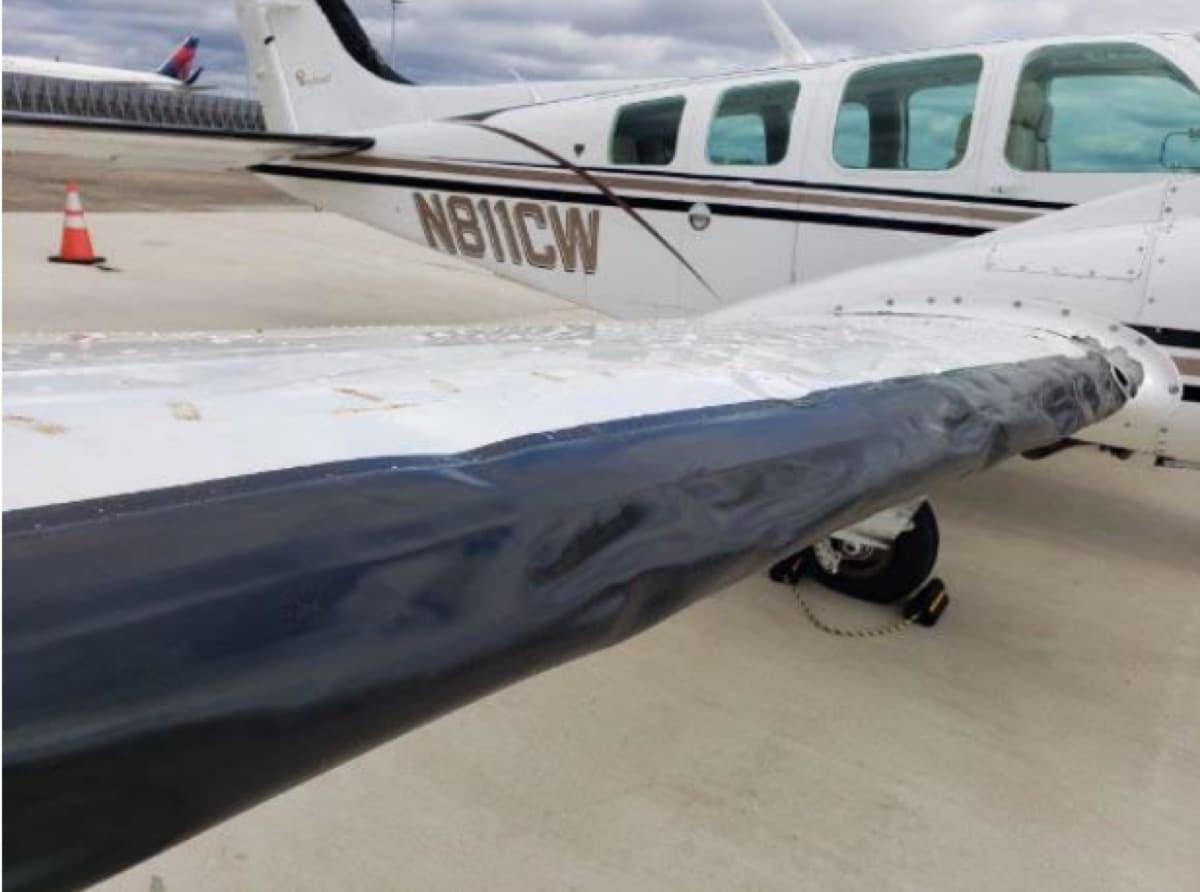
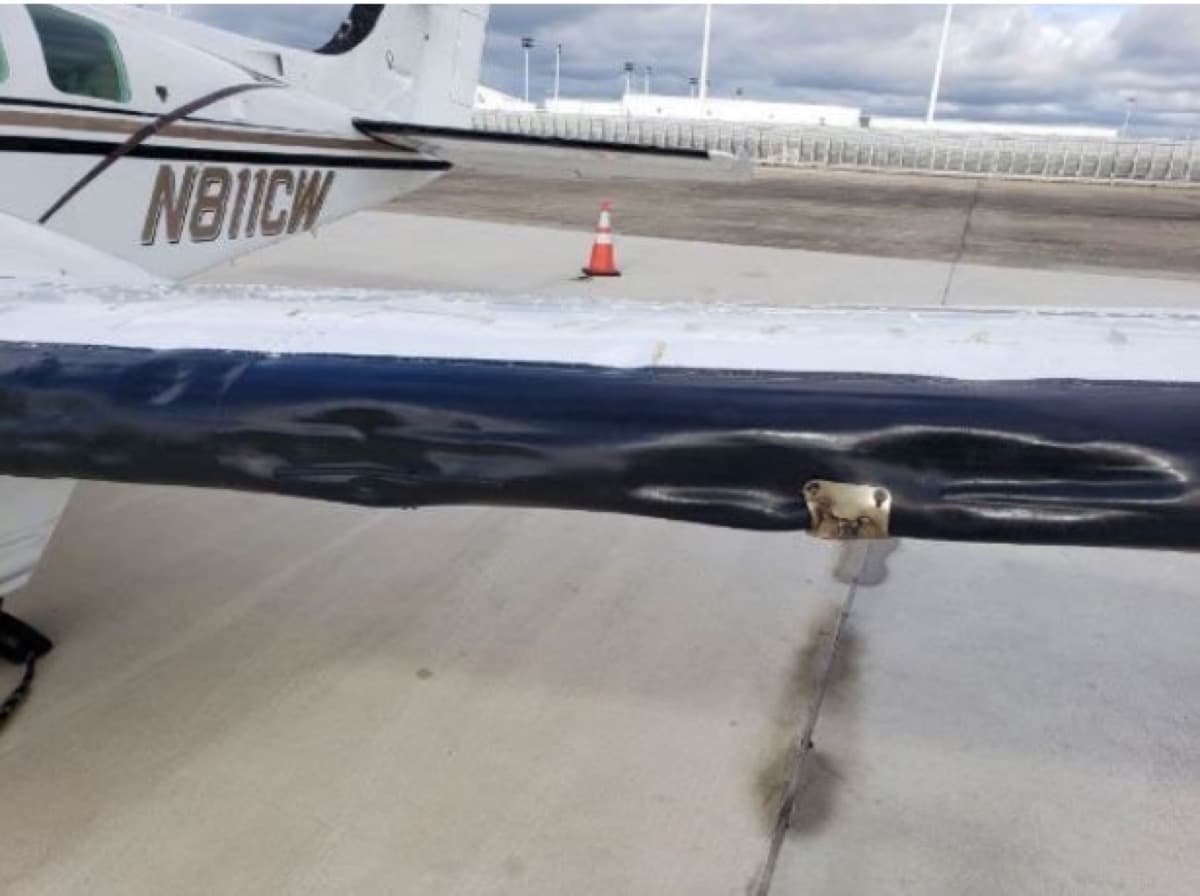
The NTSB classified the damage to the airplane as “substantial,” not something you often see in an aircraft that is able to return to the ground under control of the pilot.
The definition actually comes from the NTSB regulations (49 CFR § 830.2), and quoting them, “means damage or failure which adversely affects the structural strength, performance, or flight characteristics of the aircraft, and which would normally require major repair or replacement of the affected component.”
So, in theory, the airplane can be fixed. Looking at the photos I’d say you just need to replace both wings, the engine cowls and spinners, all the skin on the nose, and probably some stuff back on the tail feathers. As mechanics like to joke about serious damage: “It’ll buff right out.”
That said, FlightAware doesn’t show the twin having flown since its encounter with the wrath of Mother Nature.
The Flight
It was a late afternoon in January 2024. Earlier in the day, the pilot had flown from Abbeville Chris Crusta Memorial Airport (KIYA) in Louisiana up to Abilene Regional Airport (KABI) in Texas and this was the return leg mirroring the route. Although listed as an occupational pilot, this was a personal flight. There was one passenger onboard.
The flight was near Jasper, Texas, and according to the NTSB’s final report, the pilot was well aware of a weather front along his route of flight and was monitoring it. He was also talking to ATC for help routing among and between storm cells that contained “high to extreme” precipitation.
The controller offered the pilot several options, but none of them were great. The precipitation was pretty much solid, and the controller tells the pilot, “I don’t have anything without any precipitation at all, but there are a couple of spots just showing some moderate that might have some gaps that you can get through.”
One, to the north of the route, was a five-mile-wide gap of moderate precipitation with “heavy and extreme cells on either side,” which “might be a decent slot for you.” The other, which was five- to 10-miles-wide, would require deviating 75 miles south.
The pilot selects the northern option between the heavy cells. Of note, a controller asks the pilot if he has weather radar on board, to which the pilot responds, “That’s affirm.”
But, he didn’t. He was looking at NEXRAD piped into his Garmin 750, via the XM satellite service.
The Pilot
The pilot was a 71-year-old male with an ATP certificate. He had single engine land, single engine sea, and multiengine land classes on his certificate, plus glider and helicopter categories. He was also a flight instructor with CFI, CFII, MEI, helicopter instructor, and helicopter instrument instructor. He had a Class 2 medical.
He started flying at age 16, and had a logbook bursting at the seams: 30,000 hours total time, with 1,000 in the Baron, and 100 hours in the last 90 days.
The Final Moments
Operating under the assumption that the pilot has airborne radar, the controller updates the pilot, “there are some scattered areas of embedded heavy precipitation right at your 12 o’clock and about two zero miles, about five miles in diameter, and 11 to 12 o’clock and about 25 miles, and 10 miles in diameter… ahh… umm… might be able to sneak through there or if you want to continue around to the east of that, it’s much clearer just past that about 35 miles out.”
The pilot opts to attempt the sneak.
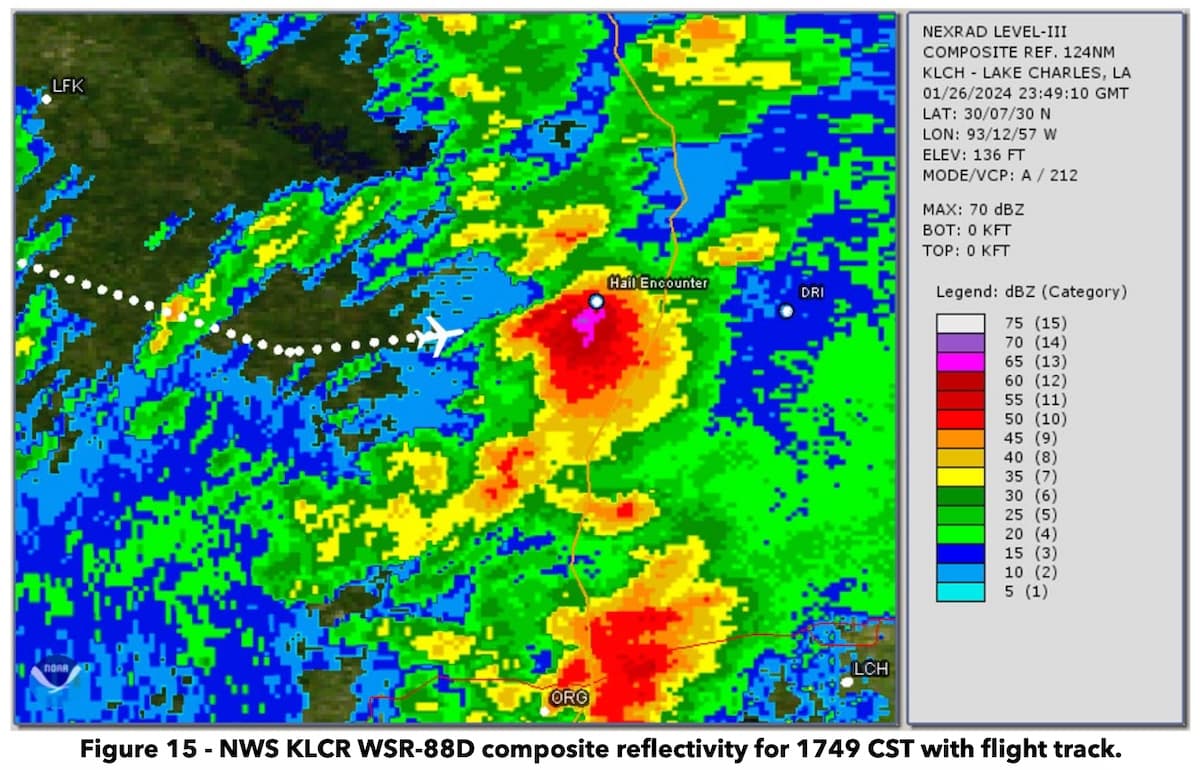
Looking at the re-created images of the storm system and the flight track is sort of like watching one of those animations of the RMS Titanic almost — but not quite — missing the iceberg. The airplane is turning north as the storm tracks toward it, closing in on each other, then bam! they side-swipe each other.
The Accident
The aircraft-pummeling hail encounter itself was short. Less than a minute long. The pilot “immediately” slowed to maneuvering speed, switched off the autopilot, kept the wings level, and held on for dear life. The storm sucked the heavy twin upwards at a peak speed of 2,942 feet a minute, then slammed it down again at over 1,000 feet a minute.
A later analysis showed hail up to 2.51 inches in diameter in the clouds in the immediate vicinity of the accident. The cell that battered the Baron had tops 38,000 to 39,000 feet, its neighbor topped out at 44,900 feet. A four- to five-inch hailstone was recovered in nearby Newton, Texas.
Following the encounter, the pilot said that the twin was handling sluggishly, as if it had a heavy load of ice on it. It didn’t, but the wings were damaged enough to affect airflow and lift, something he wouldn’t get to see until he was on the ground.
Must of been a gut punch.
After the encounter he diverts, not to the closest airport, but another one nearby that he knows from experience has emergency services, and is equipped with an Instrument Landing System — as ATC is reporting two-mile visibility with mist, a broken ceiling at 600 for the airports in the vicinity, and a dewpoint/temperature spread of one degree.
The NTSB
The NTSB was actually pretty kind to the pilot, but did highlight the controller’s inquiry about “radar on board,” and how the pilot’s answer to that question “affected” the controller’s guidance to the pilot.
Now, to be clear, “onboard radar” — or anything remotely like that term — isn’t in the pilot/controller glossary, but I would have taken the question at its face value: Asking if I had an installed airborne radar system.
While NEXRAD on XM (or the more common ADS-B ground-based feeds) give us the comfortable illusion that we have onboard radar, we don’t. We just have TV sets showing us a delayed broadcast of what the radar looked like a while ago. The length of that “while” can vary, but the images will always be out of date by the time they reach the pilot, making real-time close encounter navigation a tricky bet.
The NTSB report quotes the older Safety Alert 0-17 at length, which says the images can be as old as 15 to 20 minutes. But to be fair, XM claims a two-and-one-half minute refresh rate, on average, on its current product. Still, in 2.5 minutes, a fast-moving thunderstorm can cover a lot of ground, especially when we are talking about sneaking through five-mile gaps.
Thunderstorm speed ranges from virtually stationary to 74 mph, with most moving around 30 mph. That said, this storm was moving at the faster end of the scale, at 50 mph, meaning it traveled over two miles between each radar refresh.
Also of note is that ATC radar is built to view airplanes. While it can see weather, that’s not what it’s intended for and, frankly, it’s not really all that good at it.
Analysis & Discussion
I think we can all agree that, once in the situation, the pilot did everything right. He turned off the automation and took control of the airplane. He slowed it down, rode it out, then made the smart call to divert to the nearest airport with emergency services and a landing system appropriate for the conditions, minimizing the risk of having to conduct a missed approach in a crippled airplane.
And I think we can all agree that we will never agree on his decision-making process prior to the encounter.
So what’s the takeaway, then?
The Takeaway
Of the various interesting accident reports released this month by the NTSB I chose this one for two reasons.
The first was the impressive damage sustained by the airplane in such a brief encounter with the fearsome power of a thunderstorm, and one not even in the classic thunderstorm season, at that. To me this is a good reminder of the advice to give thunderstorms a wide berth.
And the second is to remember that wherever we get NEXRAD from — ground or space — it is never a substitute for airborne radar, and that “piped in” radar should never be used for tactical decision-making. It’s the wrong equipment for “sneaking through” gaps between thunderstorm cells regardless of how you view the wisdom of doing so in the first place.
The Numbers
Want to read more? Download the NTSB’s final report here or view the items on docket here.

Sounds like risky business to me. I was always admonished by my flight trainer, “You don’t want to become thunderstorm current.” He meant it both ways.
Thunderstorm winds, updrafts, hail, lightning are all enough to cause a breakup in flight. This guy was a gambler, pure and simple.
I’m sure a lot of risky things have been done by pilots who have lived to tell about it, such as flying under bridges, low and close to the water, under or between power lines, in and out of narrow canyons; but I was also always cautioned not to empty the Luck Bag before the Experience Bag was full, and not to try to fill the Experience Bag from the Luck Bag.
Creo que es un gran piloto que se equivoco pero salio del aprieto y aterrizo no quisiera pasar por lo que paso. Translation: I think he’s a great pilot who made a mistake but got out of the jam and landed. I wouldn’t want to go through what he went through.
My old timers who taught me called those sucker holes.
Based upon what took place in this article, I find it amazing that the Pilot lived as long as he did. I would venture to guess that this incident wasn’t his first group extremely risky decisions that he made during his flying career.
I am not an instrument rated pilot. If the pilot had said to the controller he didn’t have airborne radar how would the controllers instructions/advice differed and how could it have affected the outcome?
I’ve diverted or delayed my IFR launch for a lot less. Despite this pilot’s credentials, I’m not impressed. His flight discipline and decision making skills must have atrophied a long time ago.