

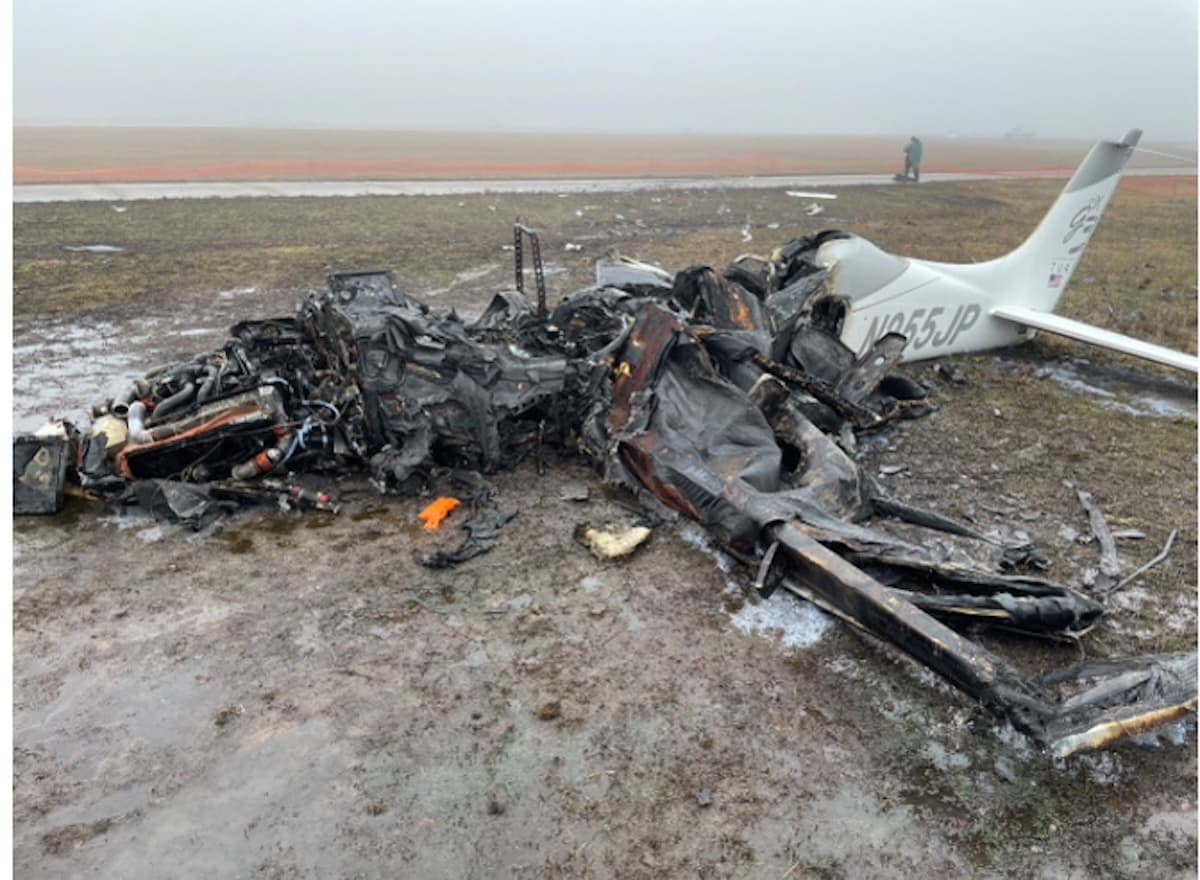
The Cirrus SR22 was kept in an unheated hangar at Bill and Hillary Clinton National Airport/Adams Field (KLIT) in Little Rock, Arkansas. On the day of the accident, the pilot called an FBO at KLIT to move the airplane outside. At the time, the outside air temperature was about 28°F.
When the pilot arrived, he attempted to start the airplane’s engine 14 times, then ceased further attempts because the battery died.
The pilot’s flight instructor told investigators that he received text messages from the pilot asking, “Tricks for starting the Cirrus in the cold?” and noted that the pilot flooded the engine and there was fuel on the ground.
An additional message stated that the FBO was taking “forever” to get a ground power unit (GPU). After FBO personnel connected a GPU, the pilot then started the airplane’s engine after five additional attempts.
A witness, who was inside the FBO, said once the airplane’s engine started, the GPU was disconnected, the wheel chock was removed, and within two minutes the airplane started taxiing and turned onto Taxiway A.
He said that the pilot did not allow the engine to warm up after engine start and before taxiing. He added that typically on cold days, he must wait at least 6 to 8 minutes before taxiing his airplane. He did not know if the Cirrus pilot performed a run-up before departure. He said he did not think enough time had elapsed from the time the airplane’s engine was started to the time of the accident for the engine oil to have warmed up enough.
The flight took off from Runway 4L and reached a maximum altitude of about 425 feet mean sea level (MSL). The airport elevation was 266 feet MSL.
During the departure climb, the pilot transmitted that he lost the engine. The airplane entered a right bank, descended, and hit the ground near the airport fire station.
The airplane was destroyed and the pilot died in the crash.
The airplane was powered by a Continental IO-550-N, fuel-injected, direct drive, air-cooled, horizontally opposed, 6-cylinder, 550 cubic inch displacement engine, rated at 310 horsepower. IO-550-N engines are equipped with non-congealing oil coolers that have a vernatherm (bypass) valve, which directs oil into the oil cooler when the engine warms up to about 160° to 180°F, otherwise, oil is routed around the cooling fins and into the oil cooler galley.
The engine was modified by the addition of a Tornado Alley Turbonormalizing System through an STC. The Tornado Alley Flight Manual supplement provided a turbocharger system description, which stated: The absolute controller and wastegates work in conjunction with each other to provide proper boost pressure to the engine. The wastegate is actuated using engine oil pressure to actuate a small hydraulic cylinder which redirects the engine by-pass exhaust flow around the turbochargers. The absolute pressure controller utilizes an aneroid bellows and spring connected to a valve that regulates the amount of oil flowing out of the wastegate actuator hydraulic control cylinder. The aneroid bellows are located inside a housing that is connected to the output air produced by the compressors. The control lines for the turbocharger system were connected to the oil cooler galley, and the engine oil temperature sensor was connected to the oil output of the oil cooler.
In the Tornado Alley Turbo Continued Airworthiness Manual for Cirrus Design SR22 Series Airplanes Turbonormalized per STCs SA10588SC and SE10589SC, the post-engine overhaul/installation instructions noted that target fuel flow is achieved with an engine oil temperature not less than 170°F.
The Tornado Alley Flight Manual supplement added steps to Cirrus’s SR22 takeoff procedures, stating that engine parameters should read in the green during takeoff and manifold pressure may temporarily increase to 31-32 inches of mercury with an associated increase in fuel flow due to cooler oil temperatures. If the manifold pressure exceeded 32 inches of mercury, then the corrective response was to reduce power.
The airplane was equipped with a crash-hardened data storage unit installed in the tail of the airplane. The unit recorded flight, engine, and autopilot parameters. Data was logged once per second.
Recorded data showed 18 engine start attempts, which was then followed by sustained engine operation at 1,000 to 1,200 rpm until the beginning of takeoff. About 1313:16, engine oil temperature reached 100°F, and the takeoff began about 1315:25. From engine start to takeoff, there was no engine rpm increase to 1,700 rpm, consistent with an engine run-up as prescribed in the Cirrus SR22 Pilot’s Operating Handbook and FAA Approved Flight Manual before takeoff checklist.
About the beginning of takeoff, oil temperature and pressure were 108°F and 47 pounds per square inch (psi). After takeoff, the following maximum engine parameters were attained: Fuel flow of 37.9 gallons per hour, manifold pressure of 32.5 inches of mercury, and oil pressure of 58 psi. The engine oil temperature at this time was 115°F and the GPS altitude was 393 feet. The increases and decreases in engine parameter values were positively correlated. Following these maximum values, there was a general decay in engine parameter values. A stall warning, which began at a GPS altitude of 433 feet, was recorded during the last five seconds of the recording.
The FAA Airplane Flying Handbook (FAA-H-8083-3C), Chapter 18: Emergency Procedures, Engine Failure After Takeoff (Single-Engine), states: Continuing straight ahead or making a slight turn gives the pilot time to establish a safe landing attitude, and the landing occurs under control and as slowly as possible (assuming a takeoff made into a headwind). This minimizes the risk of injury and usually represents the option with the lowest risk — i.e. the safest option. Turning back requires a more complex analysis and consideration of risk. At some urban airports, there may be numerous hazards in the departure path. In that case, the pilot might turn back, but only if certain the airplane can reach the field from its current position and the pilot has trained and practiced the turn back maneuver.
Turning back to an airport after a low-altitude engine failure, also known as “the impossible turn,” presents many challenges, and a pilot who attempts to turn back without due consideration and training will need considerable luck to prevent disaster. If the airplane strikes the ground during the turn, cartwheeling could occur.
If the pilot does not lower the nose sufficiently during the turn, an accelerated stall and fatal crash may occur. Even after executing a successful turn, a return to the airport often results in a downwind approach. The increased ground speed could rush a pilot not properly trained for landing downwind. The increased ground speed and associated increase in kinetic energy also raise the likelihood of serious injury if unable to make the field.
The investigation was unable to locate any logbooks that showed the pilot’s total experience flying turbocharged airplanes.
A flight instructor provided a statement for the pilot’s airplane insurance application attesting that he provided the pilot with ground instruction and 10 hours of flight training, including 10 takeoffs and landings, in the airplane on Oct. 3 and 17, 2023, and on Jan. 4 and 11, 2024. The pilot reported on the application that he had logged 15.2 hours in a Cirrus SR22.
Probable Cause: The pilot’s failure to maintain airplane control after a partial loss of engine power during initial climb. Contributing to the accident was the pilot’s failure to follow airplane flight manual procedures and limitations for the turbocharged engine, which resulted in a loss of engine power due to cold weather effects on the turbocharger control system.
To download the final report. Click here. This will trigger a PDF download to your device.
This January 2024 accident report is provided by the National Transportation Safety Board. Published as an educational tool, it is intended to help pilots learn from the misfortunes of others.
Not following standard operating procedures can bring your margin of safety to zero. I would speculate this individual did not follow them in the past and survived. Leads to more of the same actions until like gambling you lose, family suffers.
Ferris
4L AT ADAMS FIELD HEADS STRAIGHT FOR THE ARKANSAS RIVER WHICH MAY EXPLAIN HIS ATTEMPTED TURN BACK TOWARD THE AIRPORT?
Gottagethereitis.
Too cold to start, requires a GPU. Wouldn’t you want to let the plane run for a while, at least to ram some electrons into that now low voltage battery, maybe get some heat to your stiff fingers? Even at that, al alternator is not designed to be a battery charger. When a battery is run down like that, better to use a charger to get it fully charged and not strain an alternator.
This was ridiculous. Sounds like no preflight was done; what if the flaps or ailerons are frozen? Was the fuel checked?
I’m not saying you treat it like a car, such as leaving the plane running and go back into the FBO (illegal!) to have a cup of coffee and listen to the popcorn farters wax poetic, but this was supremely hasty, and he paid with his life. It is too bad his trainer/pal had to fill in some of the gaps. The “taking forever” statement should have been a clue.
Cognitive Biases:
Goal Fixation: Once a goal is locked in, the mind filters out conflicting information. Dissenting voices, inconvenient data, and risks become background noise.
Sunk Cost Fallacy: The more we invest—time, money, or effort—the harder it becomes to step back, even when continuing is harmful.
Time Pressure and Stress: As urgency increases, cognitive performance drops. Stress narrows our focus and encourages impulsive decisions.
Performance Culture: In many industries, valor is found not in stopping or reassessing, but in pushing through. Leaders are praised for “making it happen,” even if “it” turns out to be a mistake.
The impossible turn, one of the dumbest ideas ever proposed, is given its name for a reason. If not practiced and mastered, it is a very difficult maneuver.
As for the engine management, we get a good many Cirrus drivers at my home airport. I have long since stopped counting the ones that (a) have difficulty starting, (b) start the engine and sit on the ramp. with a cold engine, at high rpm and (c) neglect to do run ups.
Some very good Cirrus pilots around, but a seemingly disproportionate number that needed to stick with a 150.
Pretty hard to imagine a 22,000-hour ATP would think that trying to repeatedly crank ANY cold-soaked piston engine, turbo’d or not, without preheating it, until the battery dies…and also not doing a pre-takeoff mag/power check…is OK.
The CFI’s letter in the docket answers questions as to “why”.
I agree. It makes me wonder how much time he had in piston aircraft ?
Cranking an engine until the battery is discharged is a stupid thing to do.
Then there is the overboost problem, which was probably made much worse with cold oil .
That pilot was an accident waiting for a place to happen! And one of the reasons insurance rates are so high!
That “accident waiting to happen” took 62 years and 22,000 hours of flight time!