

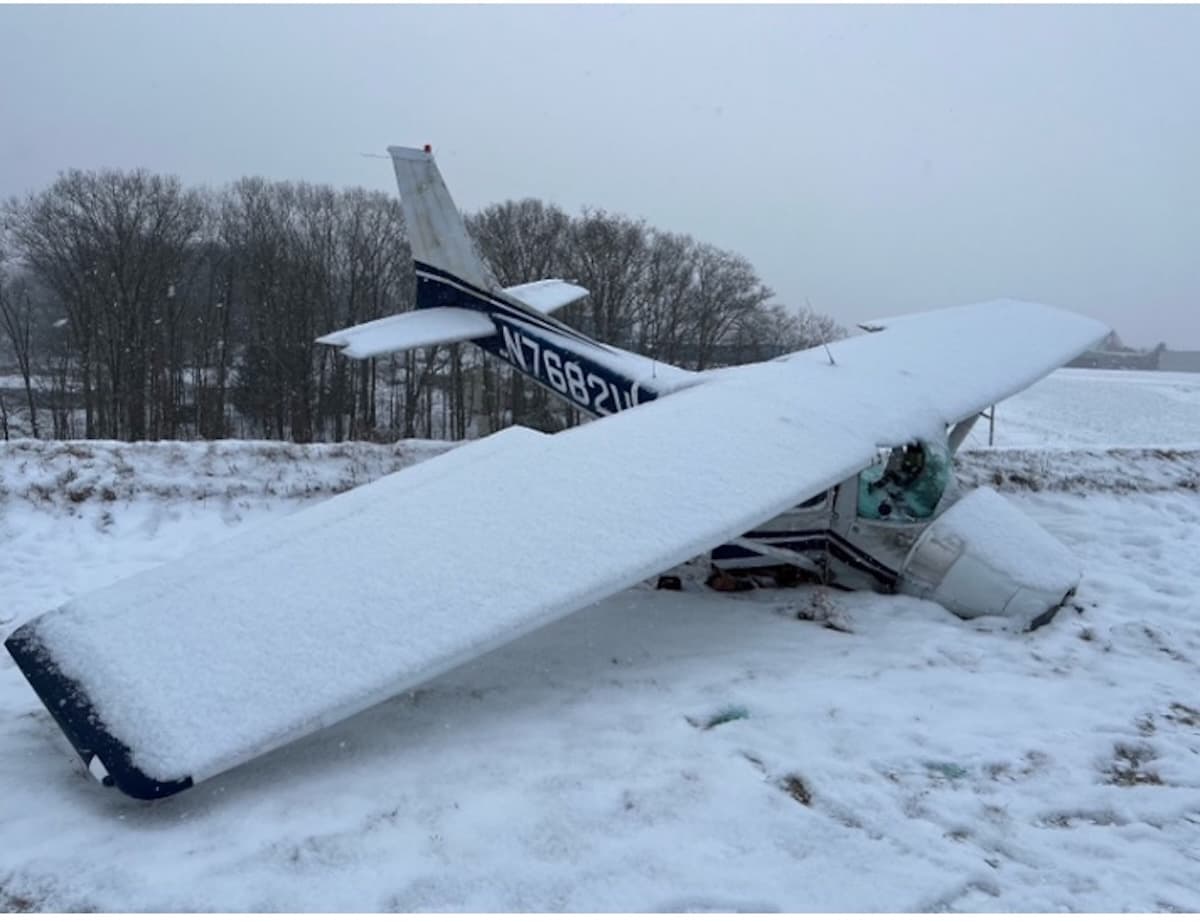
The pilot told investigators that she arrived at Beverly Regional Airport (KBVY) in Massachusetts at 0600 and conducted a preflight inspection of the Cessna 150M with no irregularities found and then began the solo visual flight rules cross-country flight about 0730.
The flight consisted of multiple legs with her final destination planned for Coleman A Young Municipal Airport (KDET), in Detroit, Michigan. The pilot was accompanied by a pet pig that weighed about 50 pounds.
About 90 minutes into the flight, the pilot diverted to Albany International Airport (KALB) in New York, because the airplane’s fuel quantity indicated lower than expected. Upon landing, she fueled the airplane with 13 gallons of fuel, for a total fuel load of 22.5 gallons usable fuel, then resumed the flight to Youngstown/Warren Regional Airport (KYNG) in Ohio, about 320 miles to the west.
According to ADS-B data, she took off from KALB about 1044 eastern standard time. About 3-1/2 hours and 255 nm into the flight, she diverted to Venango Regional Airport (KFKL), in Franklin, Pennsylvania, about 40 nm closer than KYNG.
The pilot reported that the reason for the diversion was to get fuel because the fuel was less expensive than at KYNG. She initiated a descent about 30 nm from the airport and arrived in the airport traffic pattern intending to land on Runway 21. She overshot the final approach and continued to circle over the airport.
During the maneuver, the throttle stopped responding to any input and there was a total loss of engine power. Too low to troubleshoot, she attempted to land the airplane on Taxiway F. Before reaching the intended landing area, the airplane struck a berm to the east of the taxiway and came to rest. The accident occurred at 1448 eastern standard time.
The pilot was seriously injured in the crash.
An FAA inspector examined the airplane after the accident and found that the fuselage was severely buckled from the main landing gear forward.
Both fuel tanks remained intact and, and when drained, contained a total of about 3-1/2 gallons of fuel. According to the airplane’s pilot operating handbook (POH), the unusable fuel was 3-1/2 gallons (the fuel tanks had a 26-gallon capacity, with 22.5 gallons of that fuel usable). The gascolator was empty.
The ADS-B data showed that the airplane’s groundspeed during the en route portion of the flight averaged about 72 kts. Fuel calculations based on the POH performance data indicated that with the pilot’s en route altitude of 4,000 and 5,000 feet msl, a flight track of 255°, and calculated winds that were from 247 at 16 knots, the airplane would have had an endurance of about 3.75 hours with full fuel tanks, however, this endurance was dependent on fuel mixture leaning settings. The data showed that the airplane was airborne about 4 hours.
Probable Cause: The pilots’ inadequate preflight fuel planning and in-flight fuel management, which resulted in a total loss of engine power due to fuel exhaustion.
To download the final report. Click here. This will trigger a PDF download to your device.
This January 2024 accident report is provided by the National Transportation Safety Board. Published as an educational tool, it is intended to help pilots learn from the misfortunes of others.
Should lose her license. I guess 13 gallons in 90 minutes wasn’t any kind of clue?
It would have been better to let the pig fly.
Apparently the pig (Creatively named “Pig”) fared better than the pilot: https://www.thederrick.com/free/pig-involved-in-plane-crash-doing-very-well-at-precious-paws/article_4163cf22-bd07-11ee-9add-cf6cbd7fde89.html
Yeah forget about the pilot… she survived to crash another day… we wanna know about the “PIG”!
How’s the pig?
I hope the pilot recovers fully and quickly.
Sounds like this person had a serious math phobia.
The “disconnect” is not realizing that fuel is TIME, it is not DISTANCE. In cars, we are used to the idea that if it took half a tank of fuel to get to X, therefore it will take another half a tank to get back, and 60 mph on the speedometer equals 60 miles on the ground. In an airplane, it ain’t that way at all . . . I once flew from Daytona to Palm Beach in a 150 with a stiff 40 knot tailwind, fastest ground speed I’ve had so far. On the way back, well that was another story – took a LOT longer, a LOT more fuel, and I swear I was getting passed by kids on bicycles. I used to teach this concept exactly this way in ground school, and most of them got it – now as long as they remember it, we’ll be OK.
I like this part: “The pilot was accompanied by a pet pig that weighed about 50 pounds.”
If that wasn’t in the story, it would’ve been pretty hard to understand the rest of the story—and in fact, the story would’ve been incomprehensible gibberish. So thank heavens that was in there, especially the approximate weight of the pig.
FAA and NTSB types are bureaucrats, not storytellers.
Joe Friday seems exciting in comparison.
One of these days we’re must going to run out of airplanes for ignorant pilots to run out of fuel in. It seems to happen weekly. Inexcusable.
…………AMAZING………
You run out of gas. You should loose your license! Have to take all your check rides over because you missed the class on good judgment! Every month someone draws this card and it’s costing us in insurance premiums. It’s simple math and you can use ForeFlight, if set up correctly.
Instructors we need to do a better job of training pilots.
What happened to the pet pig? Inquiring minds want to know !
Regards/J
ok , with 110 hrs in a C150, you would think that the pilot would be able to calculate fuel needs. If encountering unforecast winds, then adjust the flight plan, in order to not run both tanks empty. [ of usable fuel].
I flew a C152 on my long x/c in 1993, which was 300nm then, and had to refuel at both stops and add 9-10 gallons, because I wouldn’t have the fuel reserves to make it to the next airport.! It took most of a day.