

The pilot reported the purpose of the flight was to build flight time. Before departure from Arlington Municipal Airport (KGKY), in Arlington, Texas, he had 12.75 gallons of 100LL added to the Cessna 172, telling investigators that this resulted in both wing fuel tanks being “topped off.”
The airplane departed from KGKY about 1950, en route to East Texas Regional Airport (KGGG), in Longview, Texas.
Upon arrival at KGGG, the airplane landed, came to a full stop, and proceeded to back-taxi for takeoff. The airplane departed from KGGG about 2120 for the Terrell Municipal Airport (KTRL), in Terrell, Texas.
The airplane landed at KTRL about 2230 and came to a full stop.
The pilot attempted to refuel the airplane but told investigators the fuel pumps were “out of order.”
According to information provided by airport personnel, the airport did not have self-service fuel pumps. All fueling operations were conducted with a fuel truck and a technician. To request after-hours fuel services, pilots could call a telephone number listed on the airport website and in the FAA Chart Supplement information for KTRL. Airport personnel received no after-hours fueling request for the evening of the accident.
The pilot then checked the remaining fuel on board with a fuel measurement stick, and the right wing fuel tank had about 4 gallons of fuel, and the left wing fuel tank had about 12 gallons of fuel. The pilot decided to fly to Mesquite Metro Airport (KHQZ), in Mesquite, Texas, to refuel the airplane instead.
The pilot told investigators that, after starting the engine, he noticed that the airplane had a “rough sounding” or “weak” idle with the throttle at the idle cutoff position, but that the engine sounded stronger when the throttle was advanced.
He then taxied the airplane and performed the pre-takeoff engine run-up using the checklist.
Shortly after taking off from Runway 18, when the airplane was about 400 to 450 feet above ground level, the engine sustained a total loss of power. The pilot successfully restarted the engine, but it immediately lost total power again.
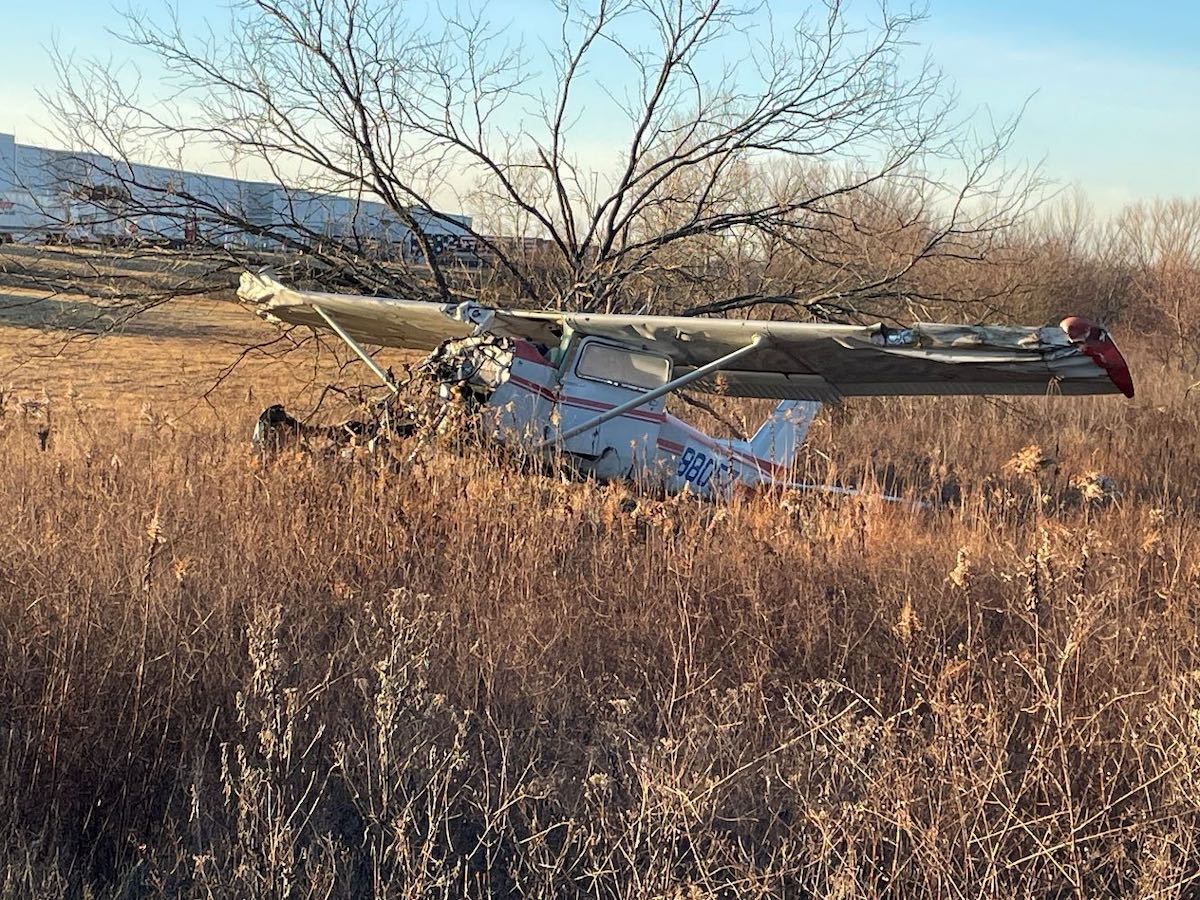
He performed a forced landing to a flat field with trees and the airplane came to rest upright. Both wings and the fuselage sustained substantial damage and the engine was separated from the firewall. The pilot and the passenger sustained minor injuries.
After the forced landing, the pilot reported that he observed a “steady stream” of fuel leaking from the “left side.”
During the wreckage recovery operation, recovery personnel found about 2 gallons of fuel in the left fuel tank and about 0.25 gallon of fuel in the right fuel tank. Both fuel tank caps were found installed, and the fuel selector handle was found in the both position. There were no visible signs of fuel leakage on the airframe or on the ground.
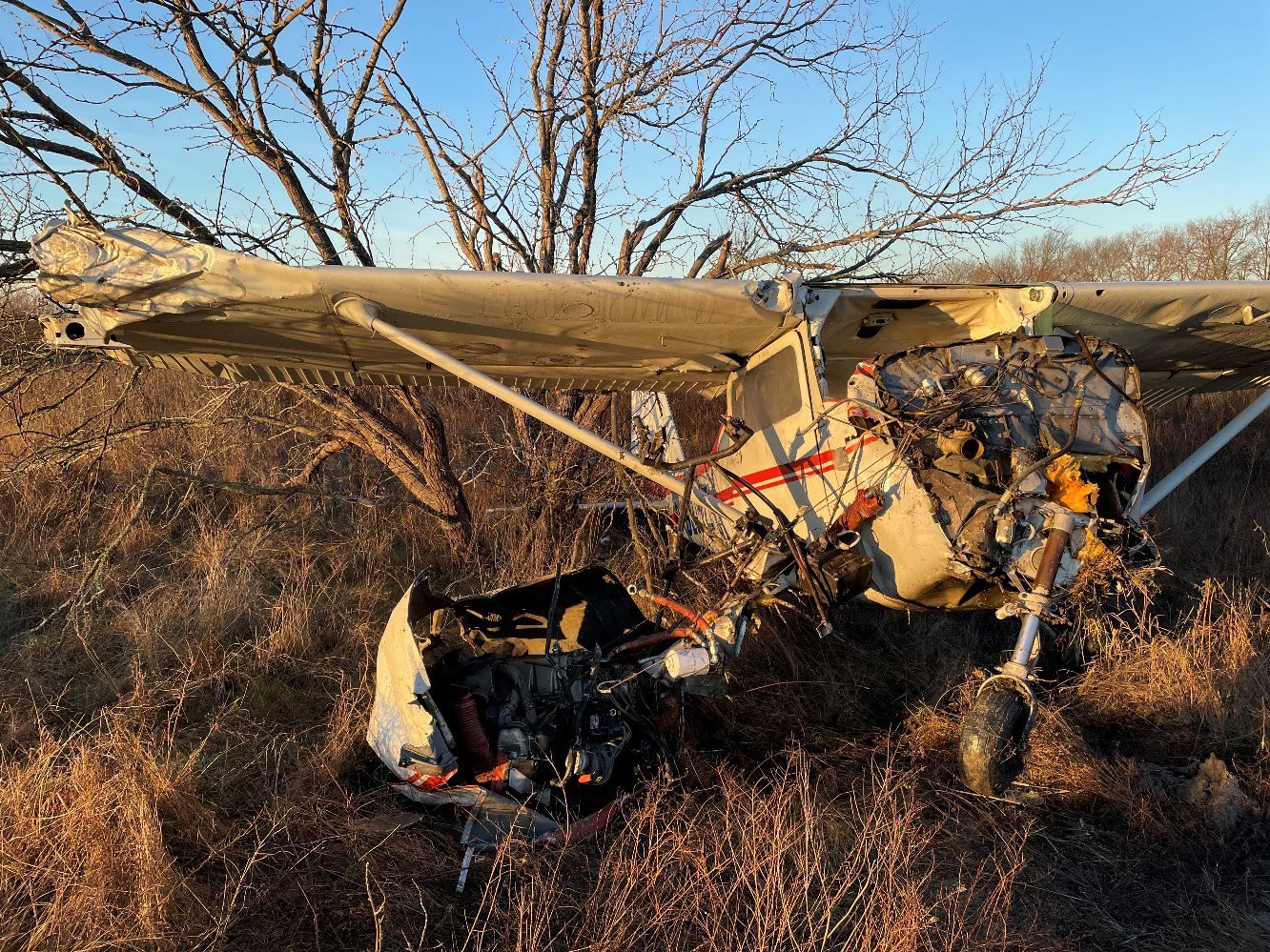
Post-accident examination revealed that the wing fuel tanks were not breached and that the fuel system was intact from the tanks to the fuel strainer inlet line at the firewall.
The airplane was equipped with a fuel selector handle in the cockpit labeled “left,” “right,” “both,” and “off” to enable the pilot to select that the fuel be supplied from the left, right, or both wing fuel tanks, or to turn the fuel supply off. By design, when the fuel selector handle is manipulated by the pilot, it mechanically moves the position of the valve.
Post-accident testing revealed the fuel selector valve moved when the fuel selector handle was manipulated by hand, but the detents in each position were weak. Testing of the fuel selector valve included blowing compressed through the fuel strainer inlet line at the firewall with the fuel selector handle at each of its four positions and observing the resultant air flow behavior at the left and right fuel tank lines.
The testing revealed that the fuel selector valve was installed 180° from the correct orientation. That is, when the fuel selector handle was in the “left” position, the valve was open to the right fuel tank line, and when the handle was in the “right” position, the valve was open to the left tank line. Likewise, when the fuel selector handle was in the “both” position, the valve was off, and when the fuel selector handle was in the “off” position, the valve was open to both wing fuel tank lines.
Based upon a review of the airframe maintenance records, it could not be determined when the fuel selector valve was installed incorrectly. There was no record of any recent work having been performed on the valve.
In response to follow-up questions, the pilot reported that, during the flight from KGGG to KTRL, he had the fuel selector positioned to the left tank for about 50 minutes then moved it to the both position before landing and before the accident takeoff.
Probable Cause: The total loss of engine power during the initial climb due to fuel exhaustion.
To download the final report. Click here. This will trigger a PDF download to your device.
This January 2024 accident report is provided by the National Transportation Safety Board. Published as an educational tool, it is intended to help pilots learn from the misfortunes of others.
The pilot must have had some time in the plane. How would one not know something was wrong when the selector is oneleft and the right tank is going down. ????
BASED ON: NTSB Identification: 193724
Log entry 10-07-2020: Fuel Shutoff valve was REMOVED & RESEALED using Viton O-rings.
Also, don’t forget that HANDLE is NOT directly attached to Selector Valve – there is a LINKAGE in between with U-Joints.
Jerry King
Nothing in the narrative makes sense, logically nor mechanically.
During a 50 hr., 100 hr. or annual inspection, a ground run-up should include placing the fuel selector in the “off” position and noting that the engine will quit.
Item 7 in the airframe maint. records lists the fuel valve being serviced. It is incorrectly listed as the ‘fuel shutoff valve’. the C172H does not have a fuel shutoff , just a fuel selector which has an ‘off’ position.
It should not be possible to have the fuel selector handle in the both position and the fuel valve in the off position, unless someone altered the attachments.
The shaft is keyed to the valve with a roll pin inserted at an angle. it can only be assembled one way.
The selector handle is keyed to the shaft, and should not be able to be installed incorrectly, again, unless someone modified the parts.
I have selected a tank to resolve a fuel imbalance, which can happen if the cap vents don’t open equally. Also, the left tank vent, under the left wing strut, must be accurately positioned so as to not pressurize the left tank or cause a vacuum at the vent tube…
I was advised by an A&P to occasionally check the ‘off’ position, by switching the valve to the ‘off’ position with the engine idling at about 1,000 rpm. The engine should start to quit after about 1 minute. If it continues to run, there is a leakage problem in the valve and needs to be serviced.
Wow! Not sure why one would be switching tanks on a C172 with a ‘both’ position. Certainly running on ‘both’ would have caught this mistake earlier. Maybe even on the ground. Somebody screwed up, for sure!
No mechanic installed the valve wrong…
Someone took or knocked the Fuel Selector Valve Handle off the panel or valve body and reinstalled it 180 degrees out of position…
the handle is keyed to the shaft with 2 flats on the shaft. It can’t be installed 180 degrees.!
Where there’s a will, there’s a way. Somebody got a hammer to make it ‘fit.’