

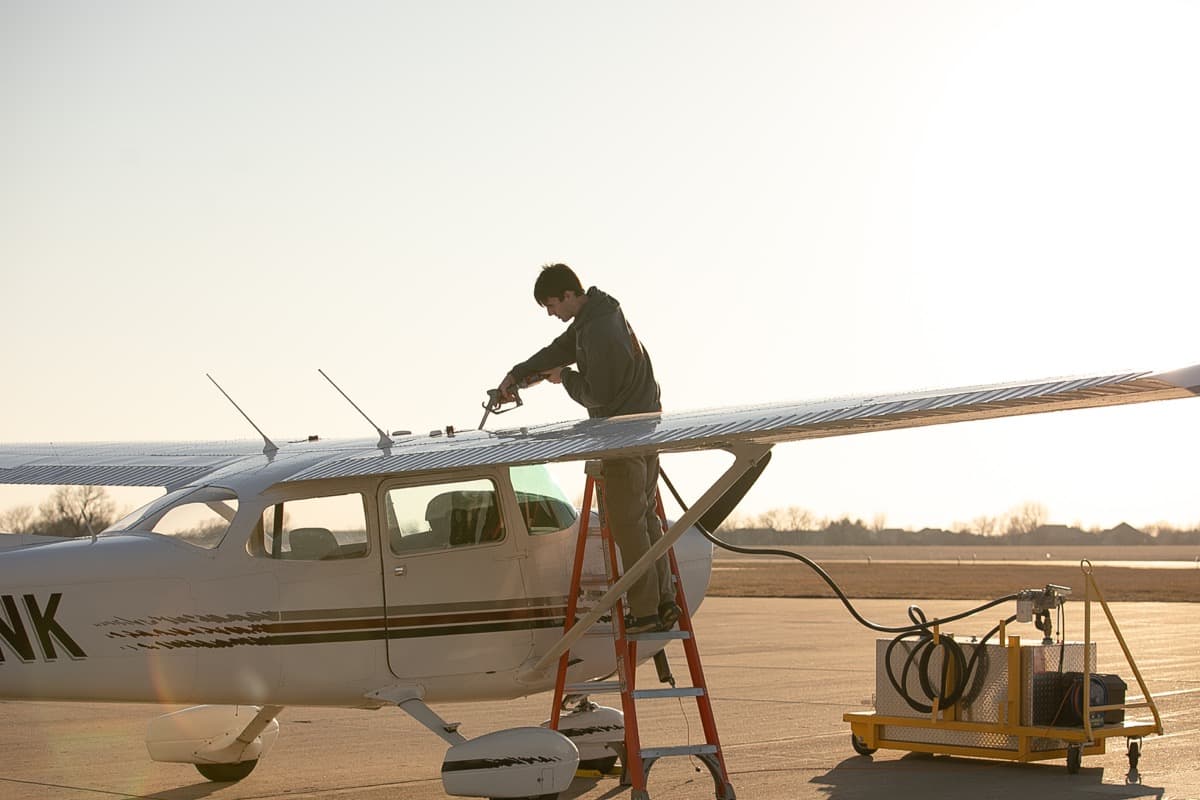
The American Society for Testing and Materials (ASTM) has published its first specification for UL100E, the unleaded aviation fuel co-developed by LyondellBasell and VP Racing.
UL100E is undergoing full scale testing by the FAA and engine and aircraft Original Equipment Manufacturers (OEMs) under the FAA’s Piston Aircraft Fuel Initiative (PAFI) program. These evaluations are expected to be completed by September 2026, according to Lyondell officials.
PAFI is the only collaborative fuel certification program designed and conducted by the FAA and OEMs, requiring an ASTM specification as a condition of fleet authorization, company officials added.
General aviation has been working for years to transition to an unleaded fuel. In 2022, a collaborative industry-government effort to move general aviation to a fleetwide drop-in, lead-free fuel solution no later than 2030 launched with the Eliminate Aviation Gasoline Lead Emissions (EAGLE) initiative.
There are three contenders left standing in the race to an unleaded fuel: General Aviation Modifications Inc. (GAMI), Swift Fuels, and LyondellBasell and VP Racing.
The unleaded fuel from GAMI, known as G100UL — which received approval through the Supplemental Type Certificate process in September 2022 — is now available for sale at some airports.
Swift Fuels received an ASTM International production specification for its 100R unleaded avgas in September 2025.
LyondellBasell and VP Racing’s UL100E, the last remaining test fuel in the PAFI program, recently passed a number of testing milestones, including material compatibility testing by several aircraft OEMs including Van’s Aircraft, Piper Aircraft, Textron Aviation, and Cirrus, as well as engine testing by Lycoming Engines and Continental Aerospace technologies and by the FAA at the William J. Hughes Technical Center for Advanced Aerospace in Atlantic City, New Jersey.
Flight testing on a Lancair Super Legacy equipped with a turbocharged TSIO-550 engine and a Harvard Mk IV warbird equipped with a Pratt & Whitney R-1340-AN-1 Wasp radial engine is ongoing, according to Lyondell officials.
Lycoming recently concluded a 300-hour endurance test on an IO-540-D4A5 engine and met valve seat recession (VSR) performance requirements with UL100E. The FAA Technical Center also finished detonation testing on a Continental IO-550-D engine and identified the optimal timing advance for UL100E in the IO-550-A, -B, -C, -D, -E, -F, and -L series of engines, company officials noted.
Next up for testing at the Technical Center is a turbocharged Lycoming TIO-540-AJ1A, which powers the six-seat Cessna T-206 Turbo Stationair.
Once PAFI testing is complete, the FAA will use the test results to define the eligible fleet and outline any operational and engine modifications required “for a small portion of the fleet” via a Special Airworthiness Information Bulletin (SAIB) for UL100E, company officials added.
Progress on UL100E testing under PAFI can be monitored at FlyEAGLE.org.
For more information: LyondellBasell.com, VPRacingFuels.com
Engine testing performed on Lycoming and Continental equipment. Nothing said about Rotax.
Assuming the testing by the airframe OEMs included materials testing of their fuel systems, including their component sub OEMS …. ??
(( Inquiring minds want to know…. ))
Rotax has so far declined to participate in the PAFI testing program. However, their engines require significantly lower octane fuels than UL100E.
The OEMS did indeed test their components and sub components. Several OEMS assembled multiple fuel-wetted components in a loop system to evaluate their chemical resistance to UL100E. Forgot to mention that Robinson Helicopters also tested their components with UL100E.
They were using the Swift 100R, maybe the Lyondellbasell and VP Racing UL100E will have better luck. I have a newly overhauled engine in a restored airframe. Hate to be a flying guinea pig!
University of North Dakota ran some of this stuff through their engines.
They stopped using it. Was destroying their engines.
Why does it seem like it’s not ready?
I’m pretty sure UND ran Swift Fuels UL94. That is different product from a different vendor. Maybe they have tested other fuels?
Wrong fuel. UND has not tested UL100E and it a passed a VSR durability test at Lycoming.
While the testing seems to be pretty thorough regarding high demand engines, it is woefully inadequate about fuel system materials testing. Compatibility with various O-ring materials, plastics, composites, rubbers, neoprene, and various tank sealants and thread dopes is critical as all of these are found in aircraft fuel systems. Perhaps they are testing this and it gets no press, but a much more in depth article on testing would be really good information to get out there. It’s great if the engine can use the fuel without eating itself, but not of much value if the fuel system fails and can’t deliver the fuel, or suddenly becomes prone to developing leaks. Please, publish more on materials compatibility before the new fuels make their way into the field.
Your are correct: materials compatibility is the most important property of the fuels as it potentially affects 100% of the fleet. The PAFI program has the most extensive materials compatibility testing with over 200 materials tested as well as OEM components.
This is not broadly publicized, but you can follow our progress at Flyeagle.org. As of November of last year, we had completed > 42% of the testing, including composite materials that were tested by Cirrus.
Materials Compatibility
14 Categories/ 214 Materials
Category Completed
OEM Wing Test (5) 100%
O-Rings (5) 100%
Paint Systems (10) 95%
Fuel Bladders (12) 92%
OEM Materials/Parts (50) 87%
Polysulfides (9) 72%
Aircraft Hoses (5) 20%
Non-Metallics (27) 19%
Metallics (32) 9%
Composite Resins (17) 0%
Composites (21) 0%
Distribution System (15) 0%
Fabric Systems (5) 0%
Finished Parts (5) 0%
Total 42%
Unfortunately, the STC process does not require such rigor, as we found out last year in California with another unleaded fuel.