

A new survey shows that the general aviation maintenance industry is under pressure from rising costs, supply chain disruptions, and persistent staffing shortages.
But in the midst of those challenges, the industry is stepping up with resilience, according to the 2026 survey, “The State of the GA Maintenance Industry” by TBX, a company that provides software to general aviation maintenance shops to track workflow, regulatory compliance, and more.
Drawing on more than 600 responses from maintenance shops and providers across the United States, the report captures a real-time view of the challenges, opportunities, and operational realities shaping GA maintenance today, according to TBX officials.
Unlike industry studies that often focus on airlines or business aviation, the TBX Annual Survey centers on the maintenance professionals who keep general aviation flying — A&Ps, IAs, shop owners, and flight schools.
“General aviation is often overlooked, even though it’s the foundation of the entire aviation ecosystem,” said Jon McLaughlin, Chief Executive Officer of TBX. “After spending the past year visiting hundreds of maintenance shops, we wanted to flip the script and listen directly to the people doing the work. This survey reflects the real maintenance perspective — what’s working, what’s broken, and what’s holding the industry back right now.”
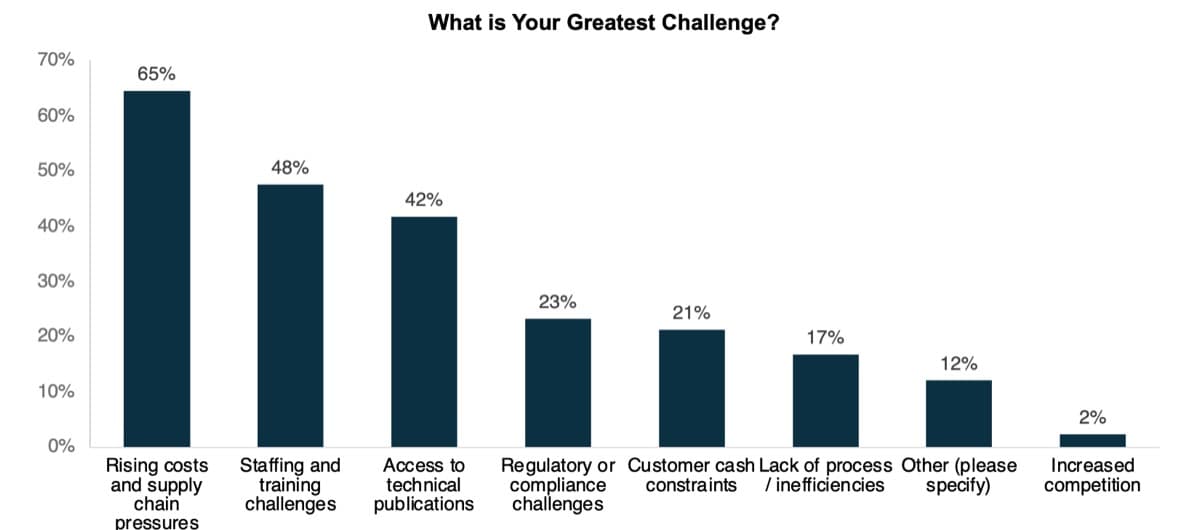
Key findings from the 2026 survey include:
- Rising costs and supply chain pressure dominate the landscape: Nearly two-thirds of respondents cited rising costs and supply chain issues as their biggest challenge, followed closely by staffing and training shortages.
- Staffing remains the single most critical constraint to growth: When asked what would most improve their business prospects, finding and retaining skilled technicians far outpaced any other factor — including insurance costs, customers, or facilities.
- On the flip side, maintenance providers noted that operational fundamentals are working, from people, to the processes and compliance. Shops reported a strongest success in maintenance tracking, compliance and records, shop processes, and team support, highlighting operational maturity despite external pressures.
- Confidence is mixed: While 63% of the respondents feel positive about their own business outlook, fewer than half expressed optimism about the future of general aviation overall.
Average Shop Rates
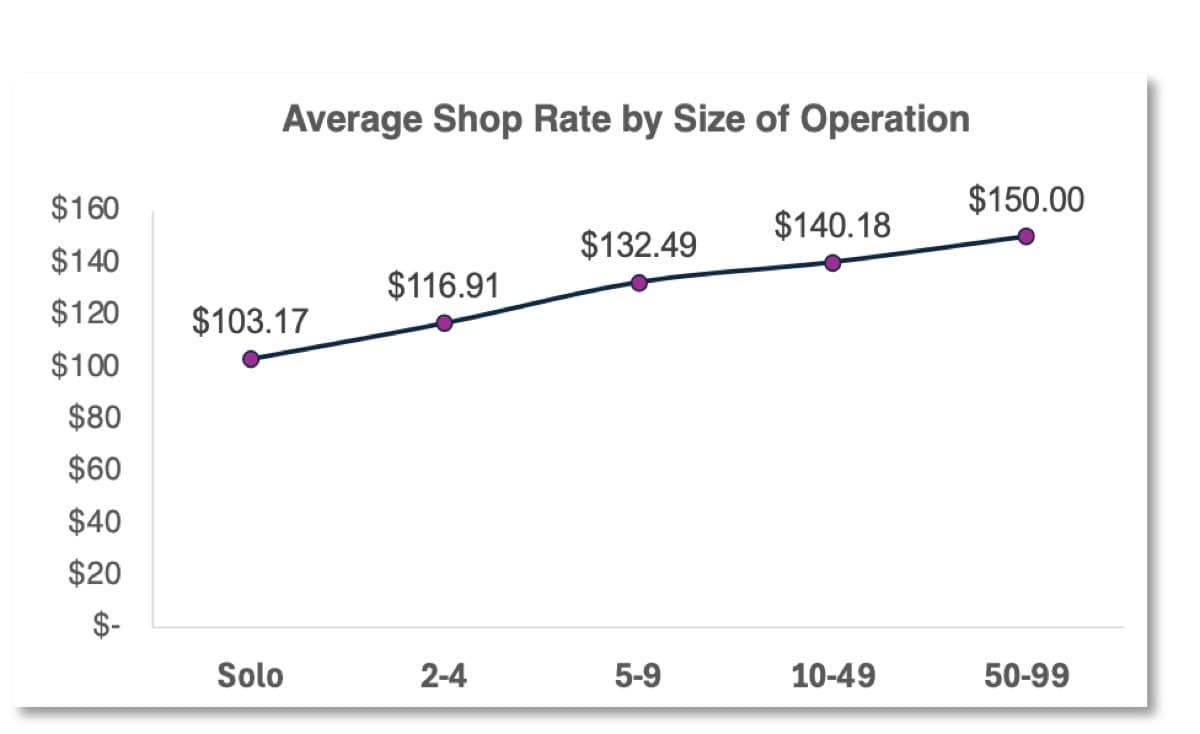
Nearly all of the survey respondents shared their shop rates, which tended to increase with the size of the operation (by the number of A&Ps), as well as geographic location. The average rate for a solo shop was $103 an hour, increasing to $150 an hour for larger shop operations with larger overhead.
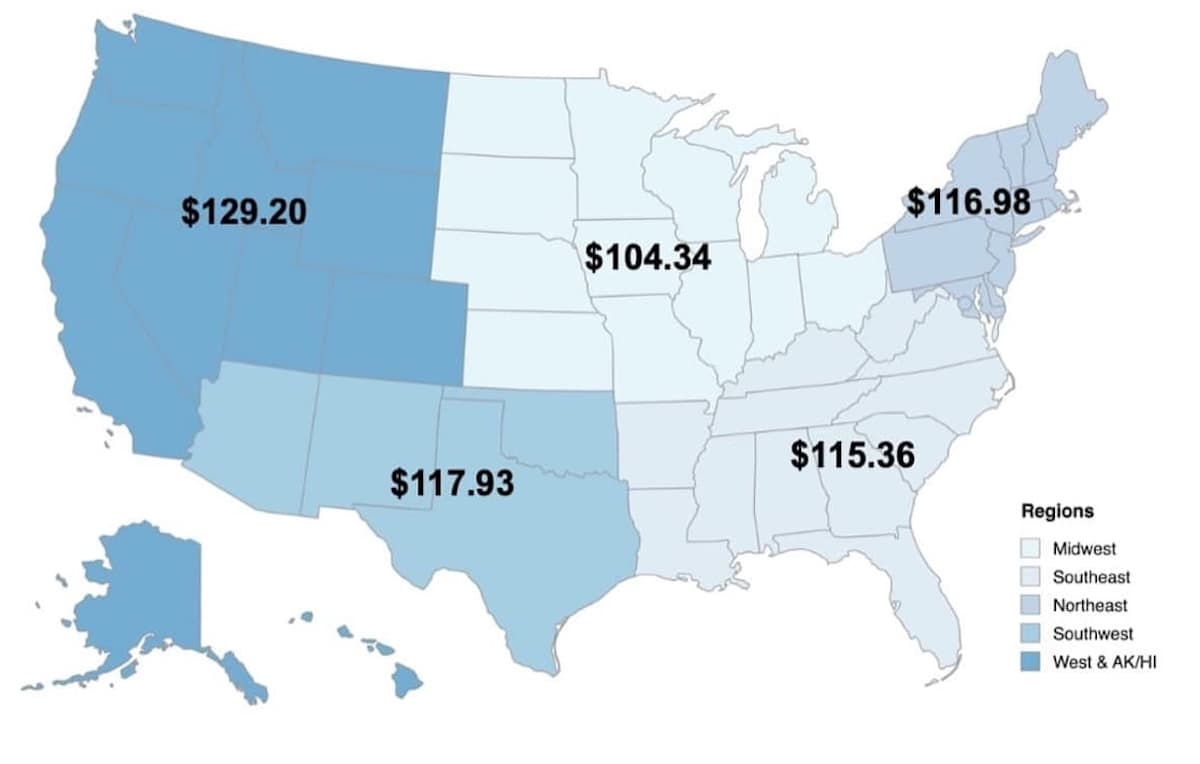
Region was another key factor in determining shop rate, although not the deciding factor, according to TBX officials.
“Although average rates tended to increase in certain regions, we were able to find higher and lower rates pretty much everywhere,” they noted.
The highest average rate was in the western part of the country at $129.20, while the lowest average rate was in the midwest at $104.34.
Pride in the Profession
The survey found that 92% of respondents said they were proud to be a part of their profession — 53% “extremely agreed,” with 39% agreeing. Only 7% were either neutral (6%) or disagreed (1%).
“As the best mechanics, inspectors, and operators often say, ‘it takes a village,’” the survey noted. “This is a strong community of people willing to put in the hours to achieve technical mastery. This strong pride in the profession is a strength, driving increased quality work, a culture of excellence, and the ability to withstand the never-ending challenges facing the maintenance community.”
“Without the maintenance community, pilots — and the broader GA industry — wouldn’t get very far,” McLaughlin said. “Our goal is to use this data to help spark better conversations and uncover opportunities for collaboration across OEMs, suppliers, vendors, operators, and trade associations to improve the long-term outlook for GA maintenance.”
The full TBX Annual Survey 2026 report, including detailed benchmarks and analysis, is available at Airworthy.com.

Given all the stories on this news service about incompetent repairs causing wrecks, I’d like to hear about decertification of incompetent techs and FBO management.
Regards/J
It’s no wonder there’s a chronic shortage of A&P mechanics. In most regions, the shop rate for automotive and boat repair already exceeds the average aircraft shop rate, often by a wide margin, despite nowhere near the same regulatory burden, documentation requirements, or liability exposure.
Auto and marine mechanics are not signing a logbook that legally declares a vehicle “roadworthy” or “seaworthy,” putting their certificate, livelihood, and personal liability on the line every time. We’re asking highly trained, licensed professionals to accept lower pay, higher responsibility, and more risk, and then act surprised when the workforce pipeline dries up. As noted in the article, GA maintenance is largely being carried by pride in the profession. Without this pride, it’s hard to imagine how much more desperate the situation would be.
I see according to the new analysis high tech analysis nothing changed in aviation, or automotive, since 1960.
Definitely need a simple implementation process for owner repair. Many owners are far more knowledgeable, and in many areas there’s a troublesome void of service providers.
Another report that indicates to me that there is value in allowing a pilot /owner to train for a limited A&P, to allow him to do work and log it on his aircraft only.
It could be a subset of the 3 A&P tests, specific to the aircraft flown…ie, all metal, single engine, normally aspirated, fixed gear.
The pilot would have to have a number of years as owner/ pilot, and have done some number of hours work under the supervision of an A&P…