

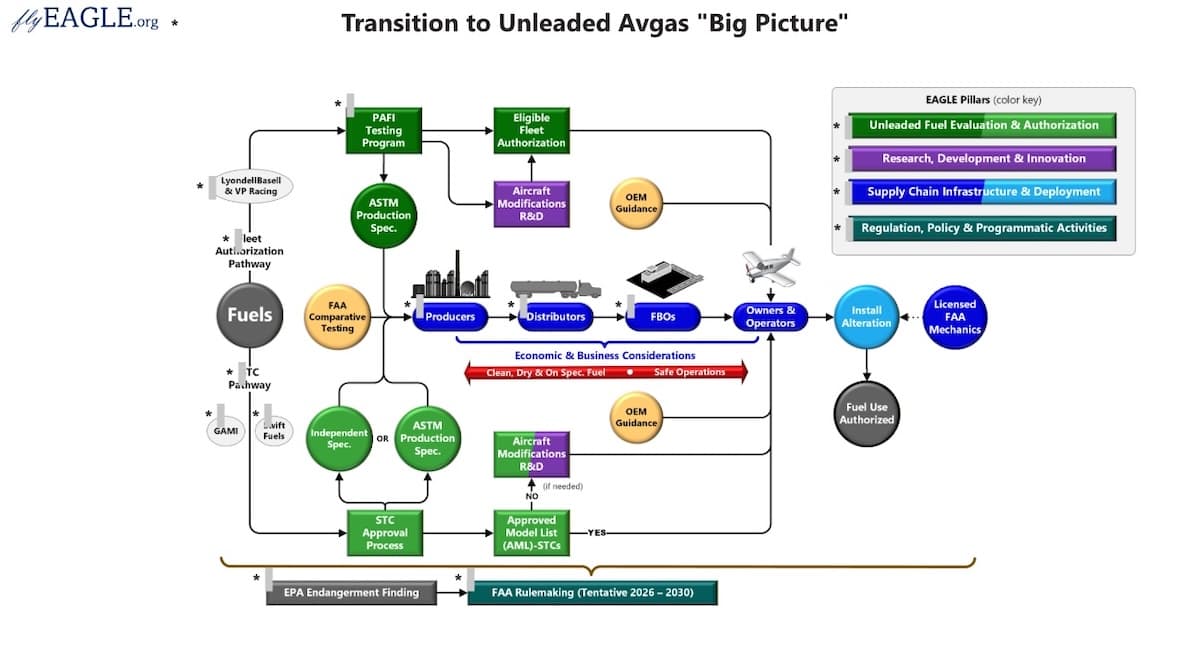
The EAGLE initiative — Eliminate Aviation Gasoline Lead Emissions — has updated its “Big Picture” flow chart, adding interactive links and pop-up narratives.
This gives those interested the “opportunity to drill into additional information about the transition to unleaded avgas,” according to EAGLE officials.
The chart shows how the transition to unleaded avgas moves from fuel development through testing, authorization/approval pathways, production, distribution, and ultimately aircraft-level authorized use.
Links and pop-up narratives include:
- EAGLE pillar objectives
- EPA Endangerment Finding and EPA/FAA Rulemaking process
- Fuel developer websites
- Piston Aviation Fuels Initiative (PAFI) metrics
- Statistics about the airports, piston fleet, logistics, etc.
For more information: FlyEAGLE.org
University of North Dakota stopped using this stuff.
Said it burnt up their engines. Now they would know how to maintain their engines properly!
So I asked the Swift guys how many hours they had on one of their engines. Wait for it, wait for it, a massive 400 hours. Why do I think this stuff is going to destroy our engines while they figure things out?
Does that seem like a lot or not enough?
The EAGLE initiative probably assures there will be no drop in alternative. EAGLE’s 2030 date means nothing as far as laws go, There will be no legal requirement to force an unleaded fuel into service. My brother asked the AOPA president when he was at Oshkosh, what if no unleaded fuel meets the requirements as a drop in fuel. The AOPA president said nothing will happen or change and the search will just continue like it always has been.
There is however, a California law that ends leaded Aviation fuel after 2030.
Must admit I’m a lot jaded about the transition to UL AVGAS. Been hearing about it, seeing presentations, and reading about it for years. I can’t devote any more brain cells to this until the new fuel actually shows up at airports where I fly. Thanks to all working to make this happen. Most importantly, it must be a drop-in replacement for current 100LL, have NO adverse affect on aircraft fuel systems, engines. or structures, and be reasonably affordable. Good luck!
I certainly understand why you and many pilots are jaded about the transition to unleaded avgas. You have been told repeatedly that a drop-in solution was right around the corner, only to have Lucy yank the football away from you. Some have even assured you that their STC’d fuel was the solution. But you may want to still devote a couple braincells to monitoring the progress of the PAFI fuel, UL100E. Unlike the STC’d fuels, testing is designed and conducted by the FAA and OEMs, not the fuel supplier. PAFI also requires an ASTM standard for the fuel which is a prerequisite for the Industry, especially distributors who must ensure fuel quality to the wing tip using an Industry approved standard.
Why should you care? Because there may be several 100 octane unleaded fuels offered at airports in the future and they will NOT be interchangeable. Some airports in California jumped on the first fuel available and have discovered that it has material compatibility issues. The NATA has also made it clear that its members will insist on the fuel being sold to an ASTM or similar Industry consensus standard, something the supplier refuses to commit to. Another candidate still does not have an AML-STC for the entire fleet. So it has become clear that no unleaded fuel will be a drop-in replacement for 100LL, unless you think that repainting your plane every other year and replacing your hoses, O-rings, and gaskets are an acceptable part of routine maintenance.
So, at some point, you will have to decide which fuel to put in your plane. Given that none of the fuel suppliers will accept liability for another supplier’s fuel, and may require you to overhaul your aircraft before switching fuels, it is important that you choose carefully. My suggestion is to keep using 100LL until a viable unleaded option is commercially available, and to monitor progress at FlyEagle.org in the interim. Only at the end of this process will you be able to reasonably assess which of the three 100-octane unleaded fuels is the best option for you and your aircraft.