

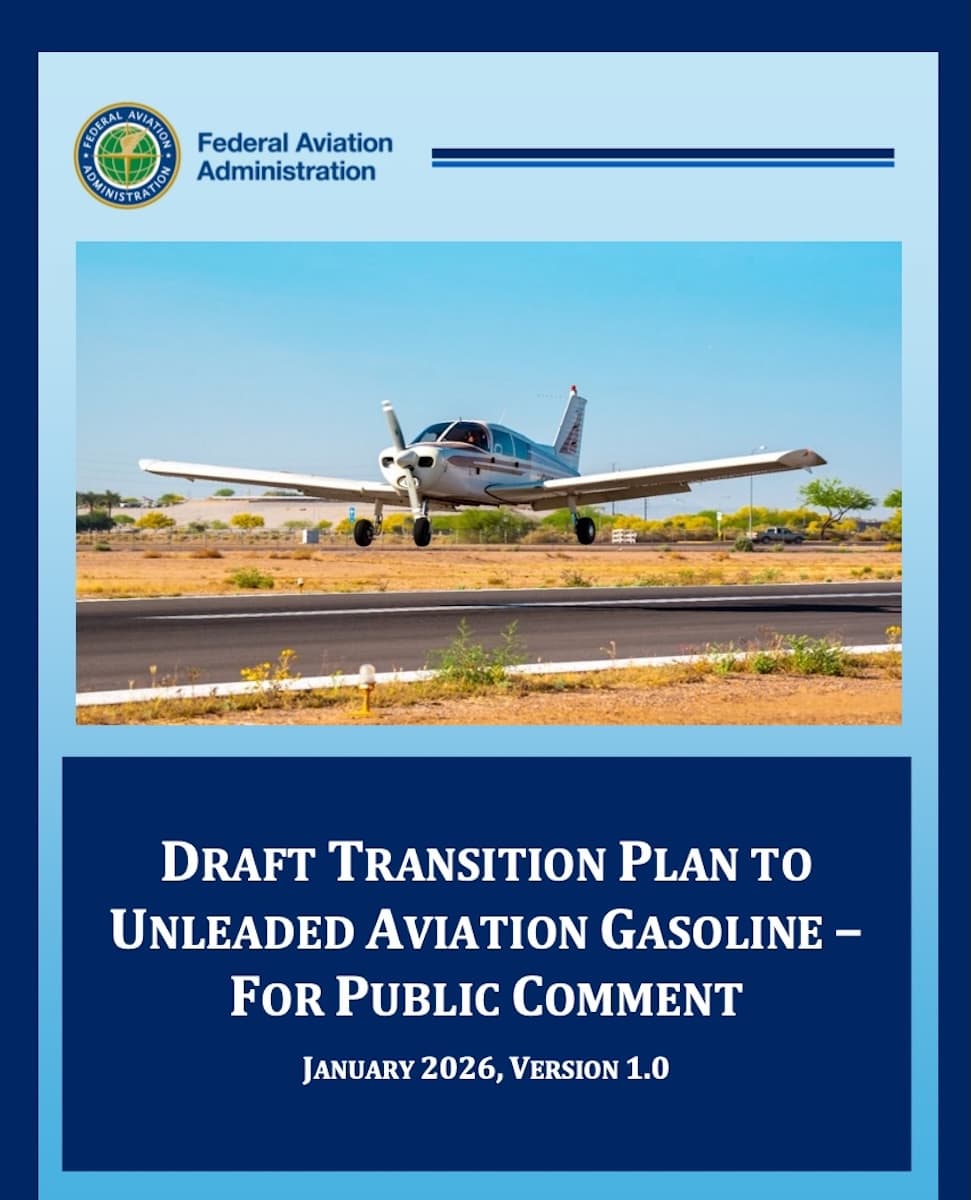
With the release Jan. 12, 2026, of the FAA’s draft Transition Plan to Unleaded Aviation Gasoline for public comment, general aviation’s transition from 100LL to unleaded avgas has moved from theoretical to operational.
Pilots, aircraft owners, and others interested in general aviation are asked to review and comment on the FAA’s draft plan, which highlights many of the technical, regulatory, and logistical challenges in moving from 100LL to unleaded fuel.
With the FAA and the government-industry collaboration known as Eliminate Aviation Gasoline Lead Emissions (EAGLE) initiative targeting a full national phase-out by Dec. 31, 2030, pilots and owners need to understand how the transition to unleaded fuel will affect them.
The Four Phases of Transition
The plan is structured into four phases.
The first phase will address two prerequisites to the transition: What are the approved fuels and how do the fuels compare? Three candidate fuels are in the mix.
“Recognizing that the market will select the fuel(s) and that there are additional factors, beyond an FAA approval, that affect the market, Phase 1 also includes comparison testing and reporting on the results of such testing to facilitate more informed decision making,” the plan outlines.
The second phase will provide time for the market to gain experience with the various unleaded fuels.
“Lessons learned from early market experience can be used to facilitate further market integration during the second phase of transition when more airports and aircraft are expected to adopt unleaded fuels,” according to the plan.
During phase three, all aircraft and airports — except those in Alaska — will be expected to switch to unleaded fuels.
Due to its unique challenges, the Alaska transition — phase four — will begin in 2032.
The Three Primary Contenders
As of early 2026, three high-octane fuels are at various stages of deployment:
GAMI G100UL: Currently approved via an Approved Model List (AML) STC for nearly all spark-ignition engines and airframes in the FAA database. It is already for sale at a small number of airports in California, Oklahoma, and Mississippi.
Swift Fuels 100R: Expanding through the STC process, Swift expects to have 100R available at more than 300 airports by 2027. It recently received an ASTM international production specification, a critical hurdle for widespread distributor acceptance.
LyondellBasell/VP Racing UL100E: This is the only fuel undergoing full-scale testing via the FAA Fleet Authorization pathway known as the Piston Aviation Fuels Initiative (PAFI). Fleet authorization — which would not require individual STCs — is anticipated for Spring 2027.
Pilot Alert: Don’t Mix The Fuels
The most critical safety concern for pilots is misfueling by mixing the fuels. While the new unleaded fuels are designed to be mixed with 100LL, they are not yet cleared to be mixed with one another, the draft plan notes.
The FAA expects to complete its comparative intermixability testing later this year.
To help prevent fueling errors, fuels has been assigned distinct colors:
- 100LL: Blue
- UL94: Purple
- 100R: Green
- G100UL: Yellow-green to blue-green
- UL100E: Orange (pending)
What We’ve Learned So Far
Early market experience has revealed that high-octane unleaded fuels behave differently than 100LL.
- Sealants and O-Rings: Reports have surfaced regarding G100UL potentially affecting certain nitrile O-rings and fuel tank sealants in specific airframes like Cirrus. Owners are encouraged to replace older nitrile components with silicone or fluoropolymer (Viton) where practical.
- The “Cleaning” Effect: Some unleaded formulations act as stronger solvents than 100LL. This can loosen old deposits in your fuel system, potentially leading to stained paint or clogged filters during the initial transition.
- On the positive side, pilots using unleaded fuels should expect significantly cleaner spark plugs and potentially extended oil change intervals due to the absence of lead sludge.
What Aircraft Owners Should Do Now
Check Your Eligibility: Verify if your aircraft requires a paid STC (like GAMI or Swift) or if it will be covered under the FAA’s eventual Fleet Authorization.
Monitor Your Local FBO: Under the 2024 FAA Reauthorization Act, airports cannot ban 100LL before Dec. 31, 2030, unless a “certified replacement” is widely available at that specific location.
Prepare for Alterations: Even “drop-in” replacements will require a placard change at the fuel port and a supplement added to your Airplane Flight Manual (AFM).
Read the Draft Plan and Make Your Voice Heard: You can see the full draft plan at FAA.gov/Aircraft/Draft_docs/pPubs. Comments are due by March 13, 2026.
Lead Additives cost 45 cents per gallon .
When pilots start dying from engine failures, We will all use this method of survival.
Over the next 20 years we unfortunately are likely to see the fluorescent Blue and Green Hair types try to ruin all that makes America great.
People that create jobs use aircraft… Ones that use strange hair color create problems.
I was curious the other day about how much Lead enters the environment every day and what the sources are. Google it yourself, seems to be a lot of sources are ahead of 100LL. That does not mean we can’t eliminate (or maybe just reduce) the amount of Lead in 100LL. In fact you may want to switch what pans you cook your meals with as some contain Lead in them.
We should spend our money where we get the largest results, I am afraid 100LL is not on top of the list.
Nothing here mentioned the need for hardened valve seats that my mechanic told me will be necessary when 100LL goes away. He further said it will be less expensive to replace the whole cylinder with an estimated cost in today’s dollars for my Cessna 182 of $20,000 to $30,000.
Avgas is unlikely to moved from theoretical to operational simply because there is no mandate that exists in the EAGLE doctrine. With the current administrations lack of concern for the environment and human health it is unlikely any mandate will be forthcoming. The only mandates that may occur would come out of California, which currently have a drop dead date at the end of 2030 for leaded fuel.
To eliminate general aviation in California is the unicorn riding, inbreads of Sacramentos dreams. To own and use your own airplane, dare I say, “flys” in the face of their “15 minute city” fantasy.