

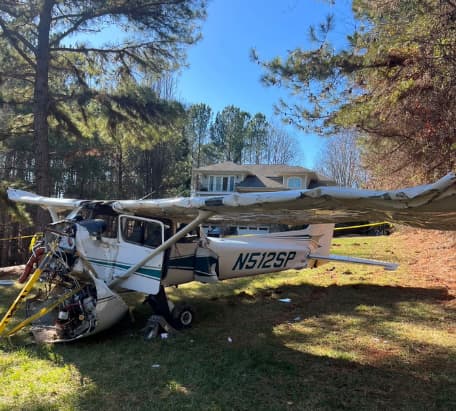
The pilot was attempting to land the Cessna 172 on a 3,170-foot-long by 40-foot-wide runway in Mooresville, N.C. He told investigators that while on final approach he encountered a “heavy gusty crosswind.”
After passing a tree line and realizing that he would not be able to land, he attempted a go-around.
The last thing the pilot remembered was the airplane hitting the trees. The airplane received substantial damage to both wings, the fuselage, and its empennage structure, while the pilot was seriously injured in the crash.
Two witnesses to the accident stated that shortly after initiating the go-around, the airplane turned to the left, missing the trees lining the runway, but then hit trees approximately 500 feet left of the runway centerline within the residential area of the airpark community.
The witnesses also noted that the airplane started the go-around attempt near the midpoint of the runway.
The pilot stated that there were no pre-impact mechanical malfunctions or failures with the airplane that would have precluded normal operation.
Probable Cause: The pilot’s failure to maintain control of the airplane during a go-around in gusting crosswind conditions.
To download the final report. Click here. This will trigger a PDF download to your device.
This January 2024 accident report is provided by the National Transportation Safety Board. Published as an educational tool, it is intended to help pilots learn from the misfortunes of others.
It’s challenging to land on a 40′ wide runway with calm winds. It gets really tough when you try to land on one with a strong, gusting crosswind.
Lake Norman’s runway is 14-32; the newby pilot attempted to land on 14 after he estimated a “heavy crosswind coming from the West, from the 250-255 direction.” That would’ve added a nasty quartering tailwind component…?
Credible pilot witnesses estimated the winds at “220@13-15G22-25 to 230@12-
14G20-25″…
They also reported he did initiate his go-around, maybe too aggressively, and appeared to encounter the resulting ‘left-turning tendencies’…not that he intentionally initiated a left turn as part of his go-around maneuvering.
Regardless, the right crosswind/possibly quartering tailwind expedited his left-hand turn into the trees. Hopefully he eventually recovered enough to recall the details.
Nose too high, probably full flaps, turned left and got gust rolled by exceeding crosswind component and turning near stall speed. Load factor/ bank angle/low speed fail. The plane did what a wind-savvy pilot would expect it to do.
May have been other circumstances involved, but it follows the same pattern as many other reported go-around accidents and ones caught on videos – stall-spin to the left, apparently from too much pitch and too little right rudder when power is applied. If the go-around is started from near or on the runway, it probably has full flaps extended and possibly very low speed, greatly limiting how much the nose can be raised if at all. At a safe altitude, some practice climbing with full flaps will demonstrate the proper initial pitch attitude that is needed and the balked landing procedure of the POH gives the airspeeds that should be maintained for best climb performance.
This accident is the fault of our flight instructors being sloppy. By letting the student land any place on the runway. Very few pilots can land on the center line and on the numbers.
They are just happy to be on the runway. Sloppy flying leads to accidents.