

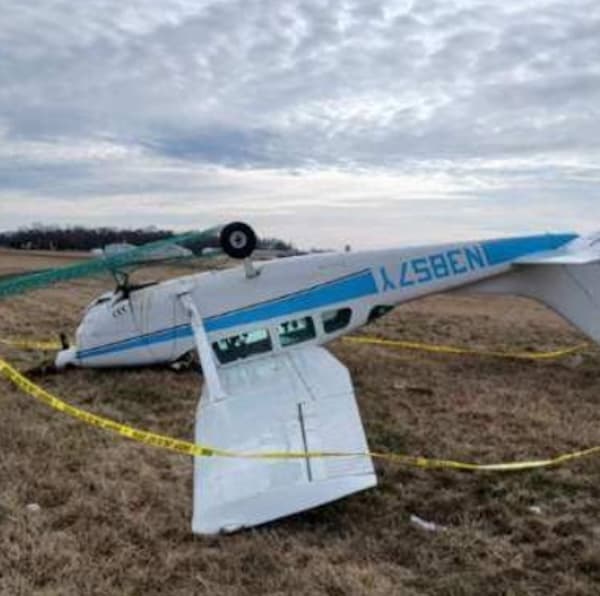
The flight instructor was acting as the safety pilot for the pilot under instruction, who was working toward an instrument rating. While in cruise flight at 6,500 feet mean sea level, the pilot heard a “loud bang,” the Cessna 210D started to “shake violently,” and oil began to accumulate on the windscreen.
The CFI took control of the plane and diverted to Henry County Airport (KPHT) in Paris, Tennessee.
The engine subsequently lost all power, and during the forced landing the airplane’s main landing gear hit the airport perimeter fence. The airplane nosed over, which resulted in substantial damage to both wings and the engine firewall.
A post-accident examination of the engine revealed a 5-inch diameter hole at the top of the crankcase between the Nos. 3 and 4 cylinders. Two quarts of oil were observed in the oil reservoir.
Cylinder Nos. 5 and 6 were removed to gain better access to cylinder Nos. 3 and 4; damage to the cylinder skirts of cylinder Nos. 3 and 4 prevented their removal. The connecting rod remained installed to the piston pin and crankshaft in cylinder No. 3; however, the connecting rod for cylinder No. 4 was not present, and the connecting rod journal displayed thermal discoloration and metal transfer. Damage to the bottom of the piston was observed through the hole in the crankcase.
The No. 4 connecting rod bolts and cap were recovered in two pieces from the oil sump along with multiple bearing remnants, pieces of the No. 4 piston and piston ring, and portions of both connecting rod bolts from the No. 4 connecting rod.
A review of the airplane’s maintenance logbooks revealed that the last engine overhaul was completed 34 years before the accident on July 29, 1990. Additionally, cylinder Nos. 1, 3, and 5 were replaced on May 1, 2021, and cylinder Nos. 2, 4, and 6 were replaced Feb. 24, 2022.
Probable Cause: The disruption of torque to the No 4 connecting rod journals, which resulted in a spun bearing and the subsequent total loss of engine power.
To download the final report. Click here. This will trigger a PDF download to your device.
This January 2024 accident report is provided by the National Transportation Safety Board. Published as an educational tool, it is intended to help pilots learn from the misfortunes of others.
At 6500 feet, I should think after pitching for best glide, there should have been oodles of time for a leisurely landing on the runway.
So, 1,100 + hours on the new cylinders, and the #4 connecting rod spins the bearing and cap blots fail .??
It would be interesting to look at the #3 rod bearing, to see if it showed heat stress, from oil starvation, causing #4 to fail.
The #4 cylinder replacement could have caused some damage to the rod bearing, if some side loads were applied during the new piston going on the rod.??