

That’s what researchers at Embry-Riddle Aeronautical University set out to do with a new bibliometric study that analyzes more than 1,600 aviation-related studies published between 1937 and 2023.
A bibliometric study uses quantitative methods, such as statistics and math, to analyze academic literature, revealing patterns in research and discovering emerging topics.
“When I realized there hadn’t been any bibliometric study of aviation safety and aviation human factors, I saw an opportunity to fill that gap and contribute something meaningful,” said Safety Science graduate Elizabeth Amorkor Okine, who led the study. “It’s a great feeling to know that something you worked so hard on will be used by others in the field.”
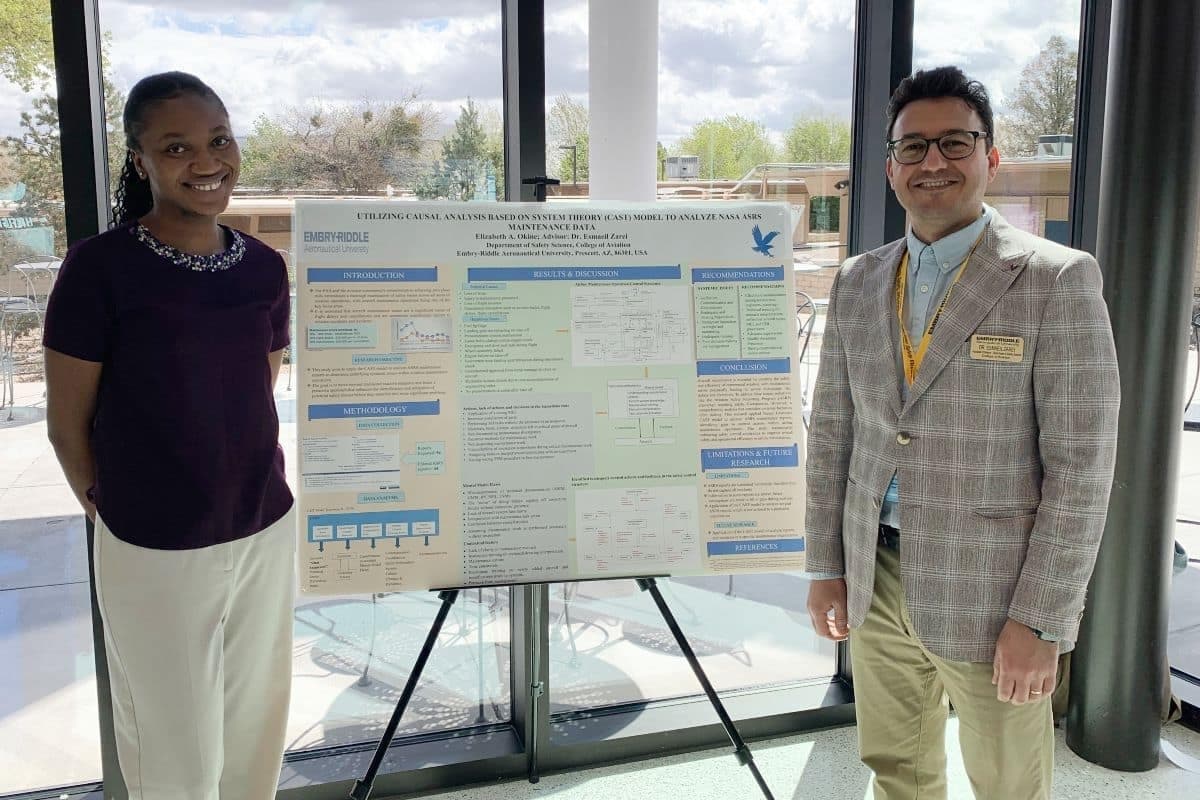
Collaborating with her mentors, Embry-Riddle faculty members Dr. Esmaeil Zarei and Professor Brian Roggow, Okine discovered that human error remains the leading cause of aviation accidents, responsible for nearly 75% of all general aviation accidents in recent years.
The most studied human factors include fatigue, situational awareness, workload, ergonomics, automation and stress, according to the researchers.
“Despite remarkable technological progress, human error continues to dominate as the leading cause of aviation accidents,” said Zarei. “This study reinforces the urgency of moving beyond a narrow focus on individual error toward systemic, human-centered solutions.”
The new research cites a 2013 study that found that the average annual costs associated with general aviation accidents are $1.64 billion using the “human capital approach” and $4.64 billion using the “willingness to pay approach.”
The researchers also compared aviation research with other complex, safety-driven industries, such as nuclear energy and chemical processing. They found aviation still lags behind in building comprehensive databases and predictive models to prevent human error.
The paper goes on to highlight three emerging branches of aviation safety:
- The use of artificial intelligence and machine learning to anticipate potential risks before they occur.
- The employment of resilience engineering to identify how aircraft systems continue to perform under stress.
- The need for a systems-thinking approach that looks at a holistic view of safety, connecting the people, procedures, and technology that shape it.
As aviation enters an era of advanced propulsion systems, autonomous systems and new types of aircraft, understanding the human element will be more important than ever, according to the Embry-Riddle researchers.
For Okine, who now works for Allegiant Air as an internal evaluation program evaluator, the project reinforced her commitment to continuous improvement.

“This experience taught me that impactful research takes patience and collaboration,” she said. “I definitely plan to keep contributing to research, especially in areas that connect human reliability, safety management and data analytics.”
The study, “Exploring the intellectual insights in aviation safety research: A systematic literature and bibliometric review” was published in 2025 in the Journal of Safety Science and Resilience and in Safety Science.
For more information: ERAU.edu
Leave a Reply