

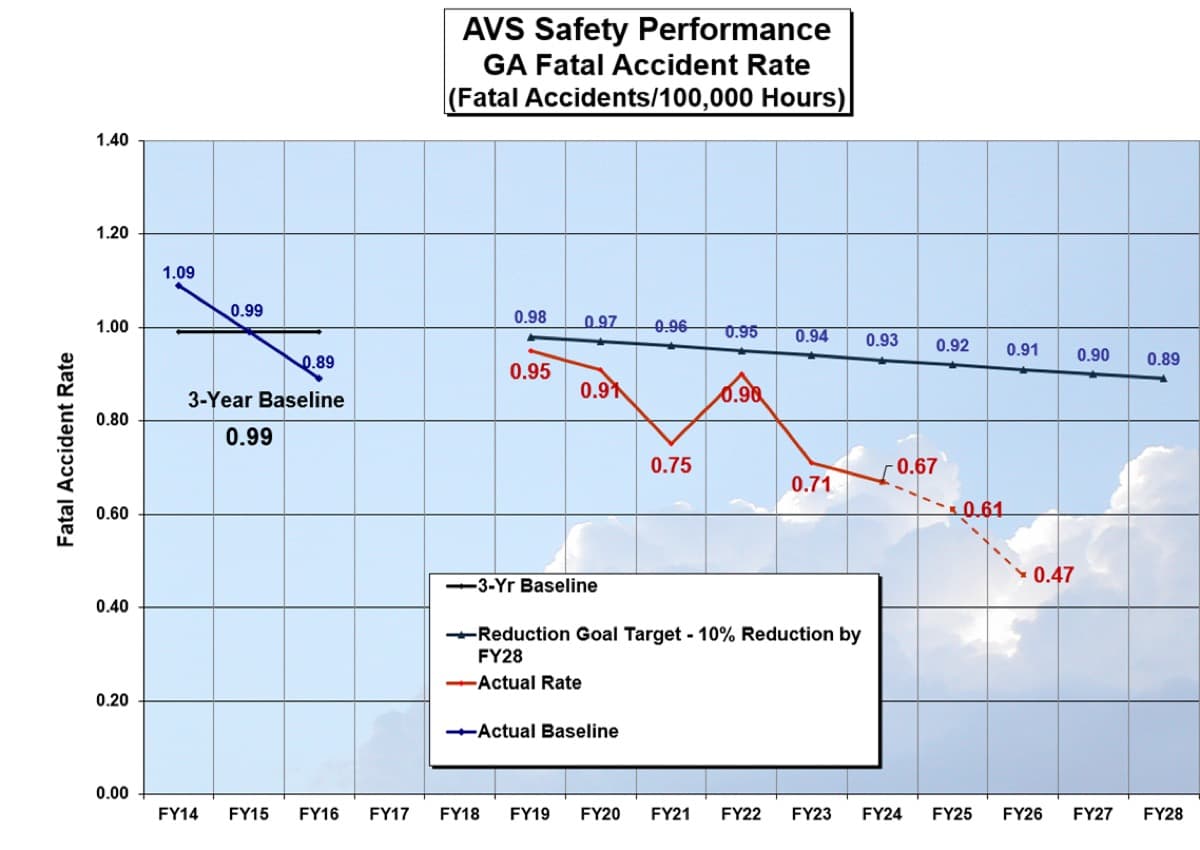
The latest edition of the General Aviation Joint Safety Committee’s (GAJSC) quarterly newsletter, FlySafe Flyer, includes a look at the general aviation fatal accident rate so far in fiscal year 2026.
The estimated GA fatal accident rate is at 0.47 accidents per 100,000 flight hours (as of Jan. 15, 2026), “well below the yearly target of 0.91,” according to officials.
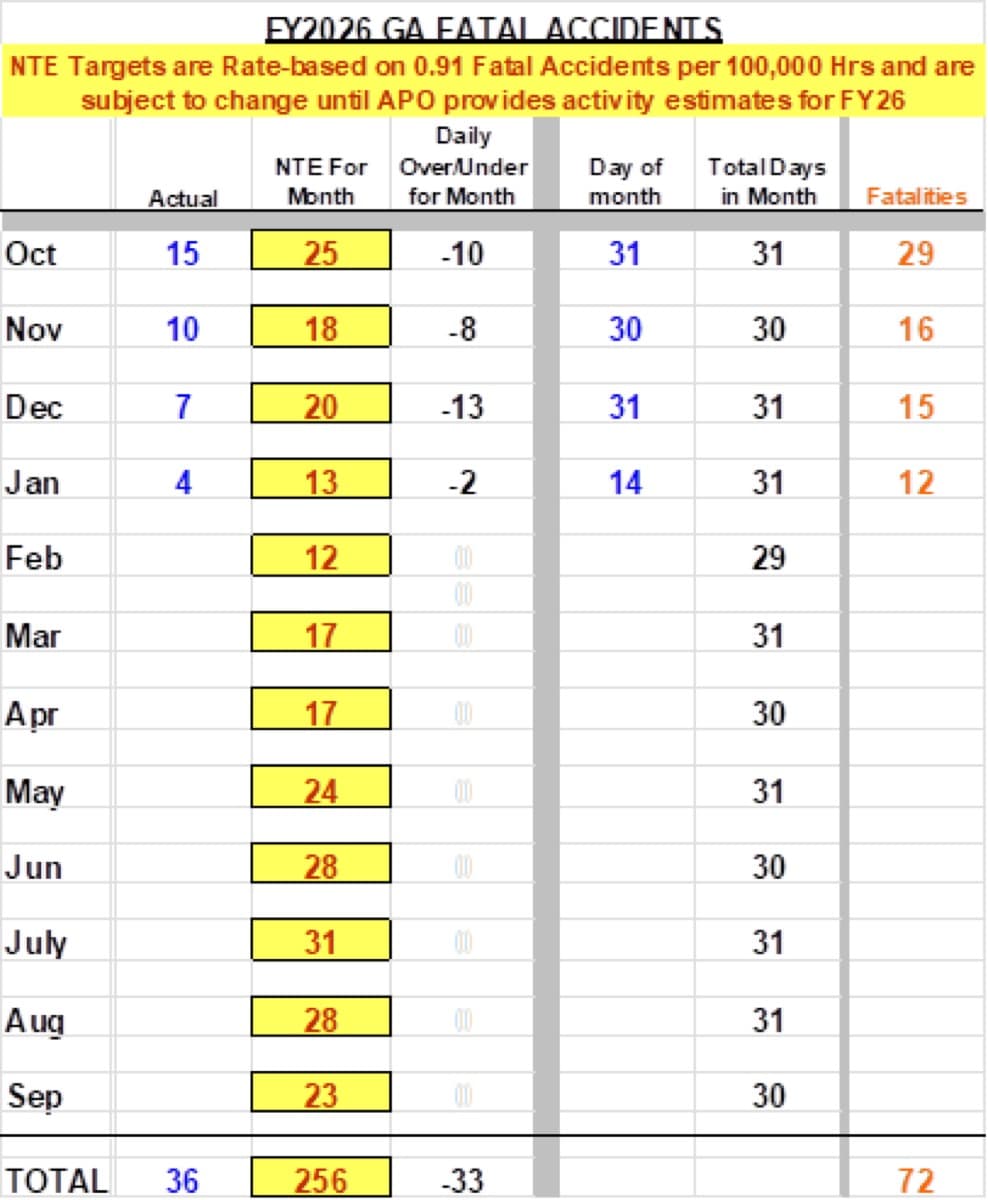
A look at the breakdown by month shows that October 2025 was the deadliest month, with 29 fatalities.
In an accompanying message from Sean Elliott, the GAJSC Co-Chair and Vice President of Advocacy and Safety for the Experimental Aircraft Association (EAA) notes that while fatal accidents are down — with GA setting its lowest annual fatal accident rate in its history at .61 fatal accidents per 100k hours in FY 2025 — it’s not time to celebrate.
“While the FAA has not yet finalized those numbers, that trend is encouraging and shows a definitive improvement over time,” he said.
While this is a “good news story,” he continued, it is not time to “take a victory lap and celebrate the indisputable success of how GA is trending safer.”
“We must continue to keep our collective foot on the gas to continue our never-ending quest to improve safety,” he said. “The reality is that we are still losing 250-plus lives each year in a GA aircraft. In some cases, these are friends, colleagues, family members, and overall members of our community that should not perish in that way. Our work is far from over. In many respects, it will only be more challenging as the low-hanging fruit for improvement dries up and we have to work that much harder to still move the trend downwards.”
He added that the GAJSC is “up to the task.”
“Our team of dedicated professionals is passionate about improving safety with a proven data-driven system for creating effective safety enhancements,” he said.
To learn more about how GAJSC works to enhance safety, go to GAJSC.org.
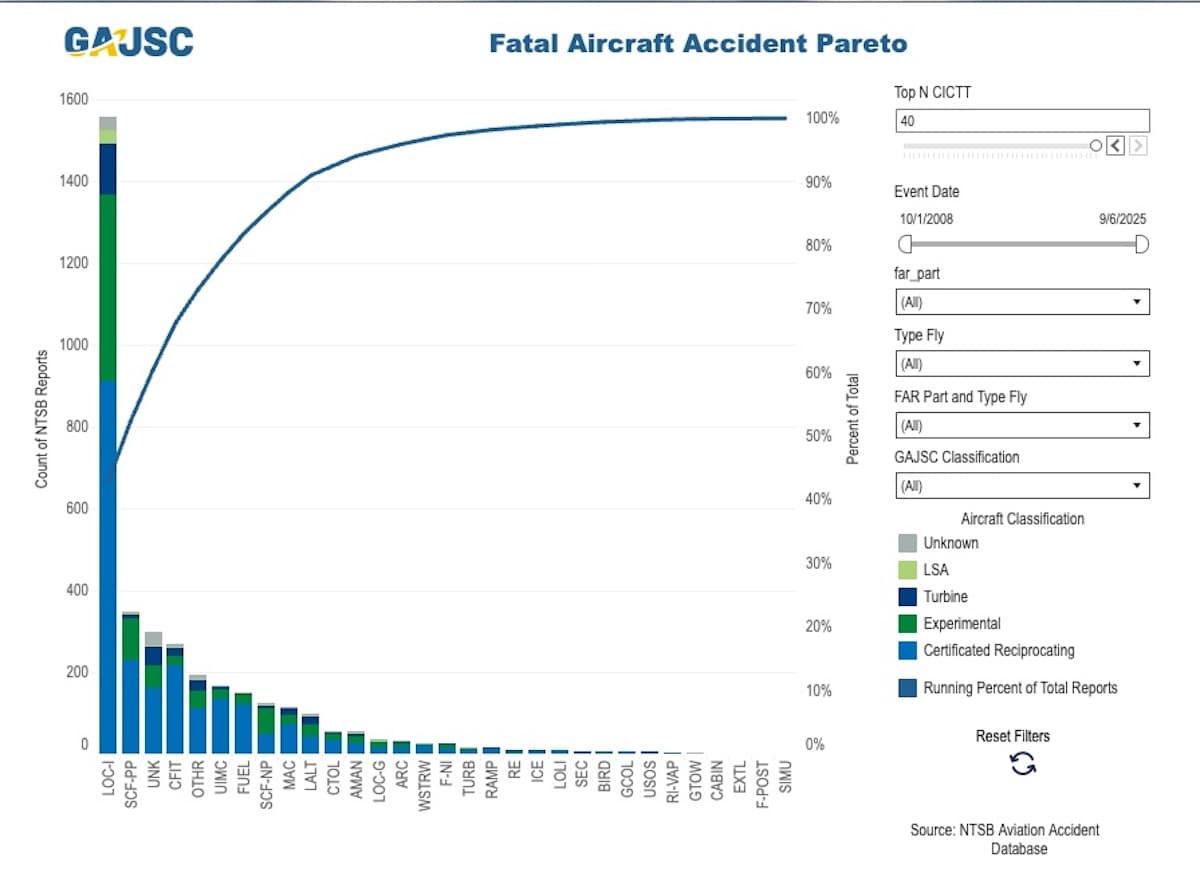
There you can also see a Pareto chart on general aviation fatal accidents, which can be customized to display a specific date range of accident data and sort results by aircraft classification, FAR part, operational category, and accident category.
So, with high fuel prices, maybe figure out how to burn less fuel per hour.?
I have flap gap seals and Hoerner wing tips on my old Cessna 175B.
At 60% power , the POH lists 8.8 gph.
With the STCs I now burn 6.8 gph at the same rpm and airspeed, but less HP needed.
others Thoughts.??
With WA State AvGas running $6-bucks average, or more, NO WONDER less folks are flying their machines. Doesn’t take a Rocket Scientist to figure out why there are less accidents. Except for flight schools and corporate flying, GA is in a pitiful state. SAY IT ISN’T SO!