

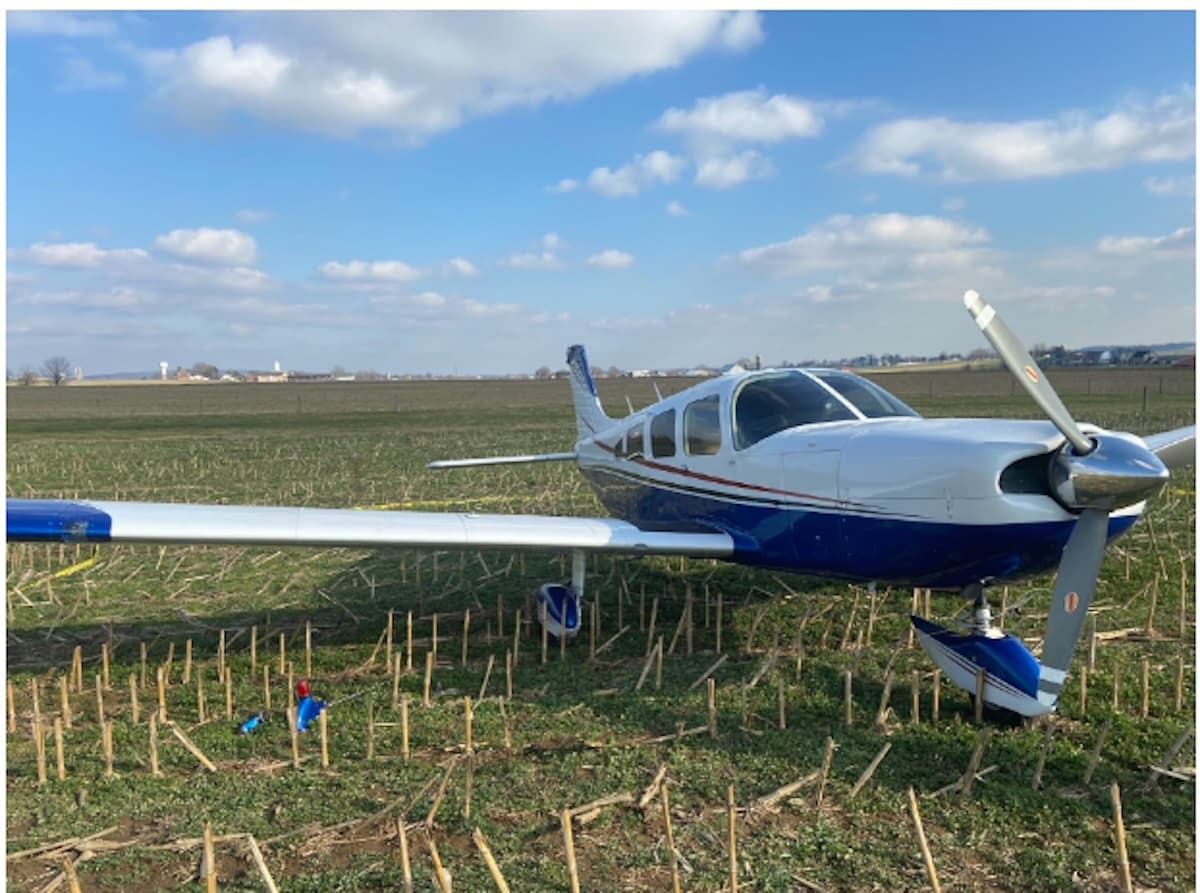
After departing on the flight, the pilot moved the Piper PA-32’s fuel selector from the left main fuel tank to the right wingtip fuel tank, and later the left wingtip fuel tank.
With an estimated 20 minutes of flight time remaining, he attempted to select the right main fuel tank, but inadvertently selected the left main fuel tank. About 10 minutes later, the engine began losing power.
Despite his efforts to troubleshoot the issue by activating the fuel pump and articulating the throttle, the engine lost power completely. The pilot then selected the right main fuel tank but was unable to restart the engine.
He performed a forced landing to a field near Gordonville, Pennsylvania. The airplane hit wires and fence posts, substantially damaging the left wing, as well as the horizontal and vertical stabilizers.
A post-accident examination of the airplane revealed that only 8 ounces of fuel remained in the left main fuel tank. While damage to the left wing incurred during the accident compromised the integrity of the tank, there was no evidence of any fuel leakage. About 25 gallons of fuel remained in the right main fuel tank. The airframe fuel strainer contained about 2 ounces of uncontaminated fuel.
Examination and operational testing of the fuel selector valve confirmed that the selector valve was functional in all positions and the indicator aligned properly in the detents.
Based on this information, the pilot’s inadvertent selection of the left main fuel tank resulted in exhausting its fuel supply, and the subsequent loss of engine power due to fuel starvation.
Probable Cause: The pilot’s improper fuel management resulting in fuel starvation, a total loss of engine power, and subsequent off-airport forced landing.
To download the final report. Click here. This will trigger a PDF download to your device.
This January 2024 accident report is provided by the National Transportation Safety Board. Published as an educational tool, it is intended to help pilots learn from the misfortunes of others.
Looking at the poh, the aircraft has 4 fuel gauges, so a glance it them would indicate which one [s] has fuel and which were indicating empty.
So, poor pilot scan and a crashed aircraft.!!
Fuel, fuel in the tank but not a drop to burn. Unless the correct tank is selected, of course. Far too many fuel related errors causing accidents.
Was the aircraft a rental? Then he obviously was signed off without proper instruction on the most basic of operations.
Was it his personal plane? Then, just, good grief.
He had 638 hours in this “Make and Model”, so…probably “good grief” either way.
It’s sad to see an aircraft damaged by the pilot not verifying the position of the fuel selector.!!
He was able to move it from the left main, to the right tip, then to the left tip, but didn’t get it to the right main, and ran the left main dry.
Aren’t we taught that if an action causes a problem, first undo it, then troubleshoot.
In this case, undoing the last change would have reselected the left wingtip tank, which was presumably near empty. He eventually selected the right main which had plenty of fuel, but out of sequence with the engine restart procedure. The procedure is to change the tank first, then turn on the aux fuel pump. He did those two items in reverse sequence, which means with the engine and aux fuel pumps both operating trying to pull fuel from an empty tank, it could have filled the fuel line to the engine with air making a restart more difficult and time consuming.
I think that if he would have looked at and intended to move the selector back, that he just might have noticed that it was in the left main, and could have moved it CW about 30 degrees to the right main….and this crash would not have happened.!!