

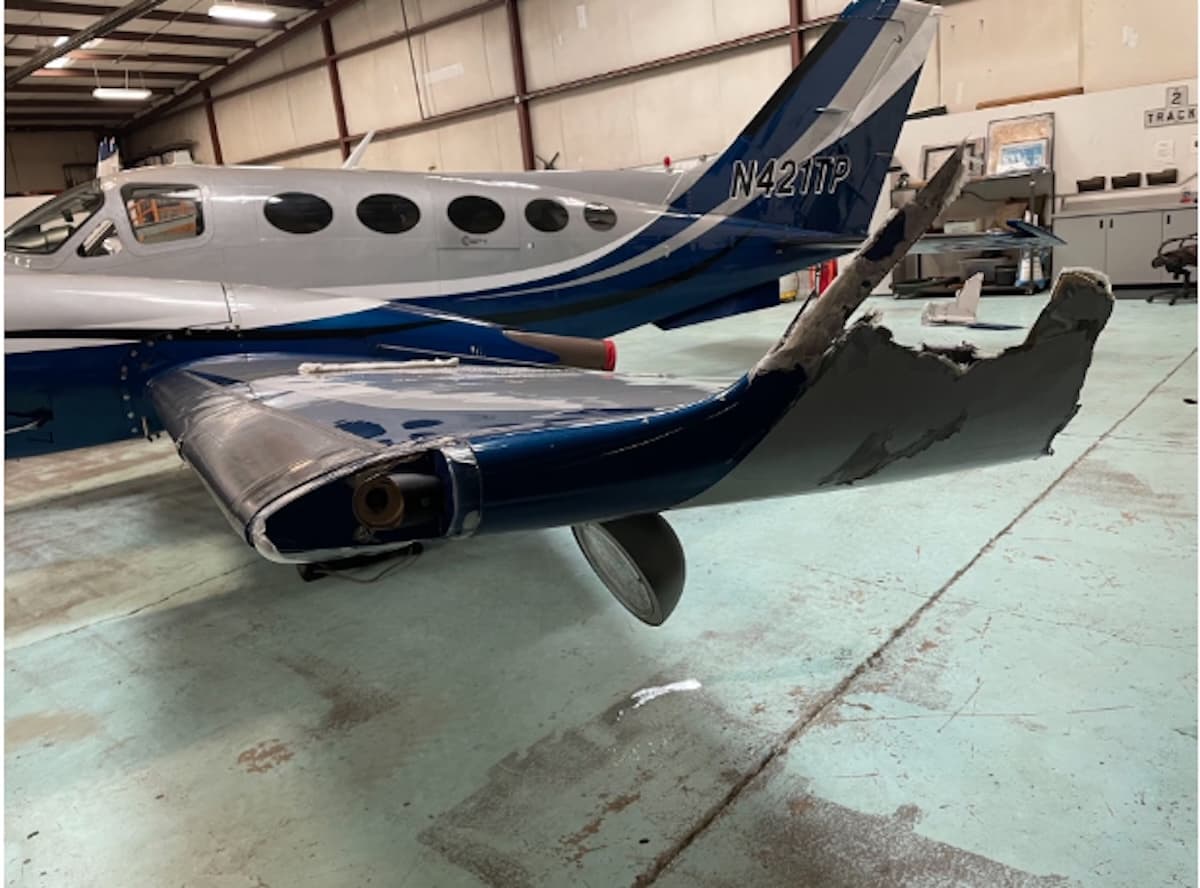
The pilot of the Cessna 421C reported that he flew from Carson City Airport (KCXP) in Nevada, to Van Nuys Airport (VNY) in California. He refueled at VNY and then departed about 1820 on an IFR flight plan with KCXP as the filed destination.
About 1826 a Piper PA-46 landed at KCXP. That airplane departed the runway due to icy runway conditions, spun 180° and came to rest adjacent to the active runway with the left wing partially blocking the runway. The pilot contacted Flight Service to notify them that the runway was partially obstructed.
The Cessna pilot checked in on frequency with Oakland ARTCC about 1859. About 1913, Flight Service issued a Notice to Airmen (NOTAM) stating there was an unsafe disabled aircraft affecting Runway 09/27 at KCXP and notified the airport manager. About 1915, the airport manager notified an airport employee of the disabled airplane on the runway. The airport manager requested Flight Service to issue another NOTAM that the runway was closed, which was issued about 1925.
About 1936, the airport manager contacted a resident adjacent to the airport and requested he monitor the airport’s CTAF and warn any inbound aircraft of the runway closure. The airport employee arrived at the airport about 1938 and proceeded to the Piper to meet the pilot.
According to the Cessna pilot, he checked the Automated Weather Observing System (AWOS) at KCXP while en route. Due to the weather reported at KCXP and because there were no instrument approaches approved for night use at KCXP, he elected to fly an instrument approach to Minden-Tahoe Airport (KMEV), cancel IFR en route, and continue the flight to KCXP under VFR.
About 1947, he changed his destination with Oakland Air Route Traffic Control Center (ZOA). The pilot did not inform ZOA of his intentions to cancel IFR once he descended below the weather and resume his flight to KCXP nor was he required to.
About 1954, the airport employee transported the pilot of the disabled airplane to the airport terminal due to cold weather.
About 1955, the ZOA controller provided NOTAM information for KMEV, and the pilot reported he had the weather for KMEV. About 1959, ZOA instructed the pilot to descend to 14,000 feet, and cleared the pilot to fly an instrument approach. The pilot reported that he rechecked the AWOS at KCXP about this time. The pilot advised ZOA that he had the airport in sight and canceled his IFR flight plan.
A second airport employee arrived at the airport about 2008. He reported that the first airport employee and the pilot of the disabled airplane went to the disabled airplane to take pictures, and he remained at the airport terminal in order to care for the pilot’s dog. The first employee could not recall what time he returned to the terminal after taking pictures, but believes he was either driving back to the terminal, or at the terminal, when the accident occurred.
The Cessna pilot reported that he had transmitted his intention to land at KCXP on the CTAF when about 10 miles from the airport. He rechecked the AWOS and transmitted his position again on the CTAF, as he overflew KCXP to the north.
The airport resident monitoring the CTAF on a handheld radio reported he heard five clicks on the radio to activate the runway lights and heard the Cessna pilot announce a 10-mile-out notice for landing Runway 27. The resident then made four or five separate radio calls on the CTAF asking, “aircraft landing at Carson, do you copy?” but did not hear a response from the pilot acknowledging the radio calls.
The pilot told investigators he did not hear any radio transmissions on the KCXP CTAF and subsequently landed on the blocked runway. He was unaware of the airplane blocking the runway until he heard a “thump” during landing.
The left winglet on the landing Cessna 421 hit the left wing of the Piper, substantially damaging the Cessna’s left aileron. The pilot then taxied the airplane to a hangar and parked.
The first airport employee, who was at the terminal, received a report of the accident from an FBO employee about 2033. He then added a voice message to the recorded AWOS message advising that the runway was closed about 2040.
He stated he had a handheld radio and a radio in the truck, and that he did not hear the accident pilot or the airport resident make any radio calls.
Airport staff flew a similar flight profile as the accident airplane the day after the accident to test the resident’s handheld radio’s transmission capability. The resident said he could hear the staff’s radio transmissions at 10 miles, but they did not hear his transmissions until the airplane was within 7 or 8 miles of the airport.
The KCXP airport emergency response plan stated the airport manager or their designee is responsible for coordinating “the closing of the airport when necessary and initiate the dissemination of relevant safety-related information to aviation users (NOTAMs).”
The plan further stated under the Alert 3 Accident Classification Response section (fire department response to an accident), “Airport staff should issue applicable NOTAMs and ensure appropriate CTAF advisories are communicated.” The airport emergency response plan did not provide for specific actions to be taken by personnel in the event of a non-accident runway closure event.
The airport possessed lighted runway closure markings to be placed on the runway warning pilots in the event of a runway closure, however they were not positioned on the runway as a result of the disabled airplane on the runway. Airport personnel stated the signs were not difficult to install but required personnel to be available in order to move them into place.
Following this accident, KCXP personnel updated the airport emergency response plan to include a checklist directing specific actions for personnel to take in the event of an aircraft accident or incident, including the issuance of a NOTAM and updating AWOS to advise of any closure or hazard at the airport.
Probable Cause: Airport personnel’s failure to properly prioritize their response actions, including updating the airport’s automated weather observation system recording in a timely manner to notify incoming pilots of a runway closure, which resulted in an airplane striking an immobilized airplane on the runway during landing at night. Contributing to the accident was the airport’s inadequate emergency response plan.
To download the final report. Click here. This will trigger a PDF download to your device.
This January 2024 accident report is provided by the National Transportation Safety Board. Published as an educational tool, it is intended to help pilots learn from the misfortunes of others.
Perhaps if the pilot had left the stranded aircraft’s nav lights and beacon on. After all he was the first one to the scene.
The airport could have only needed to do one thing……………….turn off the pilot activated lights and then no one is going to land.
I’m going to bet a lawyer’s going to buy some silk shirts after this one…
Unfortunate accident. Yes, one vehicle with flashing red lights – or even the fuel truck with a flashing amber light (scratch that – don’t need more fuel around *that* situation) – or something with lights, a flightline marshaller with flashlights could have warned of the runway issue.
I don’t think it is fair at all to fault the pilot in any percentage for hitting that plane. At night? I’ve searched for airplanes on the ground as low as 500 feet in the daytime (admittedly looking for crashed ones) and it is not as easy as one might think.
This was a ground ops failure, and I hope there were no injuries and the planes are at least repairable.
Landing A/C if in VFR should always be looking down the Runway to be sure it is clear from A/C Vehicle or anything etc.
It was white out conditions after two days of snow. White plane off the runway, white surrounds, everything white……………….impossible to see the wing over the runway.
Wow! Hard to believe the airport vehicles didn’t have at least flashing lights turned on while at or on the runway. Somebody’s got
some ‘splanin’ to do!