

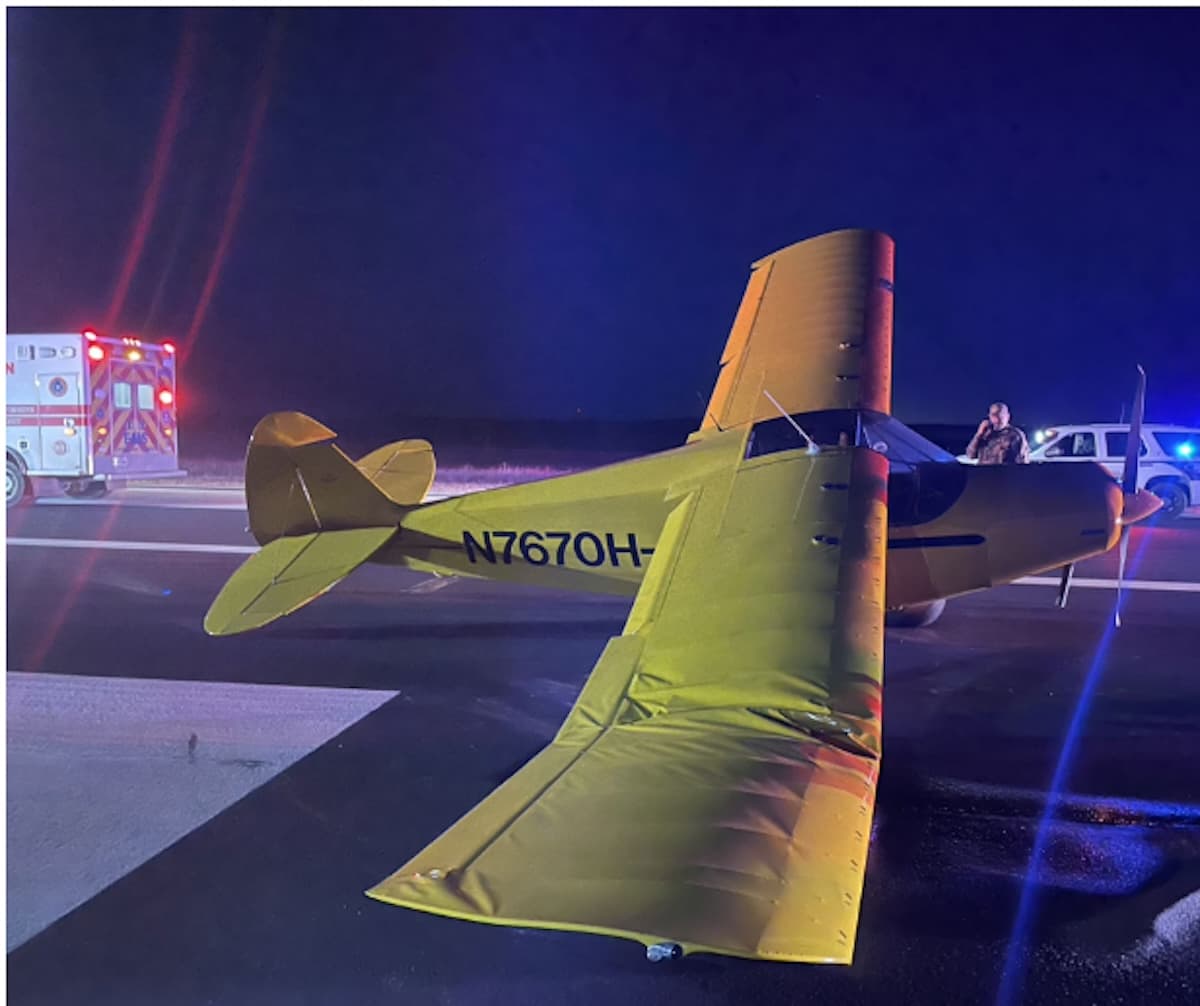
The pilot reported, that while conducting a full stop landing at the airport in Lampasas, Texas, he was concerned with a military helicopter about 3/4 of the way down the right side of the runway.
Due to the helicopter’s position, he reduced the engine power to idle and touched down about 10 mph faster than usual.
During the rollout, he overcorrected to the left, the Piper PA-12 tilted to the right, and the right wing hit the ground. The right main landing gear collapsed, and the right wing sustained substantial damage.
The pilot reported that there was a possibility of rotor wash from the military helicopter.
There was no evidence of any pre-impact mechanical malfunctions or failures with the airplane that would have precluded normal operations.
Probable Cause: The pilot’s failure to maintain directional control during the landing roll.
To download the final report. Click here. This will trigger a PDF download to your device.
This January 2024 accident report is provided by the National Transportation Safety Board. Published as an educational tool, it is intended to help pilots learn from the misfortunes of others.
Twenty five years flying military helicopters and forty years flying GA aircraft. I recommend minimum of five rotor disc diameter distance while on the ground. Of course a J3 is more likely to sustain damage than G IV and an R22 produces less downwash than an Ospry(!). There are many variables and discovering that you are too close could be very expensive. Better to be conservative in your operations around rotocraft. ALWAYS, tie your airplane down when there are rotorcraft operations on the airfield.
AIM 7−4−7. “Pilots of small aircraft should avoid operating within three rotor diameters of any helicopter in a slow hover taxi or stationary hover.” I would add more distance if downwind of the helicopter.
Another case of TinkerToy landing gear unable to withstand abnormally high forces. What do you expect for $250,000 anyway? It amazes me that the GA community allows the GA manufacturers to get away with such cookie sheet crap.
Regards/J
“Tinker toy landing gear”, “what do you expect for $250K anyway”,
and “cookie sheet crap”? I’m curious where those comments are coming from.
Sounds like you think it’s a carbon cub or similar,
but the accident aircraft turns out to be a 1946 Piper PA12.
Looks like it has bushwheels, so quite likely has beefed up gear also.
But no matter how beefy, everything has a breaking point.
Eric,
Good points!
“I’m curious where those comments are coming from.” Don’t worry; we‘re used to the banal and inane comments.
70H is a tough old bird. She’s had a storied life, including being wrecked and resurrected a couple times.
I hope I can afford an ‘original’ PA-12, someday, before they ARE worth $250G!
Tom
When the comments are made by an uneducated source you soon realize that there is no substance, only entertainment value…
Eric,
They are coming from someone who, by his own admission, is not a pilot nor aircraft owner and has no personal aviation experience on which to base his frequent opinions, other than what he reads online.
Week after week after week we read of failed landing gear on GA aircraft. It’s unacceptable. How would we think if ordinary passenger cars lost wheels after an especially hard hit in a pothole or parking block? No. Never happens. But it happens with great frequency in GA aircraft. I stand by my observation: GA landing gear is woefully flimsy. Wheels shouldn’t break off just because the plane lands hard on a runway or a bean field. It’s cheap overly cost-conscious engineering. I’m a design engineer. I know all abouit the bean counters controlling designs.
Regards/J
Please design us some landing gear that absorbs impact on landing, keeps us high enough off the ground, is light enough for GA aircraft, and won’t break when you land too hard.
Thanks in advance!
The new RV-15 has innovative spring/shock absorber main gear.
No info how high a drop it will absorb without damage ?
For existing aircraft, an STC would need to be developed . but being able to sustain side loads would require added engineering, and probably different tire/ wheels and axles….think heavy, reducing load capacity.
Go-around to avoid the copter rotor wash.!!!
Taxiing past a copter within a couple of rotor diameters can cause the downwash to affect the aircraft.