

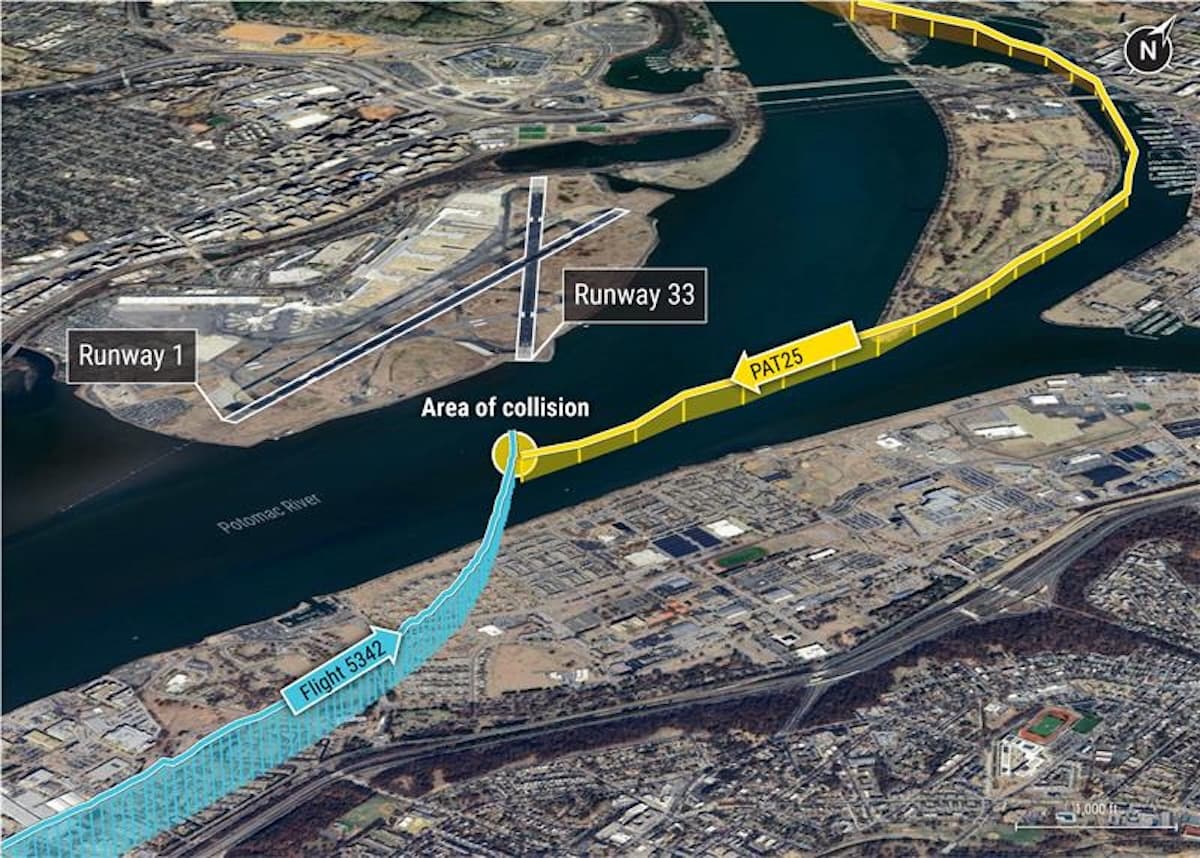
Systemic failures in airspace design, safety oversight, and risk management by the FAA and the U.S. Army contributed to a midair collision a year ago over the Potomac River that killed 67 people, the National Transportation Safety Board said Jan. 27, 2026, in its final meeting on the disaster, the nation’s deadliest aviation accident since November 2001.
The collision occurred at 8:48 p.m. Eastern time on Jan. 29, 2025, when a U.S. Army Sikorsky UH-60L Black Hawk helicopter and American Airlines flight 5342, a Mitsubishi Heavy Industries RJ Aviation CRJ700 operated by PSA Airlines, collided over the river about a half mile southeast of Ronald Reagan Washington National Airport. All 64 people on the airplane and all three crewmembers on the helicopter died in the crash.
“This complex and comprehensive one-year investigation identified serious and long-standing safety gaps in the airspace over our nation’s capital,” said Jennifer Homendy, chairwoman of the NTSB. “Sadly, the conditions for this tragedy were in place long before the night of Jan. 29.”
During its meeting, the NTSB voted to approve 74 findings and 50 recommendations to prevent similar accidents in the future.
The investigation found that the FAA’s helicopter route design in the Washington area failed to provide procedural separation between helicopters and fixed-wing aircraft operating on approach and departure paths at Reagan National. Investigators concluded that the route structure allowed helicopters to fly directly beneath an active approach corridor for commercial airliners without sufficient mitigations to manage the risk of a collision.
The investigation also identified deficiencies in FAA guidance regarding helicopter route altitudes and boundaries. Inconsistent and unclear information led some helicopter operators to misinterpret published altitudes as providing separation from fixed-wing traffic, when no such separation existed. Additionally, aeronautical charts for fixed-wing pilots did not depict nearby helicopter routes that intersected approach paths, limiting shared situational awareness, NTSB officials said.
The NTSB added that the FAA lacked effective strategies to identify, assess, and reduce recurring midair collision hazards in the skies around Reagan National. Despite available safety data showing repeated close encounters between helicopters and airplanes near the airport, the FAA did not conduct sufficient safety analysis or take timely corrective action. The agency also did not act on recommendations from local air traffic control personnel and other helicopter operators who raised concerns about known conflict areas, NTSB officials said.
The U.S. Army’s safety management processes also failed to identify and address hazards associated with helicopter operations in congested and complicated civilian airspace. The NTSB found that the Army lacked a flight data monitoring program for helicopters operating near major airports and had limited participation in safety reporting systems. As a result, routine excursions above the authorized helicopter route altitudes and close proximity incidents that presented a risk of midair collision went unrecognized by Army safety personnel.
Investigators further determined that neither aircraft was equipped with collision avoidance technology capable of providing effective alerts in the low-altitude environment where the accident occurred. Although the CRJ700’s traffic alert and collision avoidance system functioned as designed, existing altitude limits prevented higher-level alerts called resolution advisories from being issued, which could have provided the airline flight crew with real-time maneuvering instructions to avoid the collision.
The NTSB found that had the airplane been equipped with an airborne collision avoidance system that used Automatic Dependent Surveillance-Broadcast In, the crew would have had enhanced position information about the helicopter. Such a system could have provided the crew of flight 5342 with the first alert regarding the helicopter 59 seconds before collision.
Air traffic control practices also contributed to the accident. The NTSB found that the high workload during a period of elevated traffic reduced air traffic control’s ability to monitor developing conflicts and provide timely safety alerts. The use of separate radio frequencies for helicopters and airplanes further increased risk, as blocked transmissions prevented critical instructions from being fully received.
As a result of the investigation, the NTSB issued 33 safety recommendations to the FAA, eight to the U.S. Army, and additional recommendations to the Department of Transportation, the Department of War Policy Board on Federal Aviation, and the RTCA (formerly known as the Radio Technical Commission for Aeronautics). These recommendations call for comprehensive reforms to helicopter route design, air traffic control procedures, safety management systems, data sharing, and collision avoidance technology.
“Our work doesn’t end with the issuance of a final report — that’s just the first step,” Homendy said. “We will vigorously advocate for the implementation of our safety recommendations — that’s how we prevent a tragedy like this from happening again.”
The final findings, probable cause, and safety recommendations, are available on the accident investigation webpage. Additional material, including the preliminary report, previously issued safety recommendations, news releases, the public docket, investigative updates, and links to photos and videos, are also available on that page.
The final report will be published in the coming weeks on NTSB.gov.
It’s important to note that President Trump and VP Vance came out immediately after this accident and gave a press conference. Nothing was said to try and console the families or anything that a POTUS normally does. Instead, because there was a female pilot they both went on a rant about DEI and aviation. The reality was this girl was under the hood and getting training, she wasn’t even the PIC! I felt so sorry for her grieving parents. I can’t imagine how they felt.
And I don’t see anyone coming out and apologizing for all the vicious and unwarranted mudslinging directed at the female pilot shortly after the accident. It’s once again a reminder that we should never speculate on the cause of an accident until the NTSB has a chance to do their job.
After reading the accident report on the Potomac crash last year, I was immediately horrified to discover that such an incident was practically inevitable and should have been a surprise to no one. Well, even after several knowledgeable helicopter operators WARNED the FAA, as well as ATC personnell; the FAA in their infinite wisdom chose to look the other way. Guessing hey were too busy monitoring PAPER.
“The agency also did not act on recommendations from local air traffic control personnel and other helicopter operators who raised concerns about known conflict areas, NTSB officials said.” < THAT IS CRIMINAL NEGLECT