

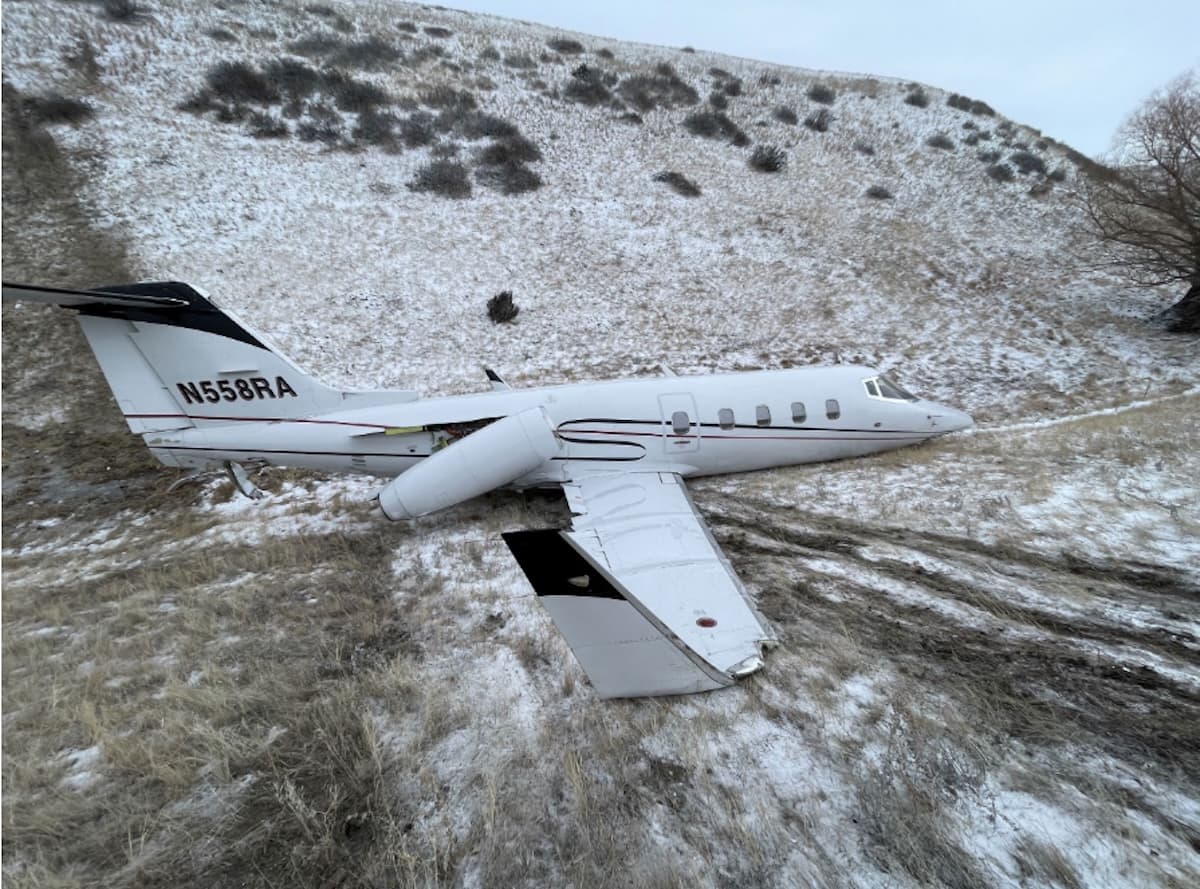
The pilot in command of the Learjet 55 reported that, while on an instrument GPS approach to the airport in Livingston, Montana, they listened to the automated surface observing system several times and determined that they would be landing with a “light quartering tailwind” on an upsloping runway.
Once clear of clouds and with the runway in sight, the pilot canceled the instrument flight rules clearance, announced their position over the airport’s common traffic advisory frequency, and received a reply with a report of 1/4 inch of dry snow covering the runway, unplowed.
During the landing roll, they applied brakes, extended spoilers, and thrust reversers. Initially the airplane slowed. However, about halfway down the runway, the airplane’s antiskid system was functioning continuously and the airplane’s rate of deceleration decreased. The pilot was unsure if the thrust reversers deployed, and he cycled the thrust reversers and did not feel any effects. The pilot stated that, in his experience, the airplane’s thrust reversers do not feel very effective.
The pilot considered aborting the landing, started to clean up the airplane, but thought it was too late. The airplane overran the departure end of the runway, onto a grass-covered area and into a deep ravine, resulting in substantial damage to the fuselage and both wings. The pilot and co-pilot both received minor injuries in the crash.
The automated weather observation station located on the airport reported that, about 44 minutes before the accident, the wind was from 090° at 12 knots. The same automated station reported that, about 16 minutes after the accident, the wind was from 090° at 12 knots. The airplane landed on Runway 22.
The FBO owner reported that, on the day of the accident, his review of the runway conditions at the airport appeared to be around an inch of snow on the runway surface. Additionally, plowing at the airport so far this year had been “abysmal,” he told investigators. Big windrows and ice chunks have been left, taxiway corners had been built up to the point there could be an occurrence should an airplane be taxiing by. Earlier this year, several departures were delayed due to the runway not being plowed, he added.
According to the chairman of the airport board, there is no formal process to conduct runway assessments. However, an airport board member lives in the area and routinely visits the airport to conduct runway assessments. The runway assessments and frequency of the observations are not documented but are conveyed verbally to the airport board via cell phone.
To the best of his knowledge, there is no formal snow or ice removal plan. When the runway is required to be cleared, a board member will use county provided equipment to clear the runway. The frequency of the snow removal is not documented. The airport snow removal equipment is limited to clear substance to 1/2-inch of the runway surface. On the day of the accident, he was not aware of a Notice to Airmen (NOTAM) issued for the conditions of the runway environment.
According to the airplane manufacturer, the estimated landing distance on a dry runway was about 3,350 feet, with loose snow and no tailwind the estimated landing distance was about 6,700 feet, and on loose snow with tailwind, the estimated landing distance was 7,531 feet.
According to the FAA, the airport is not required to have a snow and ice control plan. However, the airport was provided federal funds to purchase a snowplow to maintain the airport surfaces during inclement weather conditions. There may be times where issues arise and action is delayed. In that case it is expected that a NOTAM be issued as outlined in the grant agreement.
Probable Cause: The flight crew’s decision to land on a snow-covered runway with a tailwind, resulting in a runway excursion and subsequent impact with terrain. Contributing to the accident, was the failure of the airport authority to plow the runway.
To download the final report. Click here. This will trigger a PDF download to your device.
This January 2024 accident report is provided by the National Transportation Safety Board. Published as an educational tool, it is intended to help pilots learn from the misfortunes of others.
Experience and choices go hand in hand.
The 66 year old left seater had 31,800 hours TT. The 29 year old pilot at the controls had 1,726 hours TT, 900 hours as an instructor and 197 hours multi engine time.
George Pickett was quoted in reference to his famous charge, disparagingly commenting on Bobby Lee’s order. It would fit here as well.
As an airport manager at a busy general aviation airport, I’m familiar with snow removal and the decision to “close” runways or the airport when paved surfaces are snow/ice covered. FAA A/C (mandatory if the airports that receive federal grants) explains the FAA’s Runway Condition Assessment Matrix. As little as 1/8 inch of snow can reduce “Braking Action” on a runway to MEDIUM, POOR or NIL based upon a dry snow, wet snow, slush, dry/wet snow over ice. About AIP eligible snow removal equipment for GA airports, only plows and blowers are eligible. High speed sweepers, which removed the remaining snow that a plow and/or blower leaves behind on the runway, are not AIP eligible. I WISH the FAA would make snow sweepers AIP eligible at GA airports. Honestly, it’s the sweeper that makes the difference between a runway that is maintained to a “no worse than wet condition”. I’ve often felt the need to closed runways at my airport with less than 1/4 inch of snow, slush, and/or ice. If my SUV slips and slides on a snow covered runway when I’m assessing the “braking action” on a runway, then sure enough an aircraft touching down at a high speed (with the typical tires found on aircraft) is going the slip and slide. Personally I believe, the worse decision I could make as an airport manager is risk leaving a runway open and an aircraft loose directional stability and exit the runway surface. ME, being a contributing factor.
Poor decision to land, period. They should have at least come in with the quartering headwind, but even at that sounds like there would have been problems.
Going somewhere else would have been a better decision.
KLVM airport is at an elevation of 4659′ with a runway of only 5701′ long. There is not much margin for error on an ideal day, let alone a snow covered runway.
Landing “downslope” with headwind a better alternative