

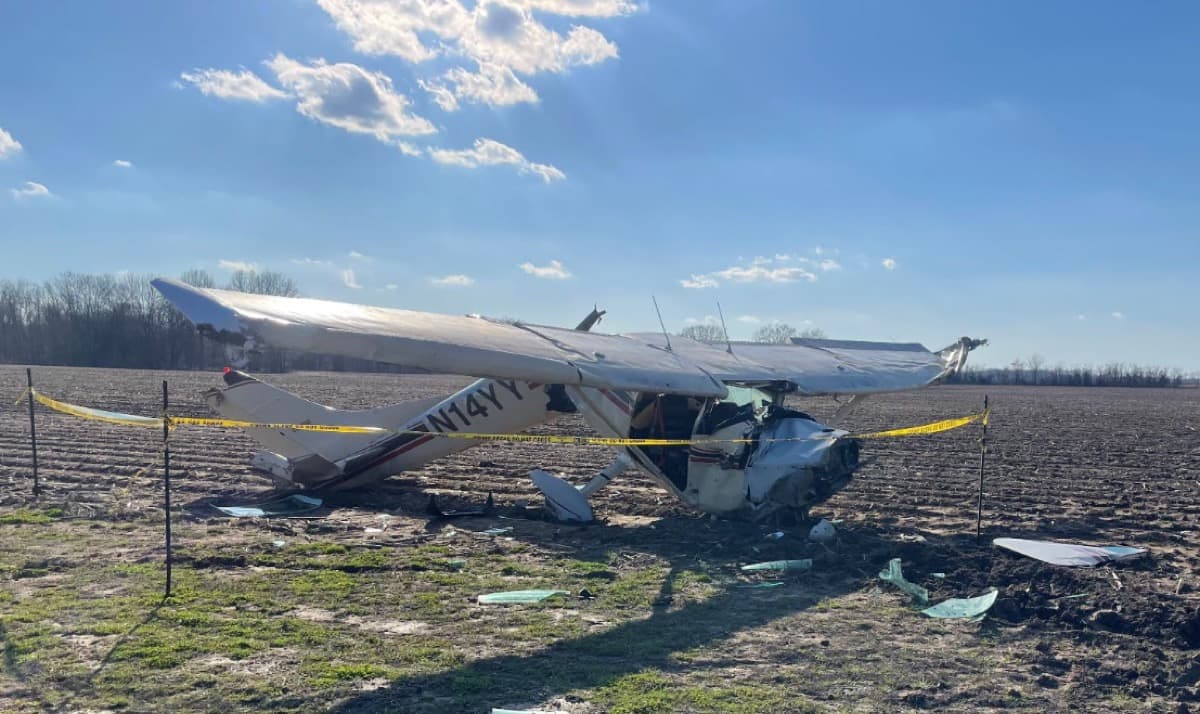
The purpose of the flight was for the pilot to position the Cessna 182P after it had been purchased by its new owner.
He told investigators that that before the accident flight, he flew with the previous owner to get familiar with the airplane. He did not detect any issues with the plane during the familiarization flight.
He planned to fly to Panola County Airport (KPMU), in Batesville, Mississippi, to refuel.
While en route to KPMU, he told investigators that he had to add a couple notches of rudder trim because the airplane was tracking to the left. That happened two times.
About 30 nautical miles (nm) from KPMU, he switched the fuel selector from BOTH to LEFT, and about one minute later, the engine exhibited signs of fuel starvation. He then switched the fuel selector back to BOTH and the engine regained power.
About 13 nm from KPMU, he again switched the fuel selector to LEFT, and the engine again exhibited signs of fuel starvation. He then switched the fuel selector to BOTH knowing there was good fuel flow in the BOTH position. He decided to divert to Selfs Airport (KMMS), in Marks, Mississippi, so he wouldn’t run out of fuel.
The pilot reported that on his first attempt to land at KMMS, he had difficulty maintaining a straight descent to Runway 2. Upon touchdown, the airplane immediately turned left, so he added engine power for a go-around. While trying to line up again for Runway 2, he could not maintain a normal straight-in approach. He said that it appeared there was no rudder control.
When the airplane touched down, it turned to the left and he performed another go-around.
He told investigators that during the last landing attempt, he was fighting the airplane and had to land because he was expecting a loss of engine power due to fuel starvation. The airplane then hit terrain off the runway edge and was destroyed by impact forces.
The pilot was seriously injured in the crash.
A witness video showed the airplane approach and attempt landings on Runway 2 at high speed with the nose yawed left and with the flaps retracted before impact with the ground. The approaches were unstabilized, and the airplane’s attitude was uncoordinated. The engine was operating during the approaches.
A post-accident examination of the fuel system revealed that the wing fuel tank caps were Monarch Fuel Caps that were installed under a Supplemental Type Certificate. The left fuel cap did not allow air to be drawn in when suction was applied to the bottom of the cap. The right fuel cap allowed air to be drawn in when suction was applied to the bottom of the cap.
The left and right wing bladder tanks were attached, secured, and exhibited no wrinkles. There was no debris in the left and right wing bladder tanks. The left and right wing forward and aft fuel line outlet screens were unobstructed. Shop air was blow into the left and right wing forward and aft fuel outlets and air exited the gascolator outlet, which was consistent with no blockage and a fuel selector position of BOTH. The gascolator screen and bowl did not contain debris.
The fuel lines leading to and exiting the fuel selector assembly were attached and secure. The fuel selector handle was broken off from the fuel selector input shaft consistent with impact damage. The fuel selector valve position was confirmed to be in the BOTH position. The fuel selector operated with no binding/sticking, and detents were felt through each of the LEFT, RIGHT, BOTH, and OFF positions.
The wing flaps and the cockpit wing flap indicator were in the fully retracted position. Flight control continuity was confirmed from the control surfaces to the cockpit controls.
The cockpit rudder trim indicator exhibited damage consistent with impact and was off its scale. The indicator tip was in the full nose right stop. The rudder trim/nose wheel bungee sprocket was nearly fully rotated to its full nose left trim stop.
The pilot, who earned his private ticket in 1975, had logged 427.8 hours. However, there were no entries in his logbook for a Cessna 182. The pilot stated on National Transportation Safety Board Pilot/Operator Aircraft Accident/Incident Report, form 6120.1, that he accumulated a total flight time of nine hours in the past 90 days and four hours in the past 30 days in a Cessna 182.
Probable Cause: The pilot’s failure to attain/maintain aircraft control during an approach for landing that resulted in an impact with terrain.
To download the final report. Click here. This will trigger a PDF download to your device.
This February 2024 accident report is provided by the National Transportation Safety Board. Published as an educational tool, it is intended to help pilots learn from the misfortunes of others.
When he noted no fuel from the left tank the first time, why not land and have an A&P troubleshoot the problem. ?
Using rudder trim will cause uncoordinated flight…sideways.
Using aileron would be much better, but the pilot would have to hold it.
[ I don’t now if the C182 has aileron trim ?]
So, tough landing attempts and a destroyed aircraft for the new owner.
The new owner’s insurance cleared this pilot?
Amazing how many pilots think they are better pilots than they really are. If your not flying an hour a week you’re not really current.
That’s an indication of a rote trained pilot lacking comprehension of what he’s doing. And that almost invariably is the underlying problem with non equipment failure crashes.