

The non-instrument-rated private pilot and two passengers departed Runway 01 at James A Rhodes Airport (KJRO), in Jackson, Ohio, at 1136 in the Piper PA-32 for a VFR cross-country flight to Haines City, Florida, to pick up a vehicle.
According to two witnesses who observed the takeoff, the airplane departed during a period of heavy snowfall.
A witness living on the airport property about three quarters down the length of the field, who was also a flight instructor, reported that the takeoff appeared normal. However, he said “it was snowing very hard and windy.” Due to the restricted visibility and “icy” conditions, he told his wife he did not feel that the flight would have a good outcome. He told investigators that the airplane was in the clouds when it reached the end of the 5,201-foot-long runway. He further stated he could barely see the windsock at the time due to heavy snowfall and estimated the visibility to be about 1/2 mile.
The second witness, who was outside of his residence about 1/2 mile west of the runway at KJRO, reported that the airplane turned left after takeoff and flew so low over his property that, if not for the snow, he could have read the registration number. The airplane continued in a left circle back toward the runway until he could no longer see it because of the snow. Shortly thereafter, he heard the airplane hit the ground. He estimated that the airplane was in the air for three to five minutes.
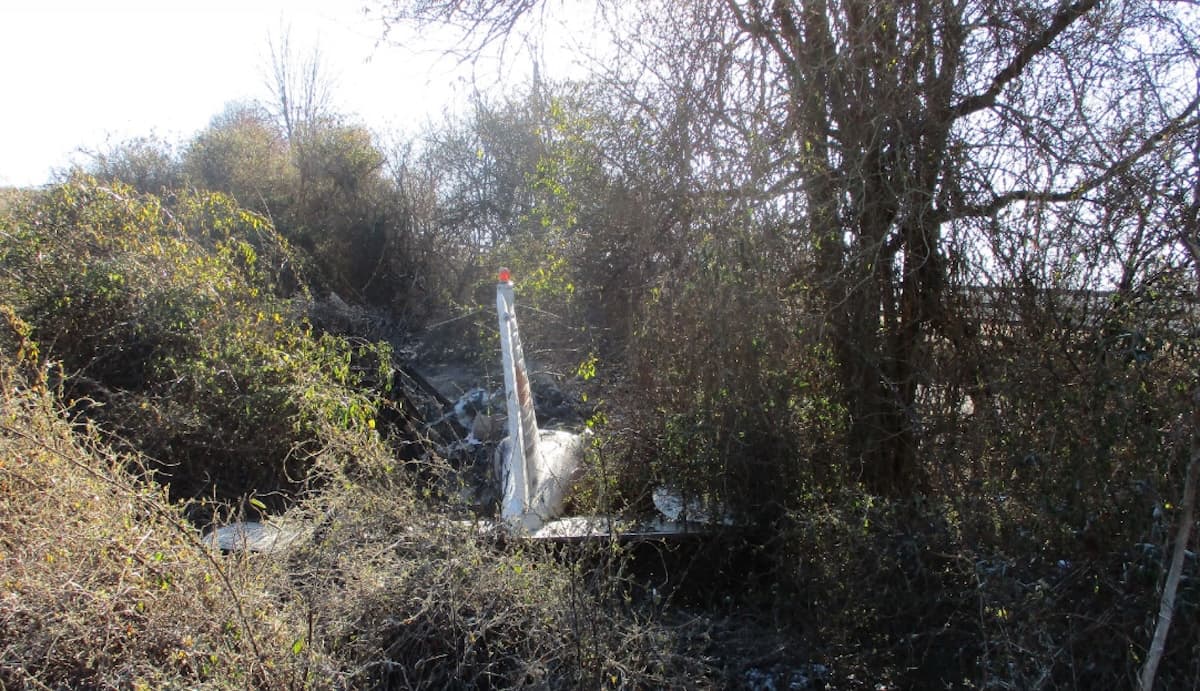
The airplane came to rest about 1/2 mile from the departure end of Runway 01. The wreckage path was on a heading of 270°, and the main wreckage came to rest on a heading of 110°.
The pilot and two passengers died in the crash.
Post-accident examination of the wreckage revealed that the fuselage and cockpit were mostly consumed by post-impact fire. All flight control surfaces were present in the wreckage.
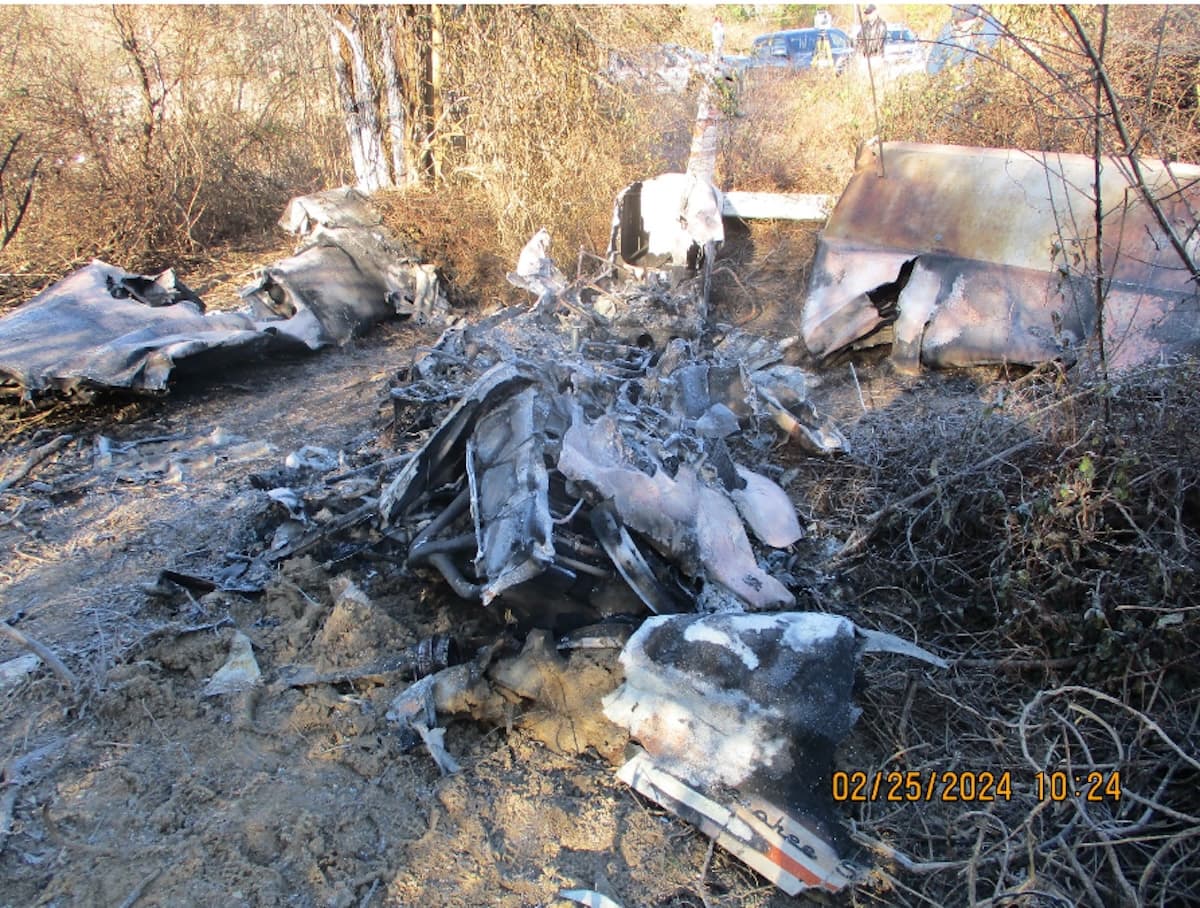
All seats except for the front right seat, which remained attached, were separated from their mounts on the cabin floor due to impact forces. All non-metal seat material, and lap belt and shoulder harness webbing, were consumed by the fire.
The instrument panel was fragmented and burned, and no instrument readings were obtained. The throttle, propeller, and mixture controls were reduced to their metal control cable components, and no position settings could be determined. The manual flap selector was found set to the full flap extended position, which was verified at the flap torque tube and control rod on the left side.
Both wings displayed compression damage along the leading edges and were separated at the wing roots due to impact forces. Aileron control continuity was confirmed from the control surfaces through overload separations in the control cables to near the aileron drive chain at the control column, where it was separated in overload. The aileron drive chain was fully intact. The vertical stabilizer and stabilator remained attached to the empennage and displayed little deformation except for the right outboard portion of the stabilator, which was bent upward. Rudder and stabilator continuity were confirmed from control surfaces to the forward cabin area.
Examination of the engine revealed “Normal Condition” spark plugs when compared to the Champion Aviation Check-a-Plug chart. Borescope examination of the cylinders revealed no anomalies to the cylinder walls, piston faces, or intake and exhaust valves. Crankshaft continuity was confirmed through multiple 360º rotations by rotating the vacuum pump drive and the crankshaft flange. Thumb compression and suction were achieved on all cylinders. All propeller blades exhibited chordwise scoring and leading-edge abrasion. One blade exhibited aft bending, and a second blade exhibited torsional twisting.
Examination of the airframe and engine revealed no preimpact mechanical malfunctions or failures that would have precluded normal operation.
The airplane’s track was not captured by ADS-B data, and no onboard devices that capture digital data were recovered.
The reported weather conditions at KJRO at 1135 included overcast clouds at 1,200 feet, 1-3/4 miles visibility in light snow, and gusting wind. Geostationary Operational Environmental Satellite-16 visible data revealed cloudy conditions at the departure airport and en route. Weather radar imagery depicted bands of light precipitation moving from northwest to southeast across the region.
The pilot generated and received a weather briefing from ForeFlight after 0700 that contained forecast for instrument flight rules surface visibilities, likely light snow, and G-AIRMETs Sierra and Zulu.
According to the pilot’s flight instructor, the pilot had accrued about 20 hours of “flying under the hood” and was working on his instrument rating.
Probable Cause: The non-instrument-rated pilot’s decision to depart under visual flight rules into instrument meteorological conditions, which resulted in an inflight collision with terrain while maneuvering.
To download the final report. Click here. This will trigger a PDF download to your device.
This February 2024 accident report is provided by the National Transportation Safety Board. Published as an educational tool, it is intended to help pilots learn from the misfortunes of others.
Set up an appointment with the undertaker before he even started the engine.
Sounds like ITOs hadn’t appeared in his instrument training yet.
A familiar scenario: upon rotation the horizon disappeared and keeping rudder position unchanged, setting up the climb speed while keeping wings level were the main occupations.
Meanwhile, the a/c nose had veered west mainly due to P-factor, and the rest of the left turning tendencies.
Pilot belatedly checks the DI, which is now reading 270someting, doesn’t understand why, but proceeds to put in more right aileron than necessary to get back on course.
Result: a steep power-on turn close to the ground. Not to be wished for.
How can you say you’re flying VFR when you’re taking off in “heavy snowfall 1/2 mile visibility “ nonsensical. $million dollar payoff to the poor passengers.Amen!
There’s not much of anything to say. It’s all been said before. Perhaps Private pilot postulates should be required, as part of their curriculum, to fly with a CFII on one flight in low IFR conditions so they can receive a healthy shock of reality before they’re turned loose on society.
Lack of respect for aviation will kill you! A terrible price to pay! “Eternity is a long time, especially near the end!” Woody Allen
Textbook example of get-there-itis [“Damn the torpedoes [weather], full speed ahead”]. . Presumably, the car was never picked up. So tragic for the innocent passengers.
He took off with two other people with a half mile visibility in heavy snow after getting a DUI.
Evil
Another JFK type accident, hire a professional pilot or instructor and they would be alive today. Topical cheap pilot who thinks their skills are better than they are!
Sa a non-instrument rated pilot took off in a snowstorm, taking his life and two other trusting souls with him to the Promised Land. All the post-crash examinations told above are irrelevant to the obvious stupidity of taking off in a snowstorm. RIP for the innocent passengers. Yet another insurance payout to raise the premiums for GA pilots to pay.
Regards/J