

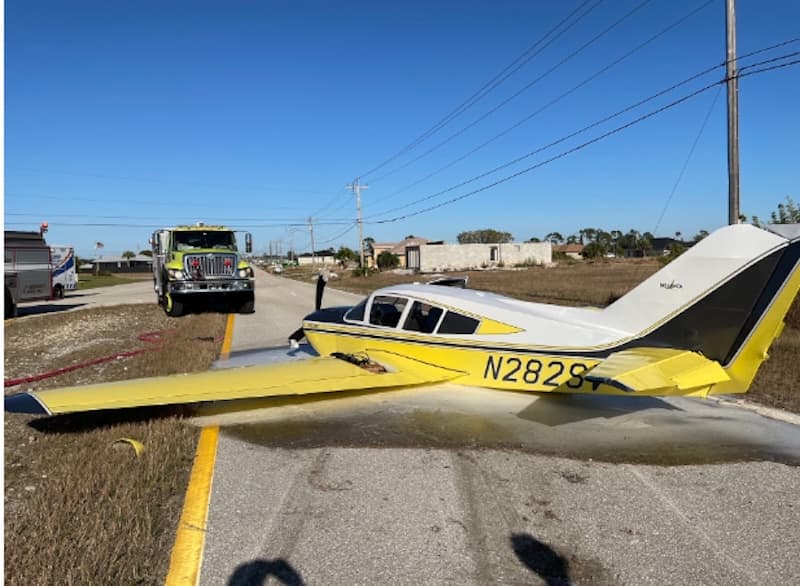
The pilot/owner of the Bellanca 17-30A told investigators that the purpose of the flight was to ensure that recent maintenance performed on the airplane was satisfactory.
According to the pilot and maintenance log entries, the left magneto and harness was replaced with an electronic magneto and new harness, the engine mounts were replaced, the engine-driven fuel pump was replaced with an overhauled unit, and the engine fuel hoses “firewall forward” were replaced. The pilot stated that he replaced the fuel lines.
He departed from Pine Shadows Airpark (94FL), in Fort Meyers, Florida, and was airborne for about five minutes when the engine lost total power at an altitude of 1,500 feet MSL. He changed power settings and used the fuel boost pump, but there was no change in the engine’s power output.
He elected to land in a residential neighborhood in Cape Coral, Florida, however during the approach, the airplane contacted powerlines before it touched down in the grass of a divided highway and came to rest on the roadway.
The pilot told investigators that the airplane contained 84 gallons of fuel in the tanks at the time of the takeoff and it had not flown or been refueled since December 2023. He performed a full preflight inspection the night before the accident. The fuel tanks were sampled at that time with no contamination noted.
The pilot stated that, before takeoff, he completed an engine run-up with no problems noted and all three fuel gauges showed “full.” The pilot did not have any difficulties starting the engine.
The wreckage was recovered to an aircraft salvage facility where an examination of the airframe and engine was performed. Fuel was supplied at the fuel pump inlet from an external source with automotive gasoline. The fuel pump return was re-routed to the external source. The engine would not start, and a fuel leak was observed from the back of the engine.
Further inspection revealed that fuel was leaking from the cooling shroud of the fuel metering throttle body. The cooling shroud was removed and the fuel line from the throttle body to the fuel manifold was found looser than finger tight. The line was tightened.
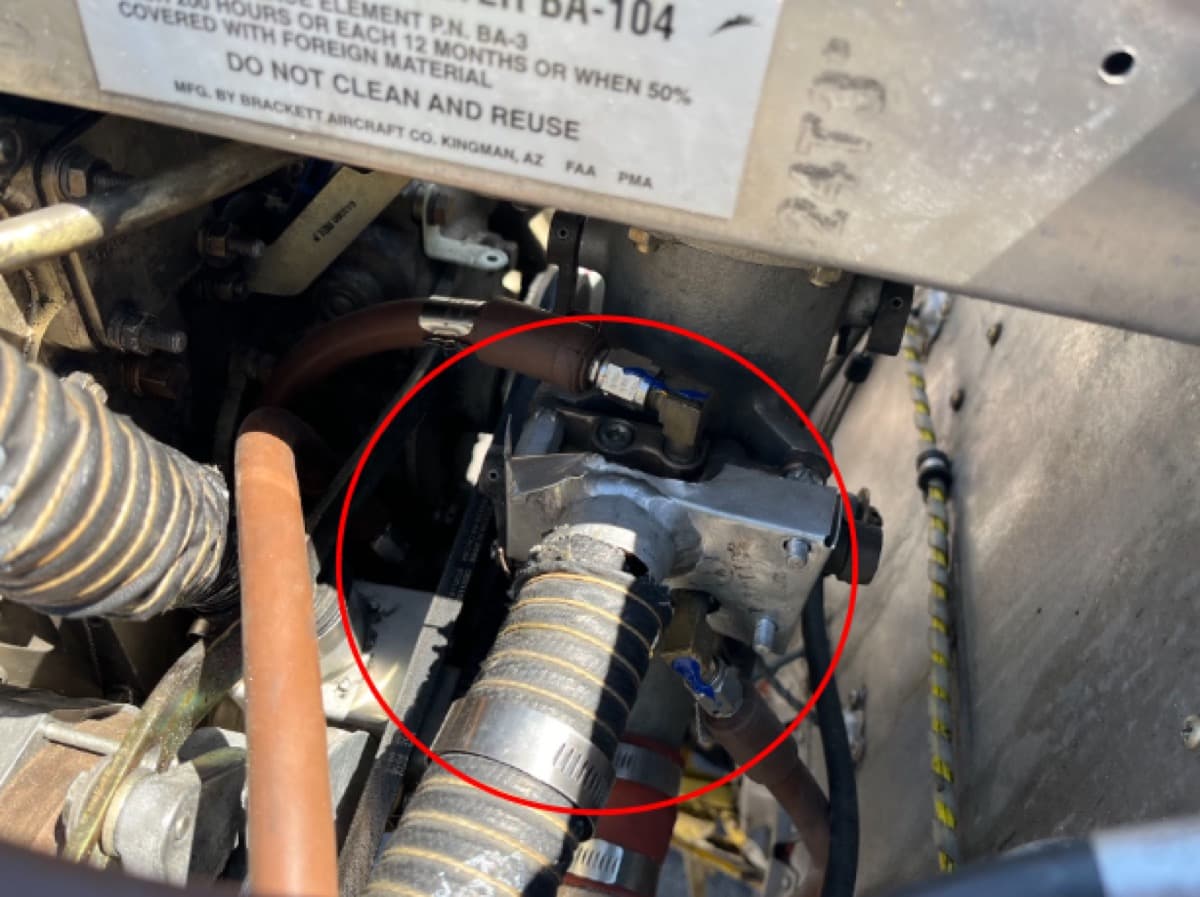
An engine start was attempted, and the engine started immediately. The engine idled smoothly. The throttle was advanced to 1,700 rpm, and a magneto check was performed. Both magnetos produced an acceptable RPM drop. Throttle was advanced to approximately 2,000 rpm. The engine ran smoothly, and the throttle was reduced to idle power to conclude the test.
Probable Cause: A total loss of engine power due to fuel starvation as a result of the pilot’s failure to properly secure a fuel supply line.
To download the final report. Click here. This will trigger a PDF download to your device.
This February 2024 accident report is provided by the National Transportation Safety Board. Published as an educational tool, it is intended to help pilots learn from the misfortunes of others.
Okay, this is rare because most loose fuel lines were by an A&P- IA.
It doesn’t say anything about the pilot being an A&P. As an old school A&PIA I can’t say we are capable of doing the job flawlessly BUT, being an active/trained/experienced A&P would have built an “extra layer” of redundancy in his completion checks. I would be much more likely to double, tripple check, maybe put some Torque Check on the fittings of that pump, before I’d let myself cover it with the shroud…. just sayin’..
Per the FAA airman registry, he is a retired ATP, flying under basicmed.
He is not an A&P, so not authorized to do that work, unless under the supervision of and A&P. But, it sounded like no followup by the A&P.!