

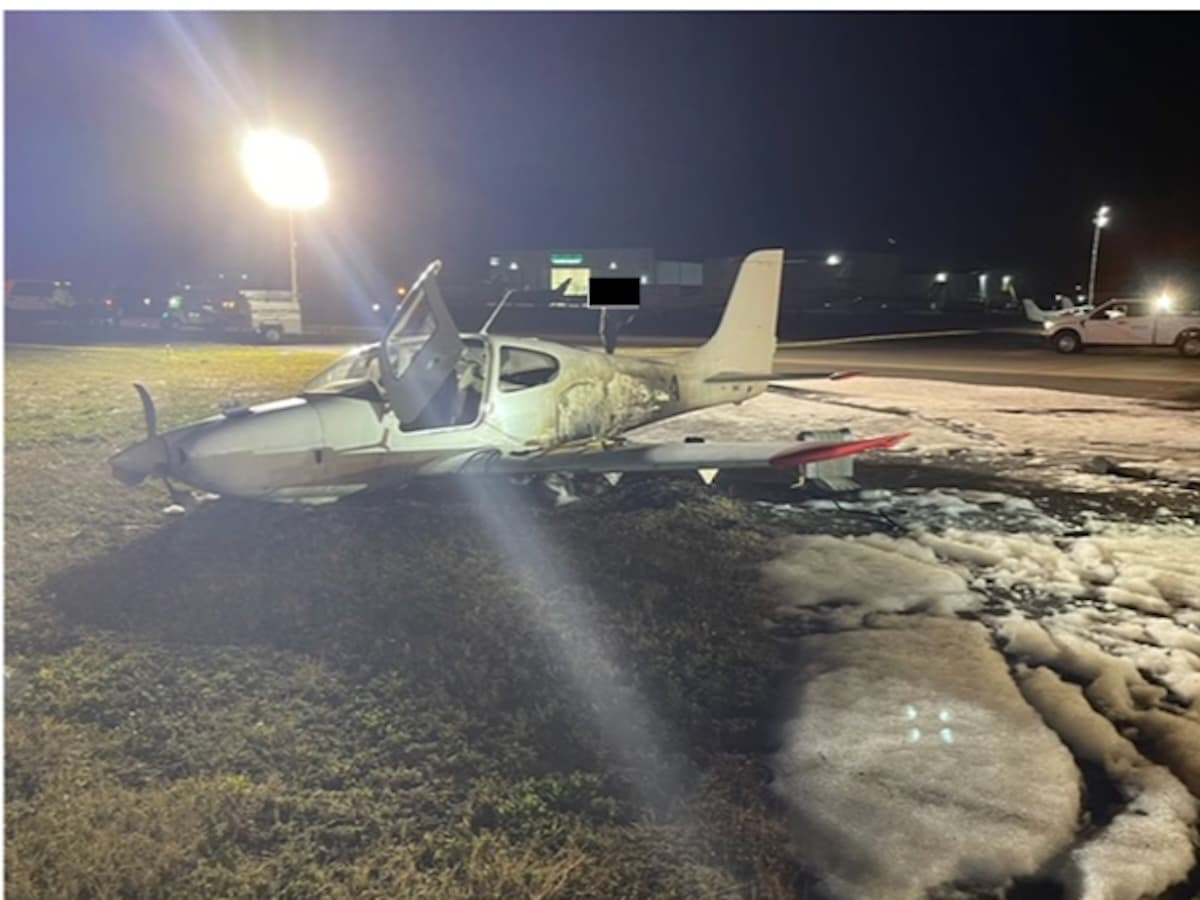
The flight departed Sanford International Airport (KSFB) in Florida, at 1718 for an instrument training lesson.
On the return flight to KSFB, the pilot under instruction was utilizing a view-limiting device to conduct a practice instrument approach to Runway 9R. He told investigators that the tower controller “switched them back and forth between 9R and 9L” before the flight instructor requested Runway 9C.
When the flight instructor advised the pilot to remove the view-limiting device, he immediately observed that the Cirrus SR20 was low on the approach path. The flight instructor acknowledged that the airplane was low and told the pilot receiving instruction to set up for a practice short field landing.
During the approach, the flight instructor noted that they were still low, so he took control of the airplane and added power. Shortly after, the engine lost all power.
The airplane subsequently hit a parked, unoccupied airplane short of the runway, and came to rest on a grassy area next to the airport ramp. The airplane caught fire, which was extinguished by first responders. The airplane sustained substantial damage to both wings and the fuselage.
The pilot receiving instruction was seriously injured. The flight instructor and a pilot-rated passenger were not injured.
According to the flight instructor, prior to departing, an additional 34 gallons of fuel was added between the two fuel tanks that already had an unknown quantity of fuel in them. This brought the fuel tanks up to “tab plus 5 gallons” on each side. The flight instructor confirmed that the 34 gallons of fuel added to the airplane was divided between the two fuel tanks.
A review of the fueling documents provided by the flight school showed that 34 gallons of 100LL was added to the airplane, but there was no documentation to show the total fuel quantity onboard the airplane prior to departure.
The engine and flight data from the Multi-Function Display and the Primary Flight Display (PFD) were examined. An initial reduction of fuel flow at 18:17:55 was observed from the engine during the descent. Fuel flow briefly increased at 18:18:20 before decreasing gradually starting at 18:18:30 down to 2.5 gph. A loss of engine power occurred at 18:18:50.
According to the airframe manufacturer, in SR20 series airplanes equipped with the Avidyne Entegra display system, there was no warning displayed on the MFD for fuel quantity. Fuel quantity was indicated only by a gauge forward of the fuel selector. There was an Amber “FUEL” caution light on the annunciator panel that would illuminate to indicate a low fuel condition. The “FUEL” caution light would illuminate when approximately 14 gallons of total useable fuel remained between both fuel tanks. This light would not illuminate if one tank was depleted to the unusable fuel level, while the other fuel tank had more than 14 gallons remaining. Furthermore, the remaining fuel caution was dependent on a pilot setting initial fuel quantity and was based on the fuel flow transducer.
During the post-accident examination, it was noted that the right wing fuel tank was not breached during the accident. The fuel remaining in the right wing was drained and 1/4 of a gallon of clean, 100LL aviation fuel was collected from the tank. The left wing fuel tank had been breached during the accident and the burn areas of the post-impact fire was primarily confined to the aft left side of the airframe.
The fuel selector was found in the “right” position and was not manipulated by first responders. The first responders did manipulate the airframe boost pump toggle switch to off and the fuel mixture knob to the idle cut-off position.
The airplane flap position switch and flap actuator were found in the 0% or “UP” position. According to the Cirrus Pilot Operating Handbook, the normal approach speed, with flaps up, is 88 knots. The total useable fuel is 56 gallons, and the total fuel capacity is 60.5 gallons. Filling the airplane to the “tabs” equates to 20 gallons per tank.The airplane PFD recorded that the airplane’s indicated airspeed was 68 knots about 6 seconds before the impact.
Review of the operator’s checklist for the airplane revealed that during the landing approach, the fuel selector should be placed to the “fullest tank.”
Probable Cause: A total loss of engine power due to fuel starvation and the flight crew’s mismanagement of the available fuel.
To download the final report. Click here. This will trigger a PDF download to your device.
This February 2024 accident report is provided by the National Transportation Safety Board. Published as an educational tool, it is intended to help pilots learn from the misfortunes of others.
There is absolutely no excuse for the incompetence of the instructor. The basic reason for this inexcusable accident is incompetence . That is what caused this crash. The instructor – “fat, dumb & happy” – is where the responsibility for this ultimately rests. The instructor should have his/her licence suspended .
The right seat instructor was giving instrument instruction to the left seat pilot, who holds a private certificate.
So, the left seat pilot was pilot in command….his responsibility.!!
I doubt the FAA, NTSB, or the courts, would have seen it that way. I don’t think there’s any question as to whether the CFII was “acting as PIC” vs. just “logging PIC time” in this case.
The CFII was giving dual instrument instruction to a non-instrument rated ‘learner’, who was being subjected to a view limiting device. That makes the CFII responsible for the “safety of flight”…ergo, the PIC…and “technically” the CFII was also the “sole manipulator of the controls” at the time of the crash.
Yup, looking at the regs, you’re right.!
I always hesitate to comment (the old, “there but for the grace of God go I”), but fuel starvation is unacceptable. Almost without exception, always depart with full tanks or don’t leave the pattern. This is becoming an almost daily event and when CFI’s are involved, it becomes downright stupid.
I always tell my students: “You can look into the dictionaries of all the languages on the earth and you will not find one word that will alibi you if you run out of gas in an airplane.” Inexcusable.
Running out of fuel is bad enough on an actual enroute type flight. On a training flight with two “qualified” pilots on board, it’s inexcusable.
Yes, there is a difference between “pilots” and “aviators.”
Does the “view limiting device” interfere with the pilot’s ability to include the fuel gauges in a normal visual scan pattern?
The gauges and fuel selector are on the lower, center console, so all 3 can see them.!!!
Apparently, no one looked.!!
Also the fuel truck log showed 24 gallons of fuel added, not 34.!! Barely 2 hrs of fuel.
Why are so many powered pilots trying to be glider pilots?
Lot of investigating and text for out of gas and poor instructor.
I agree; there’s a lot of “fluff” here just to get to the bottom line:
“Review of the operator’s checklist for the airplane revealed that during the landing approach, the fuel selector should be placed to the ‘fullest tank’”.
Given the events leading up to where the plane could “not maintain the corrected new path”, this is one where I would absolutely hammer the CFI.
Even with 350 SR20 hours, I wonder if the CFI was a ‘self-taught’ Cirrus instructor, or one of their factory “CSIP” training course graduates.
You run out of fuel you should lose your license!!! These are unacceptable accidents!
3 folks in the aircraft and no one notices that the pilot is not changing fuel tanks.?
And no one notices the fuel gauges. ?
So, a fire dameged aircraft, and, Oh, watch out for the rocket in the back area !!