

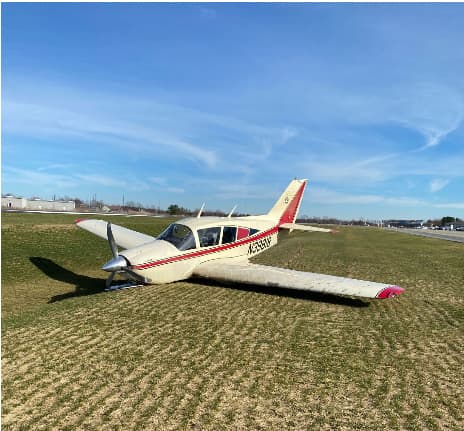
The pilot reported that during the approach to Runway 29 at the airport in Stevensville, Maryland, the Bellanca 17-30 was stable, and that the touchdown was “smooth.”
He told investigators that the airplane handled as expected in flight and during the approach and that there was a wind from 010° at 8 knots.
After touchdown, as he lowered the nosewheel, the airplane made an uncontrolled turn to the left, which he attempted to correct with full right rudder and right brake. The airplane hit a runway light before departing the runway and coming to rest in a ditch.
The wings and fuselage were substantially damaged.
Probable Cause: The pilot’s failure to maintain directional control of the airplane while landing with a crosswind.
To download the final report. Click here. This will trigger a PDF download to your device.
This February 2024 accident report is provided by the National Transportation Safety Board. Published as an educational tool, it is intended to help pilots learn from the misfortunes of others.
Although the PIC disagrees, I’m not going to debate the NTSB inspector who actually analyzed the damaged components. He can probably tell the difference between something that failed due to corrosion or mx/human error…and something broken by hitting the ground during a wild, 3-wheeling, off-road adventure.
There are a few ADs that require inspection of 17-30A nose gear, and other areas near it, that would probably reveal any corrosion or mechanical anomalies.
I’m going with the theory that the pilot just tubed the right-crosswind landing on the 60-foot wide runway:
A “side slip” technique would’ve required left rudder and right aileron. Maybe the winds were stronger than 8 knots? Maybe the right wing came up a bit; he used “full right rudder and right brake”…no mention of right aileron.
He got pushed off the left side of the pavement, hit a runway light at some point, the left main & nose gear got stuck in the dirt, and at that point he’s just a pax along for the ride.
Super Vikings are pretty stout beasts; I’ll bet it’s flyable again.
Doesn’t look like this is on the pilot, this looks like a mechanical failure. A better picture might confirm it, but there looks to be a gray portion of the rod that indicates that there was some remaining attachment that may have separated upon touchdown. The investigation seems subjective.
So, flying home after an annual inspection, a steering link fails on landing.
The pic of the broken link looks to have a lot of rust/corrosion on the fractured ends. So, the inspection missed the fracture in the link…. sad that it was missed.!