

WATSONVILLE, California — In a decision that reinforces long-standing airport safety protections, a judge has ruled in favor of the Watsonville Pilots Association (WPA), finding that the city of Watsonville unlawfully approved development projects near Watsonville Municipal Airport (KWVI) without complying with state aeronautical law and prior court orders.
In a 24-page decision issued Feb. 3, 2026, Santa Cruz County Superior Court Judge Timothy Schmal granted the pilots association’s petitions for writ of mandate, declaratory relief, and injunctive relief, concluding that the city acted in violation of the State Aeronautics Act (SAA) and the California Environmental Quality Act (CEQA).
The ruling centers on the city’s 2021 approval of a 21-unit residential project at 547 Airport Boulevard, located within the airport’s designated safety zones. The court found that the city approved the project despite failing to incorporate mandatory state airport safety standards — contained in the California Airport Land Use Planning Handbook — into its General Plan, as required by law and by earlier court rulings dating back more than a decade.
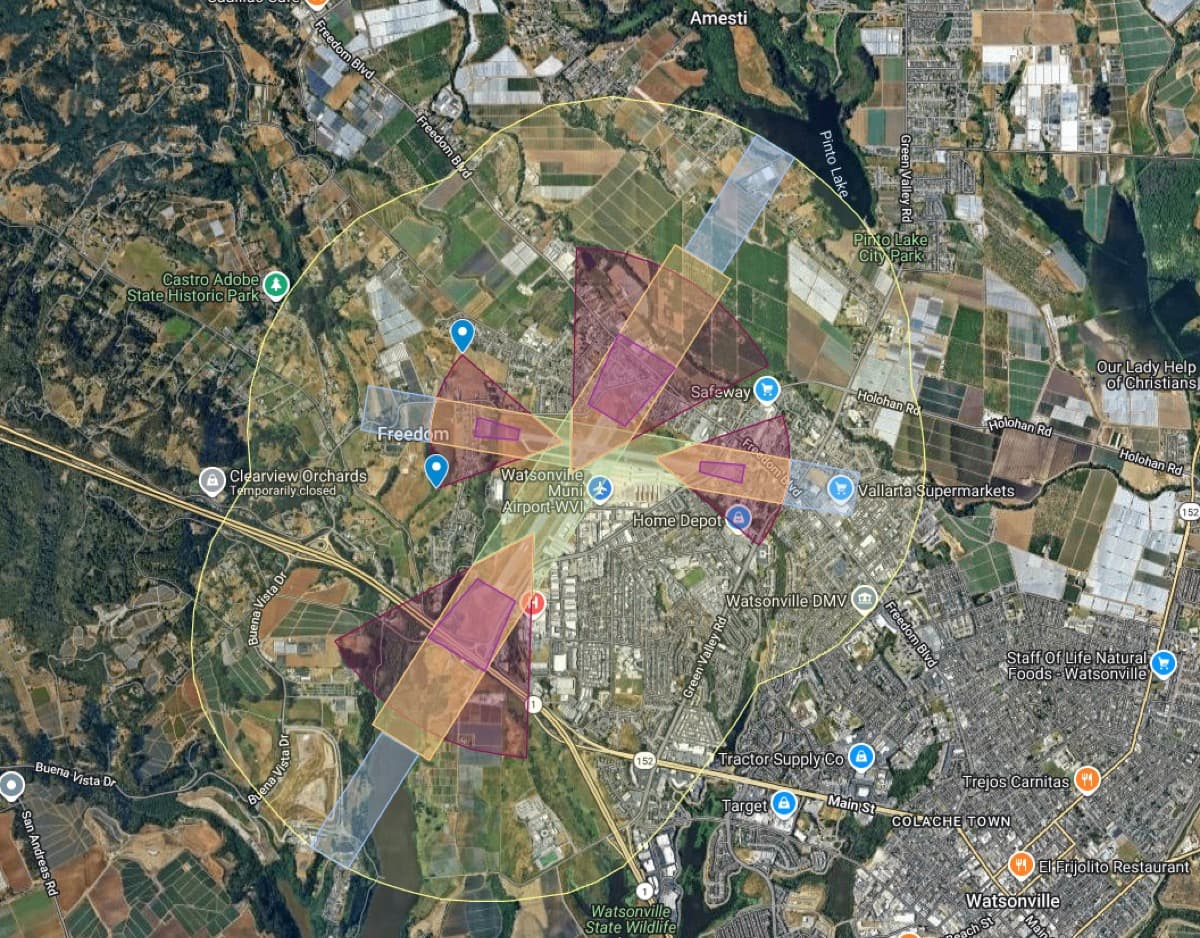
“This case is not about discretion,” the court wrote, emphasizing that the city has a “very strong mandate” to adopt all state airport compatibility standards into its General Plan before approving development near the airport.
The court traced a long history of litigation between WPA and the city, noting that both the Superior Court and the Sixth District Court of Appeal previously ruled — in 2008, 2010, and again in 2014 — that Watsonville must incorporate state aeronautical safety criteria as non-discretionary standards in its planning documents.
Despite those rulings, the city resumed approving airport-adjacent projects based on its own interpretation of safety compatibility, a move the court characterized as a clear departure from settled law. City officials argued they could rely on the city’s older 2005 General Plan and internal analyses, even though the plan does not incorporate the state’s airport safety standards.
The court rejected that argument, saying that “making findings in development applications that incorporate handbook standards is not enough” and that the city “has no discretion to substitute its own analysis for formal adoption of the standards into its General Plan.”
Environmental Review Also Found Deficient
In addition to violations of the State Aeronautics Act, the court ruled that the city improperly relied on a mitigated negative declaration (MND) rather than preparing a full environmental impact report (EIR) under CEQA.
The judge found that the city’s environmental review failed to adequately analyze aircraft noise and safety hazards for residents who would live and work near the airport. The city relied on a 2018 noise study that did not measure noise at or near the project site and offered only cursory discussion of airport safety risks, despite statutory requirements to closely examine those impacts when no airport land-use compatibility plan is in place.
“The MND’s analysis was conclusory at best,” the court wrote, concluding that the city failed to meaningfully apply state standards or provide the public with sufficient information about potential risks.
Implications for Future Development
Although the specific residential project’s permits have since expired, the court rejected arguments that the case was moot. The ruling leaves in place the city’s legislative actions changing zoning and land-use designations near the airport, meaning similar projects could be proposed again.
As a result, the court found an “ongoing, justiciable controversy” — meaning something that is capable of being decided by legal principles or by a court of law — and issued a ruling clarifying that Watsonville may not approve future development in airport safety zones unless it first brings its General Plan into compliance with state law or unless an Airport Land Use Commission is formally established.
The decision restores judicial oversight over airport-area development in Watsonville and reinforces statewide airport safety planning requirements that the pilots association has fought to uphold for nearly two decades, according to WPA officials.
Looking Forward
Officials with the Watsonville Pilots Association say they recognize that Watsonville “faces significant housing needs,” noting they support “responsible, well-planned growth that expands housing access while protecting public safety and critical infrastructure.”
Association officials add they remain committed to working with the city to “advance housing solutions that comply with the State Aeronautics Act and CEQA.
“By incorporating the required airport safety standards into the city’s General Plan, Watsonville can move forward with greater certainty — supporting thoughtful development while ensuring the safety of residents, airport users, and the broader community,” officials concluded.
For more information: WatsonvillePlots.org
Location — Addison, Texas. Politicians sponsored the Dallas Grand Prix which consisted of racing across the only runway. Reason, brainless politicians wanted to close the airport because the land was very premium and because the politicians were on the take (like the majority of politicians). Fortunately, the FAA grant program stipulated that all grants monies (several millions over the years) had to be returned if the airport was closed. The Dallas grad prix was moved elsewhere.
The airport brings in millions of dollars to the community annually. That depicts the stupidity of politicians!
An “airport land use commission?” My first thought was “another group that can be lobbied/bought by the developers.”
This same problem exists throughout most of North America and then the municipalities appear shocked that is does not go well. I do wonder if getting elected impacts the brain of politicians.
What brain?
It seems common practice for municipals to act more in the interest of immediate development rather than safety and consideration of their local airports and citizens. Forgetting the employment, financial and taxable income their local airports provide to the local area.
Airport historically have been built in open space areas and over times municipals have crowded and squeezed up to the airport property and then act as if the airport is the problem, and not the poor planning and development the municipals have allowed to push up to the airport property lines. Encroaching upon RPZ and building homes, multi-level housing in direct conflict to runways and common scene safety areas. The open space around airports is there by design and for a reason.
This ruling should be a wakeup call to municipals of their responsibility to properly plan and develop their towns while considering the airport, safety, noise issues and federal and state aviation requirements.
I can think of several other California airports who suffer the same situation. It will be interesting to see if this legal standing reaches other municipalities.