

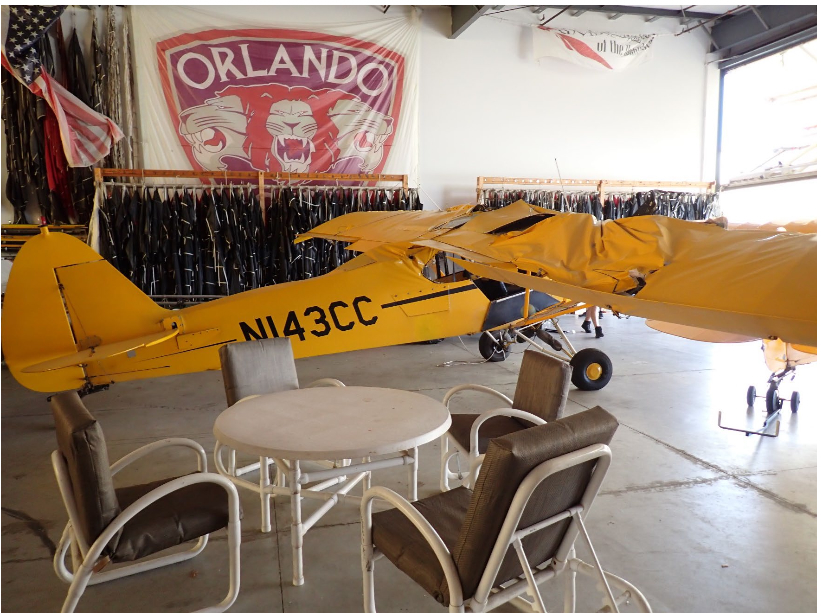
After dropping his banner, the pilot told investigators that while on short final approach to land at the airport in Edgewater, Florida, he heard a loud snap about 20 to 30 feet above the runway. The control stick went slack in his hand and he lost aileron control of the CubCrafters PA-18-150.
The airplane rolled to the right. He used the rudder and elevator to attempt to control the airplane. The airplane traveled between two airplanes that were on a taxiway and hit the side of a hangar, resulting in substantial damage to the fuselage and both wings.
Post-accident examination of the airplane revealed that the left aileron direct cable was separated where the cable went through a pulley on the lower left side of the fuselage. The damage on the separated cable was consistent with having occurred before the impact. The separated ends of the cable displayed significant wear of the cable strands, consistent with the cable rubbing against the pulley.
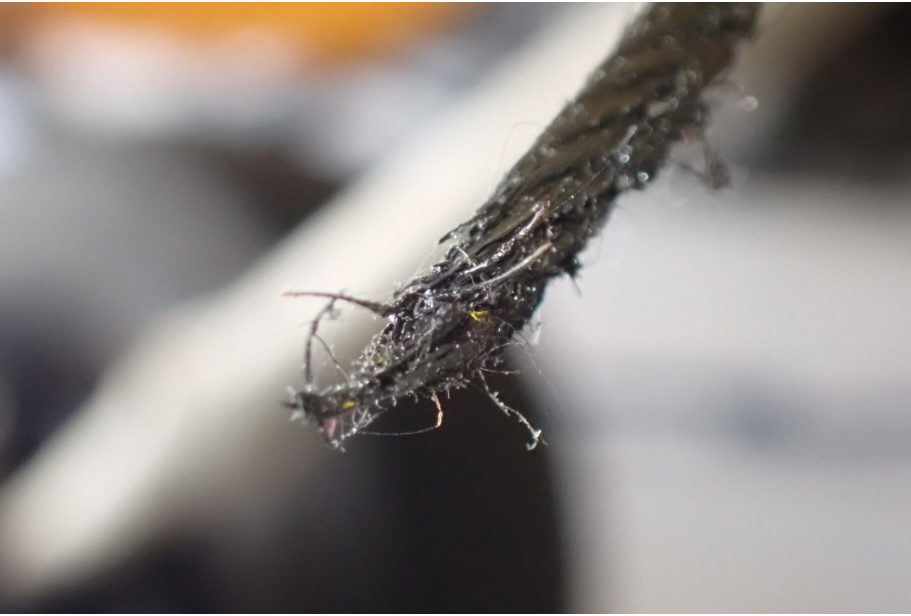
The control cable also displayed significant corrosion in multiple locations and the area around the separation was coated with dirt, grime, and a greasy substance.
The aileron pulley at the location of the cable separation was checked for operation and the pulley would bind while attempting to rotate.
When the pulley was removed from the airframe, the pulley bushing and bolt displayed significant corrosion and a small portion of the outer part of the pulley had broken free. The fracture area was coated with the same dirt, grime, and greasy substances as found on the control cable, consistent with the fracture occurring before the accident.
Control continuity was established for the remaining flight control cables.
Inspection of the right aileron direct cable revealed corrosion on the portions of the cable that were outside of the airframe structure. The corrosion resulted in the cable being stiff. When bent, large flakes of corroded metal broke free from the cable.
The inspection revealed about 10 broken cable strands in the right aileron direct cable. It also displayed wear damage where it went through the right lower fuselage cable pulley.
Further examination of the airframe revealed corrosion of several of the structural tubes and the landing gear.
Post-accident examination of the engine revealed severe corrosion concentrated around the cylinder bases. The valve springs on several of the cylinders also displayed corrosion, however none of the valve springs had fractured.
Visible indications of exhaust leaks were found on the No. 2 and No. 3 cylinders around the exhaust riser flanges.
There were no anomalies observed that would have precluded normal operation of the engine. The pilot reported the engine operated normally during the flight and was running at the time of impact with the hangar.
A review of the maintenance records showed that the airplane had three 100-hour inspections in the past six months. The last 100-hour inspection was performed 67.7 hours before the accident, on Feb. 2, 2024, about a month before the March 1, 2024, accident.
Further review of the maintenance records revealed that both the left and right aileron direct cables were changed on June 11, 2015, at a tachometer time of 4,377.6. The tachometer time at the time of the accident was 7,045.6, indicating the left aileron control cable had been in service for 2,668 hours. The right aileron direct cable had been replaced on Sept. 23, 2021, and had been in service for 1,419.4 hours.
The logbooks indicated that before changing the aileron direct cables in 2015, the cables were made of stainless steel. Maintenance personnel switched to a part that was composed of galvanized steel. When asked why they switched to galvanized steel, the mechanic responded that they had found broken strands on multiple occasions with the stainless-steel cables and were trying to improve cable longevity.
When asked if maintenance personnel applied anti-corrosion products to the galvanized steel, the mechanic replied that they did not routinely use anti-corrosion products on the galvanized steel cables on the accident airplane.
Probable Cause: Maintenance personnel’s failure to detect the worn aileron cable during the most recent inspections, which resulted in the separation of the aileron control cable and a subsequent loss of airplane control during landing.
To download the final report. Click here. This will trigger a PDF download to your device.
This March 2024 accident report is provided by the National Transportation Safety Board. Published as an educational tool, it is intended to help pilots learn from the misfortunes of others.
Over 7000 hours on a CarbonCub? Wow! And poor salt air environment maintenance, to boot.
Otto,
We have the same thing in the automotive industry with owners who want a lick’m ‘n stick’m State Inspection (the auto version of pencil-whipping), also lackadaisical shop owners who don’t fail vehicles with incorrect lighting (For example, LEDs in projector housings, ornamental lighting), worn out tires or other components, tires that extend beyond the body/fender line, or vehicles that fail emissions and they want them cheated through. Those shops eventually get sanctioned or eliminated, but not fast enough.
Oddly, pilots seemed to be more concerned with their automobile operation and cheaped out on the plane maintenance; maybe because they used the automobile more?
I wonder if in this situation, were maintenance personnel encouraged to turn a blind eye? I don’t know about you, but if my aileron cable was rusted, worn or stiff, I’d want all of the cables replaced at the same time. If that meant I couldn’t fly for a while, so be it. I’d rather that than the expense of having to replace the cables and some bent/wrinkled/destroyed airframe parts – or ending up maimed or dead.
Edgewater is, like it’s name implies, right on the edge of the Atlantic. This is a highly corrosive salt-air environment. I would be especially dilligent in inspecting or purchasing a plane operating in coastal Florida areas.
Having said that, as an A&P myself, it sounds like this plane received pencil-whip inspections for the last several years. This type of thing is why I never got my IA and worked in GA (mainly with airlines) – I would never have passed a plane in this kind of condition. Some aircraft owners would have been unhappy with me (It passed last year by so-and-so, why not you?), and they would have just found another IA.
But I know of good IA’s who wouldn’t let this kind of neglect go by either, and this GA plane should be the exception rather than the norm.