

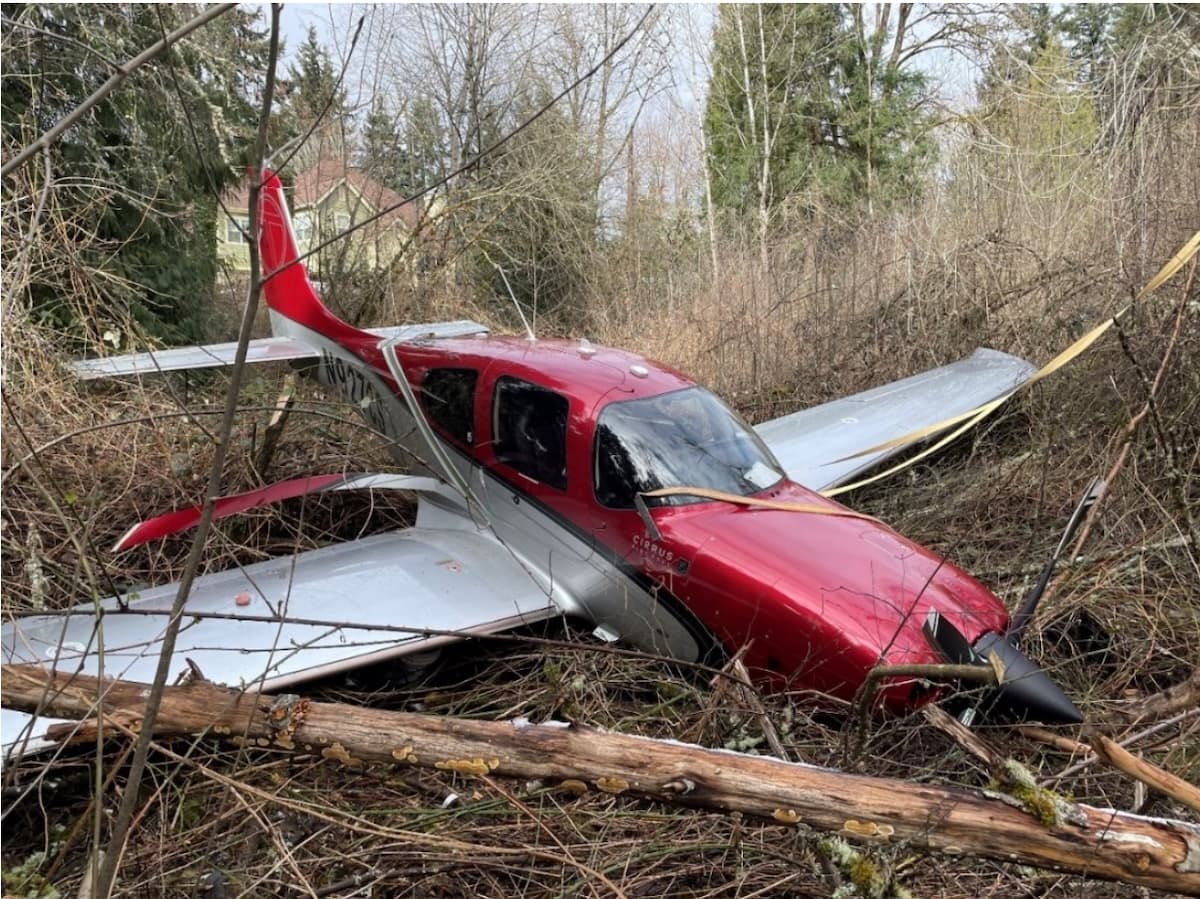
The flight instructor and pilot receiving instruction reported that after takeoff from Runway 34 at Renton Municipal Airport (KRNT) in Washington, in the Cirrus SR22T, they leveled off at about 2,500 feet mean sea level (MSL).
A few minutes later, the engine RPM surged a few times, followed by the sound of a loud bang and subsequent total loss of engine power. Unable to restart the engine, they deployed the CAPS parachute system and the airplane descended into a wooded wetland area adjacent to a residential neighborhood near Bellevue, Washington.
Examination of the accident site revealed that the airplane hit terrain about four miles northeast of the departure end of Runway 34. The airplane came to rest upright in an approximate 10° nose-low attitude on a heading of about 66° magnetic at an elevation of about 417 feet MSL.
Review of the airframe and engine logbooks revealed that the engine, a Continental Motors TSIO-550-K1B, was overhauled in November 2019, and installed on the airframe in April 2020. At the time of the March 5, 2024, accident, the engine had accumulated about 680 hours since major overhaul.
Examination of the recovered wreckage revealed damage to the nose landing gear fairing. Both wings and flaps were removed by recovery personnel. The engine remained attached to the fuselage via the engine mount. All six cylinders and all engine accessories remained attached. All fuel and oil lines appeared attached to their respective fittings. No evidence of any mechanical damage was observed to the engine crankcase. Throttle and mixture control continuity was established from the cockpit controls to the fuel servo and moved its available length when actuated by hand. The engine was shipped to the Continental Motors facilities for further examination.
Subsequent examination of the engine revealed that all six cylinders remained attached to the engine crankcase and no external visible damage was observed. The engine was placed on a rotating engine stand and disassembled.
Fretting was observed on the parting surface of the No. 2 main bearing saddle. Damage to the Nos. 3 and 4 cylinders barrel skirts were observed. The No. 2 main bearing (M2) saddle remained in place and was deformed, consistent with a rotating main bearing. The engine was further dissembled to access the crankshaft and rotating mass. Damage to the interior crank case was observed throughout. The crankshaft near the M2 journal and the No. 3 connecting rod journal was fracture separated.
The crankshaft was sent to the NTSB Materials Laboratory in Washington, D.C., for examination. The examination of the fracture surface revealed characteristics consistent with fatigue cracking that initiated at multiple locations along the radius of the web within the C3 journal. As this crack propagated rearward, a second smaller fatigue crack initiated along the radius of the aft M2 bearing.
Review of maintenance records did not reveal any recent maintenance performed on the crankshaft.
Probable Cause: A total loss of engine power due to a fatigue fracture of the crankshaft.
To download the final report. Click here. This will trigger a PDF download to your device.
This March 2024 accident report is provided by the National Transportation Safety Board. Published as an educational tool, it is intended to help pilots learn from the misfortunes of others.
I thought I was going to read that the engine was overhauled at an FBO maintenance shop, but it was a Continental rebuild. I’d be inclined to go with a manufacturer rebuild, only because my automotive experience tells me that a manufacturer almost always has a “clean room” type of environment rather than a repair shop where two or several more jobs are going at once. In this case, it didn’t seem to matter, but there may have been something else going on, as I did not sift through the maintenance logs.
I believe that TCM will reuse the crankshaft on an overhaul, after doing all the inspections.
So, this engine may have a total time close to the 3,400 airrfame hours.!
The Cirrus SR22 runs the engine at high rpm with their combined throttle and prop controls, and the turbo. So a lot of stress on the engine…depending on how hard the pilot runs it….go fast needs more power.!!
spun a main…dry-torqued the thru-bolts maybe?