

The NTSB’s final report on the March 2024 accident starts with: “About 30 minutes into the flight, without warning, the airplane’s engine made a loud noise and stopped producing power.”
Half a breath after the loud noise, oil sprays across the windscreen, blocking the forward view. The nearest airport is too far to reach at his altitude, and the pilot is flying over the Altamaha River in Georgia, which is in flood stage. He establishes best glide, makes his Mayday call to Center, then glides beyond the river.
It’s still not the friendliest part of Georgia in terms of off-airport landing areas. Below is a carpet of closely spaced pine trees and hilly terrain. But the airplane is a 2015 Cirrus SR22 Xi Edition and, like all Cirrus aircraft, is equipped with a full-frame parachute. The pilot waits until reaching the bottom of the deployment altitude to get well clear of the river and surrounding swampy land, then he “pulls CAPs,” deploying the chute.
He, his wife, and their dog float down out of the sky toward the forest.
The Cirrus smacks into the trees, flips nose down, and comes to rest tangled in young pines with the spinner nearly touching the ground. The pilot, wife, and dog are not injured.
The Cirrus isn’t so lucky. It’s “substantially” damaged, according to NTSB investigators.
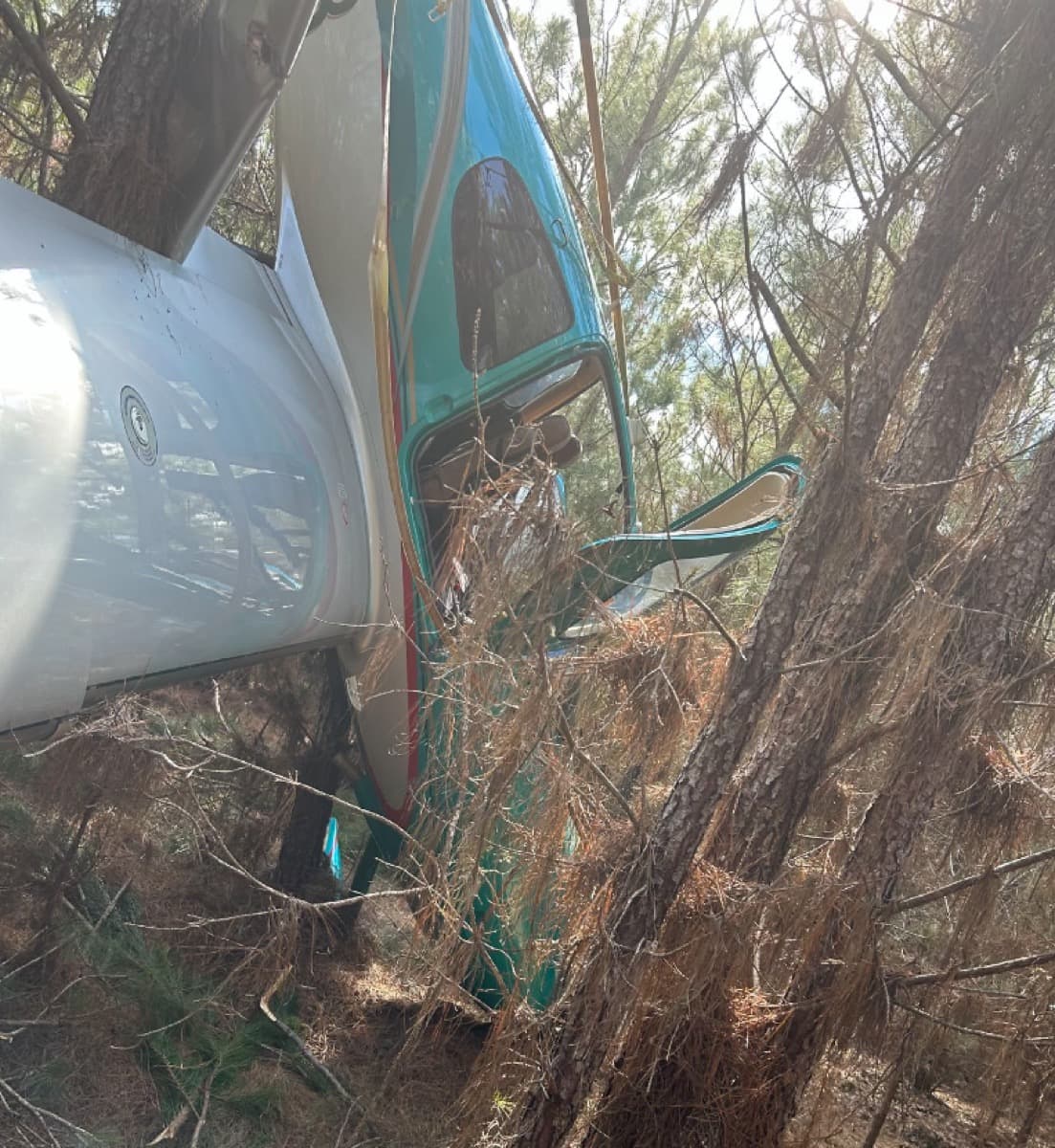
The NTSB
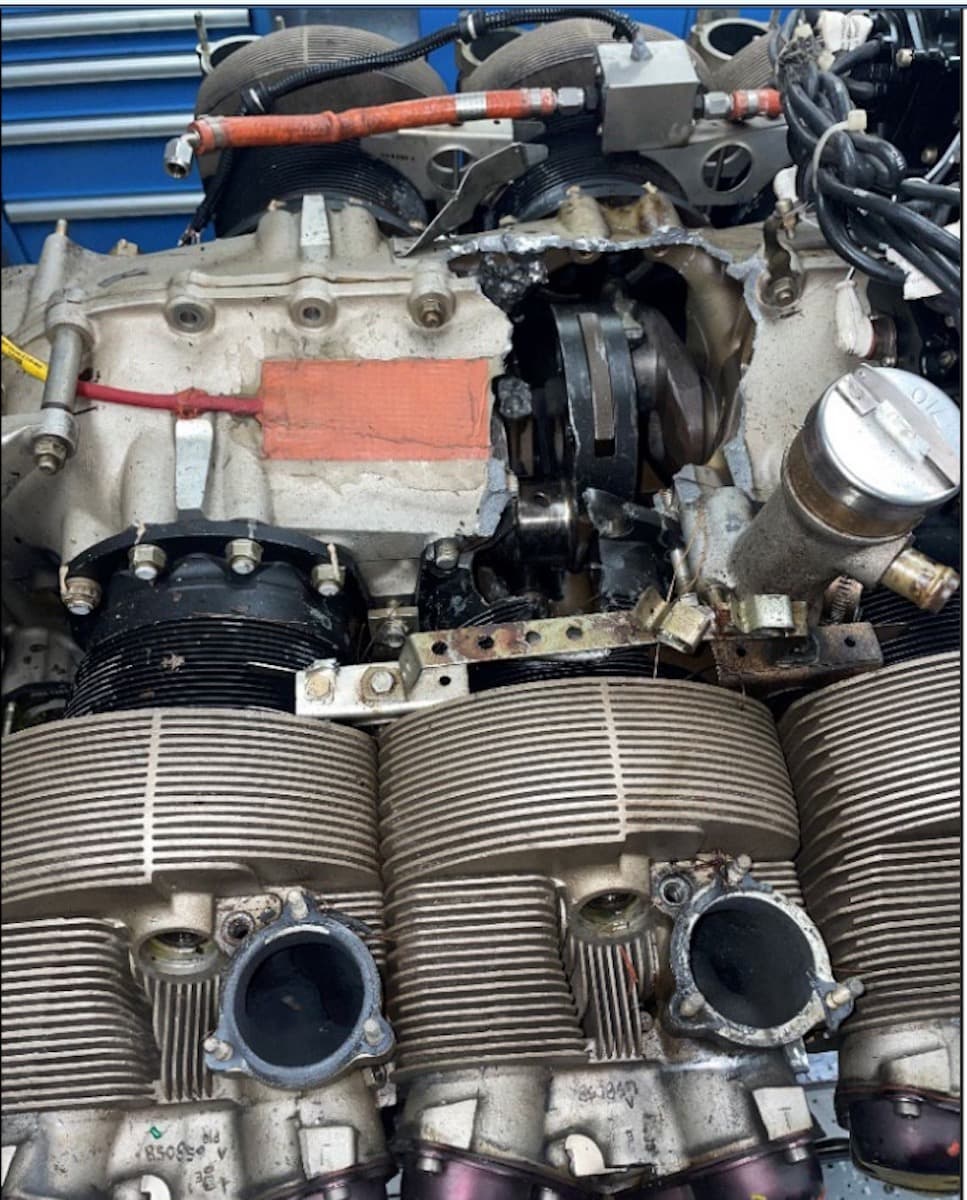
It didn’t take the NTSB investigators long to figure out why the engine stopped producing power. With the cowl off, they discovered “a hole in the crown of the engine crankcase near the Nos. 3 and 4 cylinders.”
That’s a serious understatement. A good quarter of the top of the engine case is…. well… gone, along with a good chunk of the base of the middle cylinder on the pilot’s side, the No. Four.
Were it not for the ragged edges, you’d swear the engine was a cutaway model for teaching powerplant mechanics.
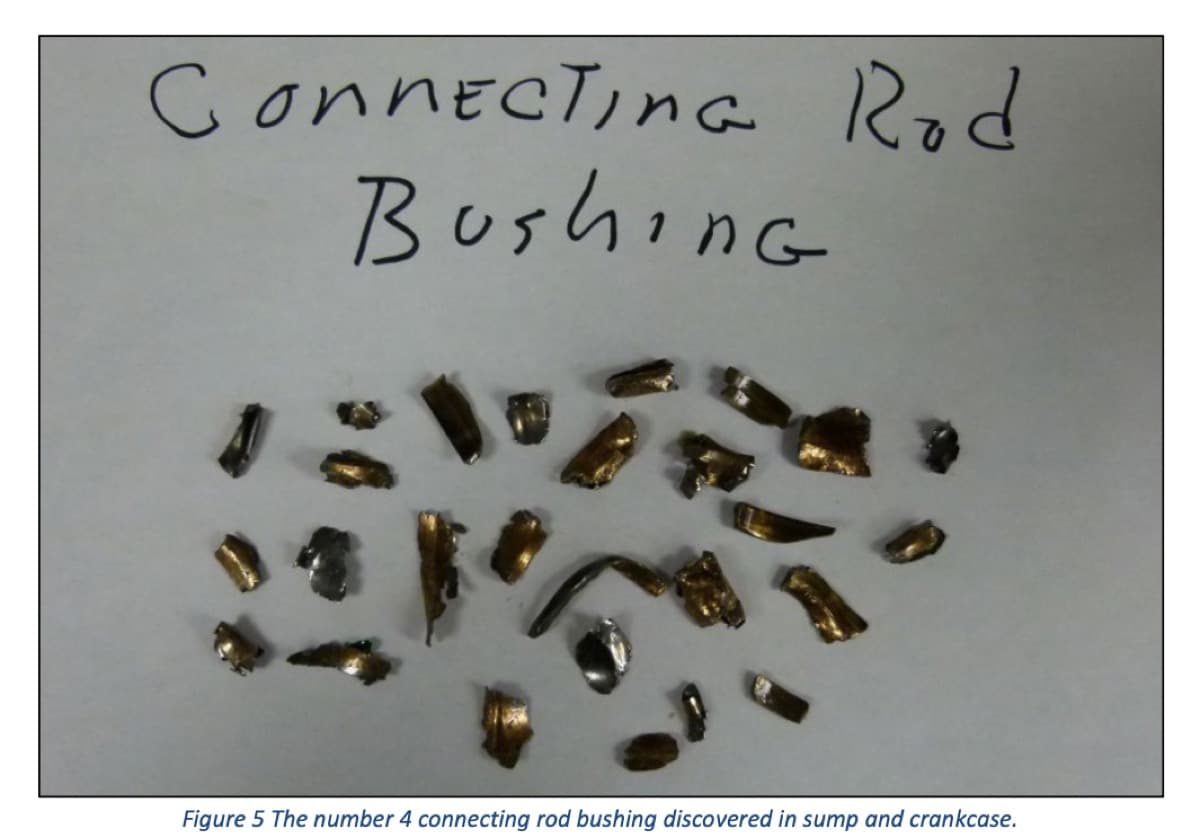
It also didn’t take long for the investigators to discover that the connecting rod for the No. Four piston was no longer connected. Actually, it was altogether missing, and only small fragments of it and its bushing were recovered — from throughout the crank case and down in the oil sump. Pieces of the piston were also recovered from the oil sump. A substantial volume of metal fragments were found in the oil filter and the oil pump even had internal scratches from metal passing through the system.
The five remaining connecting rods were all in trouble, too, every one of them. All of their bushings were “dislocated” to varying degrees, showing “various signs of migration out of their respective locations,” and all of the bushings were chipped. In fact, some of the remaining bushings, while still more or less in their seats, were broken.
For those less mechanically savvy, these are the high-load sleeves at the piston end of the connecting rod that the piston pin lives in.
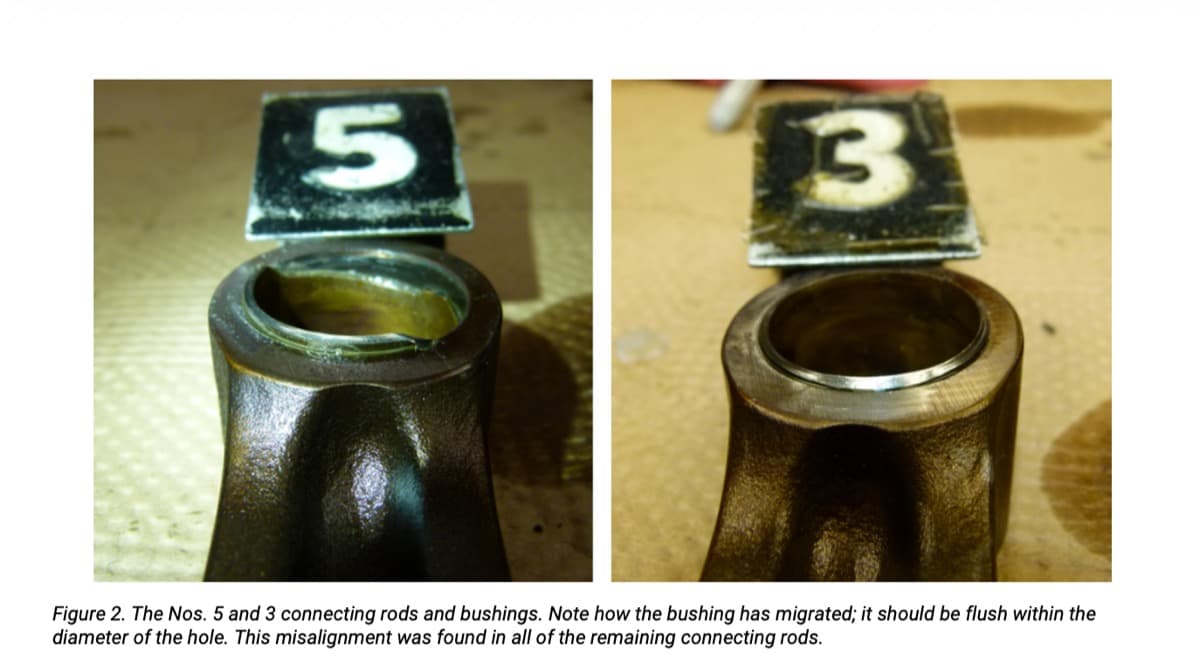
“Given these findings,” the report reads, “it is likely that the bushings unseated themselves and migrated outward, resulting in imbalance, vibration, and the eventual failure of the No. 4 bushing and the subsequent total loss of engine power.”
So how could an engine in this condition fail “without warning?”
Analysis & Discussion
The first thing that jumps out when looking at the large volume of reports and documents on the docket is that a Critical Service Bulletin (CSB) from the engine manufacturer, Continental, wasn’t followed. That said, the mechanic who took care of the airplane felt he was “going over and above” the requirements of the CSB, and, of course, there is no requirement for either owners or mechanics to adhere to manufacturer bulletins — critical or not.
But would it have made a difference in this case? Let’s take a look at the CSB.
The Cirrus was powered by a Continental IO-550, a powerplant included in the bulletin, CSB07-01A, along with nearly every other engine that Continental has ever made. This document, first issued 19 years ago in 2007, and revised four years before the accident in 2020, states that Continental had received field reports of metal from connecting rod bushings being found in oil sumps and oil filters, and calls for what Continental calls “augmented” oil change procedures and visual inspection of the bushings any time a cylinder is removed for any reason.
What on earth is an augmented oil change?
Apparently it’s comprised of two steps: Cutting open and inspecting the oil filter, which pretty much everyone does anyway, and actually straining the entire volume of oil as it’s drained from the sump at each and every oil change, then inspecting the strainer for metal chips.
The bulletin recommends using a 1,000-micron mesh screen. A thousand microns is about 25% smaller than the eye of a needle. A screen that small will catch a grain of beach sand. Arbor Fabricating makes one for $75 that fits over a standard 5-gallon bucket, the unit specifically recommended by Continental in the CSB.
After straining, you are to wash the strainer out and look for bushing fragments. Sounds messy. Washing oil off a screen isn’t the easiest thing to do under any circumstances and can’t be fun at the 1,000 micron level.
If bushing metal is found, then Continental says the cylinders should be pulled (two at a time) and all the bushings inspected. Pricey and not without risk itself. Pulling one cylinder — much less all of them — is major surgery that often causes problems of its own and should not be undertaken lightly.
But back to the augmented oil change…
The bulletin makes no mention of microscopic analysis of oil samples for signs of metal, which was part of the plan in place for the accident airplane. Its oil was also changed more frequently than the minimum — every 20 to 30 hours, rather than every 50 — hence the “over and above” mentioned by the mechanic.
Still, this was one sick engine, with all the bushings coming apart at the seams. Why didn’t that show up in the oil analysis? The previous six oil analyses all showed normal wear metal levels and the filters were always clean. The engine self-destructed only 15 hours after an oil change, and, statistically, it’s hard to imagine all the bushings on each cylinder going into failure mode simultaneously in such a short period. The engine itself was middle-aged at 1,507 hours — generally a safe zone where catastrophic failures aren’t often seen.
All of that said, on the final oil change before the failure, the mechanic noted “trace” amounts of metal in the filter. He notified the oil analysis company of this when he sent the sample in. The mechanic was “in communication” with the lab on the findings, but there was nothing to indicate a potential issue with the engine, no “red flags.”
So that begs the question: Does a microscopic oil sample analysis adequately replace the old-school recommended straining? Would straining the oil have caught the trouble had it been done?
We’ll never know. Straining obviously has the benefit of looking at the entire contents of the sump, while a sample is…well, just that. On the other hand, the microscopic analysis should be able to pick up on things before they are bad enough to see with the naked eye. Should one do both?
The Takeaway
In this case, I’m not pointing my finger at either the owner or the mechanic.
But it’s interesting, and worth thinking about, that a pretty much “old school” technique might be able to catch problems our newer tools miss. My engine is on the list. Will I start straining in addition to inspecting the filter and sending out a sample? Let me sleep on that…Actually, I don’t need to sleep on it. My airplane doesn’t have a full-frame parachute, and I frequently fly over unfriendly terrain, in terms of off-airport landings. Yeah, it’s gonna be messy, but it’s also cheap insurance. I’m ordering the stupid strainer.
Interestingly, the last line of the report on the interview with the mechanic in the NTSB accident docket says that the mechanic is going to do the same thing going forward — adding the two-decade-old straining recommendation to his go-to “over and above” recipe of microscopic oil analysis and frequent changes.
The Numbers
Want to read more? Download the NTSB’s final report here or view the items on docket here.

Am I missing something here? It seems as though this scenario is akin to building inspectors developing scheduled techniques to catch signs of scorching and melting in a structure wired with aluminum instead of copper wire before anything disastrous occurs. Why not install higher quality bushings and be done with it?
I’m a big believer in engine oil analysis, maybe because I do anesthesia for a living. I can stare at urine in a cup, but a lab analysis makes me feel a lot better. It’s always a reassuring feeling to get back a clean report.
I’m buying the screen in spite of flying a low compression engine.
Seems ridiculous that with umpteen millions of engines of all types in service that one this “sophisticated” has wrist pin issues and causing this kind of jeopardy, uncertainty, service and cost issues.
The FAA did not see fit to issue an AD, which leads me to believe there were only a few rare incidents involving premature worn bushings. So, how many incidents have been reported since 2007? Does anyone know? No one has ever mentioned the bulletin to me, and I have had my C182 O-470U worked on by very reputable shops over the years. My current O-470U is the third engine I have installed. It is now 200 hrs over TBO, to be replaced first of May.