

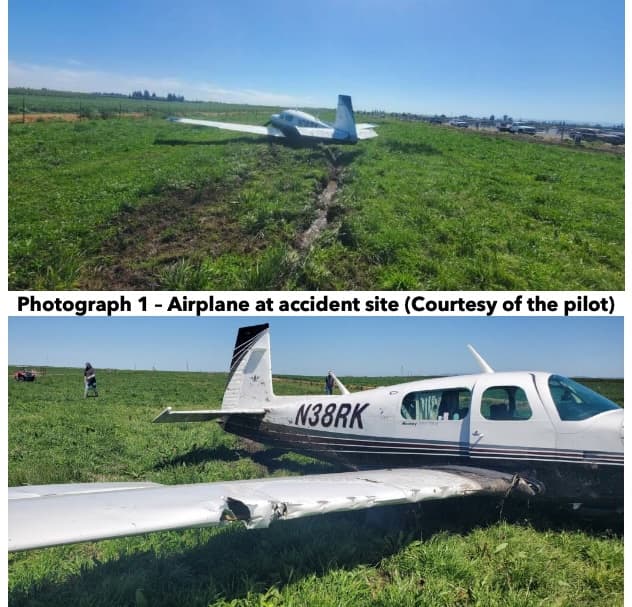
The pilot intended to get fuel at the destination airport, which had cheaper fuel and was a short distance away.
During the Mooney M20K’s preflight inspection, he noticed that the low fuel indicator was illuminated for one tank, and the panel gauge for the other indicated it was one-quarter full, which he estimated would equate to about 20 gallons. He cross-checked the levels with the airplane’s fuel totalizer system, which indicated 20 gallons of fuel remained.
While en route, he noticed the fuel gauge level dropping faster than he anticipated. A short time later the engine lost all power due to fuel exhaustion.
He made a forced landing onto a dirt road on a farm, after maneuvering the airplane under a power line. The Mooney hit a fence on roll-out and sustained substantial damage to both wings. The pilot and passenger were not injured.
The pilot reported there were no preaccident mechanical failures or malfunctions with the airplane that would have precluded normal operation.
The airplane’s low fuel indicators illuminate when about two-and-one-half gallons of fuel remain in their respective tanks. Each tank holds about 9 gallons of fuel when one-quarter full, rather than the 20 gallons the pilot had estimated.
The pilot told investigators that he had mistakenly used the airplane’s total fuel capacity of about 76 gallons when making that calculation, rather than half the value that a single tank could hold. He added that he may not have properly adjusted the totalizer the last time he fueled up, so its reading was not accurate. Because the totalizer and fuel tank gauge readings were similar, he concluded that sufficient fuel remained “due to confirmation bias.”
The pilot added that he is risk averse, conservative in nature, and has never departed with the low fuel light on before but, he surmised, the cheaper fuel at the destination likely influenced his decision to proceed with the flight.
Probable Cause: The pilot’s improper preflight fuel planning that resulted in the loss of engine power due to fuel exhaustion.
To download the final report. Click here. This will trigger a PDF download to your device.
This March 2024 accident report is provided by the National Transportation Safety Board. Published as an educational tool, it is intended to help pilots learn from the misfortunes of others.
When will some pilots get smart! YOU SHOULD LOSE YOUR PILOT LICENSE FOR RUNNING OUT OF GAS! and have to take all your checkrides over if you want to keep flying! Can’t fix stupid!
What a shame, very nice looking airplane..
I wonder if this guy keeps an empty gas can in his car when (probably frequently) runs out of gas and has to “hoof it” to the nearest/ cheapest gas station! Obviously this guy was really an aspiring glider guider!
Short arms and deep pockets, in a Mooney, no less.
Yep, I’d go with license revocation, too. Either that, or such a substantial increase in rate such as to offset the increases that naturally occur to other pilots. The only problem with that is, once the high rates are paid, then the insurance company thinks it is OK to raise the rates anyway, since people keep paying them.
I’m back to revocation. Insurance pays for stupid, but stupid should have a cost. Pilots are supposed to be trained out of stupid and into diligence, but alas, this fails time and again.
I’m leaning toward a mandatory revocation of certificate for running out of fuel. Other than a massive fuel leak in flight, there is no reason to ever run out of fuel in this country. This happens just about weekly and is destroying our rapidly shrinking fleet of general aviation aircraft.
He’s not risk averse, he’s cheap.
I see a number of issues that lead me to think that this guy should not be flying anything.
– he landing on his last flight with ‘low fuel ‘ warning on one tank and 1/4 tank on the other, which is about 9 gallons, barely 45 minuted of fuel….legal, but dumb.!
– He takes off not knowing that he miss-calculated the remaining fuel, didn’t stick the tanks, but believed the gauge and miss-understood the fuel totalizer.
– He didn’t lean the mixture on this ‘short ‘ flight.
– the fuel totalizer mfrs,clearly state, that the ‘fuel remaining’ is not an accurate display of the actual fuel remaining..
So, trying to save $1 per gallon he does serious damage to the aircraft, a lot more than 60 -70 gallons of fuel, assuming that he planned on filling the tanks…probably not.!