

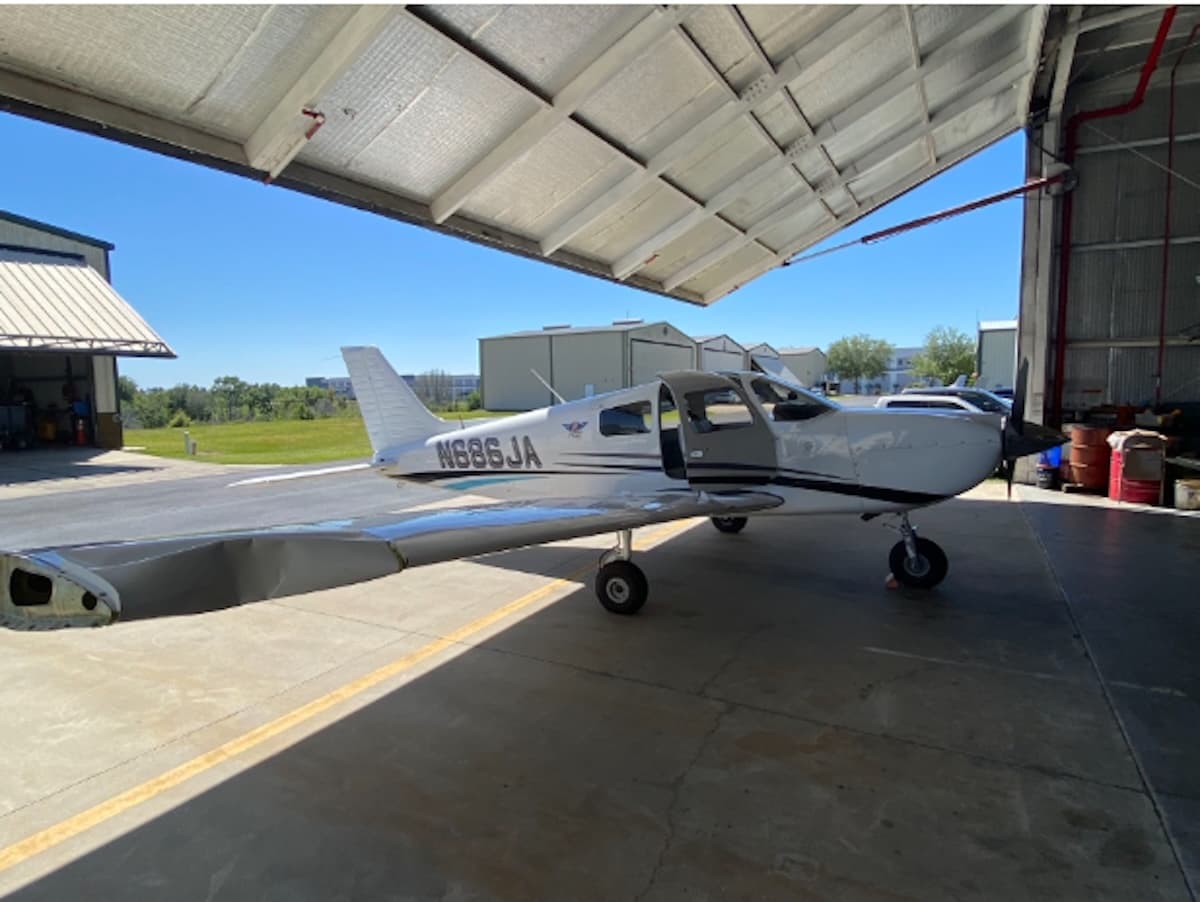
The student pilot landed at the airport in Apopka, Florida, after a solo cross-country flight and was taxiing the airplane along a taxiway.
A video from a security camera showed the Piper PA-28 taxiing while an individual who was not wearing visible hearing protection, audio headphones, or wearing visibility-enhancing outer clothing was performing landscape work with a powered edger alongside a building.
As the airplane approached the building traveling at what the pilot reported as a “standard ground speed,” the landscape worker — who told investigators he did not notice the airplane approaching from his left — moved towards the taxiway.
As the airplane continued along the taxiway centerline, the worker moved to the edge of the taxiway with his head tilted down and then turned to the right to follow the edge of the taxiway, placing his back to the approaching airplane. The outboard portion of the airplane’s right wing near the wingtip hit the worker and knocked him forcefully to the ground, resulting in serious injuries. The airplane veered slightly to the right off centerline before stopping.
A post-accident examination of the airplane by an FAA inspector revealed that the airplane’s wing had incurred minor damage. The inspector also found that there were no discrepancies with the airplane’s braking or steering systems, nor did the pilot report any. Additionally, there were no skid marks on the taxiway, and the main landing gear tires did not exhibit any flat spots consistent with heavy braking having been applied before the collision.
Probable Cause: The pilot and the landscape worker’s inadequate visual lookout, which resulted in a collision.
To download the final report. Click here. This will trigger a PDF download to your device.
This March 2024 accident report is provided by the National Transportation Safety Board. Published as an educational tool, it is intended to help pilots learn from the misfortunes of others.
When you say “Landscaper” are you saying a commercial landscaper, an airport employee or a private owner/lease holder at the airport?
Let me correct my comment: 14 CFR Part 91.113 “Right of way rules: Except water operations” will NOT apply in the LGA accident, since it involves a vehicle, not another airplane. It also does not apply in the Piper/landscaper taxi collision.
Curran
To DA: Thanks, very well put.
Here’s my take: I wish more folks would read the all the information GAN provides before responding. For example, these are the Piper PIC’s eight “Additional Comments” taken verbatim from his NTSB Form 6120.1:
1. I was properly rated and had all required endorsements to conduct the solo flight of N686JA on the date in question.
2. I was operating this aircraft on a designated taxi way at a public use airport.
3. As PIC of thee aircraft I had the right of way over any vehicular or pedestrian traffic in the area.
4. Prior to conducting my flight, I checked all applicable NOTAM’ s and found none advising that vehicles and/or personnel would be conducting maintenance activities on or about designated taxi ways.
5. An untrained lawn service worker was operating power equipment on or about the designated taxi way in question.
6. This lawn service worker was not wearing high visibility clothing or a safety vest, was distracted through the use of audio headphones and failed to maintain a proper lookout for aircraft lawfully operating on said taxi way.
7. Sun angle and visibility restrictions imposed by aircraft structures made this landscape worker impossible to easily see.
8. This landscape worker failed to maintain a proper lookout and had no legal right to occupy the taxi way or adjacent areas to the detriment of the aircraft having the right of way.
Statements #1 and #2 are irrelevant. Statement #3 sounds reasonable, maybe even like it should be a “best practice”, but it is not supported by an FAA requirement for “any vehicular or pedestrian traffic in the area” to get out of his way.
As far as comparisons to the Air Canada tragedy: Feel free to read 14 CFR Part 91.113 “Right of way rules: Except water operations”. While you’re at it, look up the FAA’s definition of “runway incursion”…both of which likely apply in the LGA accident. OTOH, neither applies in this taxi accident case.
For Statements #4, #5 and #6, you be the judge. Here’s the landscaper’s version: “Mike (his boss) and I consistently talk about safety while working at the airport and the importance of paying attention to everything around us. I do not wear hearing protection, headphones or earbuds so that I can hear the aircraft around me. When we are working at the airport, we notify the staff, and it is squawked on the radio that there is a mower or a landscaper on the taxiway, so that all pilots know to keep a lookout for us.”
He parsed his words carefully in #7, using the phrase “impossible to easily see”. He never unequivocally states whether he saw the man prior to the collision or not. If he did…when? Did he decide to play ‘chicken‘ with the landscaper…and lost?
The video shots make it pretty clear that he probably should have seen ‘something’ if he was not exclusively, laser-like focused on staying on the taxiway centerline, or doing something else inside the cockpit, heads down. Regardless, it confirms he was taxiing too fast for the conditions and highlights how his failure to maintain a safe taxi speed is key to the incident.
Statement #8 is a very feeble attempt to place the blame solely on the landscaper…again with no legal footing. The NTSB agrees: Their Probable Cause and Findings that “The pilot and the landscape worker’s inadequate visual lookout, which resulted in a collision” confirm that no regulations or other legally binding standards were violated.
Then what does apply? Failure to exercise common sense and good judgment, while adhering to the concept of “see and avoid”…even on the ground …all of which are clearly factors.
However, while the landscaper can be accused of lacking the first two, the pilot is 100% guilty of failing to demonstrate all three. He, and likely his CFI, need some instruction on what constitutes taxiing at “standard ground speed”. According to the FAA Aviation Safety Inspector: “The operator downloaded the data from the Garmin G3X and showed that the student was taxiing at an excessive rate of speed before impact. The G3X data showed that the aircraft was traveling at a ground speed of 14.9 knots prior to impact.”
That’s over 17 mph, on a narrow taxiway, in a confined area, with an ‘obstruction’ he might have seen, but made no attempt to avoid.
In fact, instead of trying to deflect blame, he’d be better served reading good stuff, like, for example, the Airplane Flying Handbook (AFH), Page 2-19: “When taxiing, the pilot’s eyes should be looking outside the airplane scanning from side to side while looking both near and far to assess routing and potential conflicts.”
It goes on to say: “A safe taxiing speed should be maintained. The primary requirements for safe taxiing are positive control, the ability to recognize any potential hazards in time to avoid them, and the ability to stop or turn where and when desired, without undue reliance on the brakes. Pilots should proceed at a cautious speed on congested or busy ramps. Normally, the speed should be at the rate where movement of the airplane is dependent on the throttle. That is, slow enough so when the throttle is closed, the airplane can be stopped promptly.” There are many more AFH nuggets, but you get the idea…
So, Mr. Potter; do I blame the Piper pilot? Absolutely, he was negligent, or at least, poorly trained. He’s lucky he didn’t kill the man. Disagree? I’m all ears…
“Minor Damage”……..It looks like Major damage and the wing will have to come off and the spar inspected or replaced…..
The CFI will also need to be interviewed and the pilot training evaluated !!
Amazing……
The CFI definitely needs to be evaluated and my guess is the FAA has already taken action. As they should.
As for the damage, take a breath and chill out. I have repaired many PA-28 wings exactly like this on more occasions than I care to remember. Cessna aircraft as well. Careless un-observant pilots are the culprits. Some trying to impress their friends by showing off their “Pilot $hit” while taxing, eyes on electronics instead looking outside and, occasionally just like the one here.
Before we go screaming into the abyss, please understand, many small aircraft (especially training aircraft) are constructed to be easily repaired. About the last two feet (1 or 2 ribs) are separate panels/ skins, as to not transferred load inboard and easily facilitate repair. Look at this PA-28 and you will notice the leading edge inboard of the damaged area is fine. The last 18-24 inches is a separate skin leaving the rest of the leading edge OK. As that portion of the leading edge collapses, it absorbs the load so there is no need to replace the spar…unless you are trying to scam the insurance company. I would estimate this repair to take 40 to 50 labor hours (or less) to include paint. Parts?…would require the leading edge skin, possibly the outboard rib and possibly the second nose rib, but the photos are not good enough for me to tell from my desk chair.
But, next time your out on the flight line, please go look at any of the Cherokee line, Cessna singles, Luscombe or others, and notice the construction. Then, take your finger off the panic button. While this accident is unfortunate with blame to go around…I believe all parties have learned by their collective mistakes.
Very unfortunate accident. Two careless individuals and excess taxi speed means a life-changing injury. Fault on both here: The pilot for disregarding taxi protocol and failing to be observant, and the landscaper for making assumptions.
Nope. I don’t see it that way. The airplane has the right-of-way. the landscaper probably blended into the background since he was not wearing safety gear to enhance his profile. Would you opine the same way about the LaGuardia crash — also assigning blame to the pilot? Nope.
Regards/?
Nevertheless, it’s a good case study of an unusual accident and will hopefully help some pilot (and landscaper) avoid a similar problem in the future.