

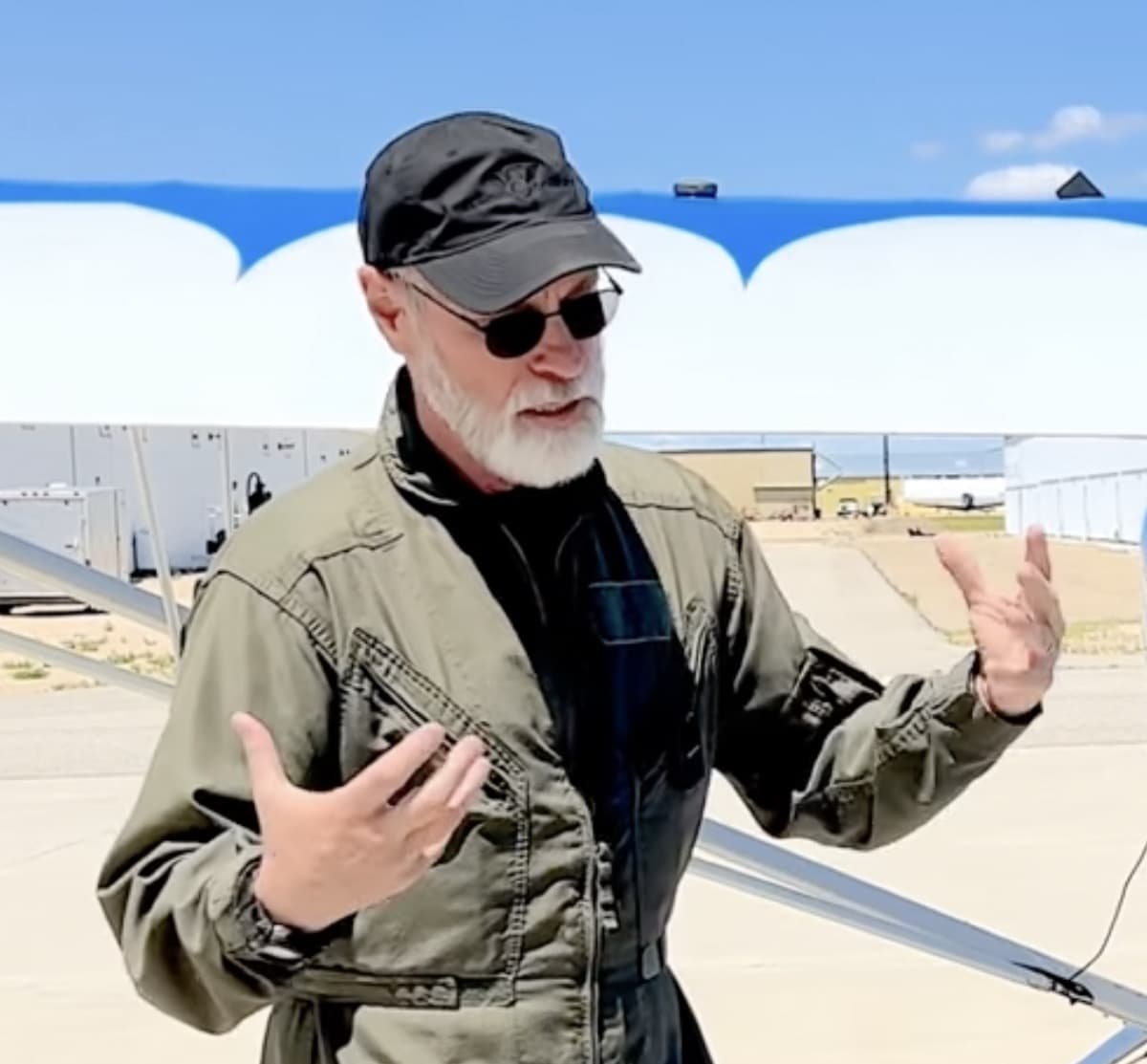
In January 2026, Rich Stowell, known internationally in the flight training community as The Spin Doctor, released a landmark white paper aimed at addressing the leading cause of fatal accidents in general aviation: Inflight Loss of Control (LOC-I).
Drawing from his experience of more than 35,000 spins, Stowell argues that while GA has clear standards for stalls and spins, recovery from spiral dives and roll upsets has remained a “mess” of conflicting guidance for decades.
In his paper, “Standardizing Roll Recovery in General Aviation,” he distills it into three words — Power-Push-Roll — as the universal standard for recovering from developed roll upsets.
As the paper explains:
- Power: Address the throttle setting first to manage airspeed and engine overspeed.
- Push: Startled pilots have a reflexive urge to pull the yoke, which is “very wrong and very dangerous” in a spiral dive as it increases G-loads and can exceed structural limits. Instead pilots should push to reduce Angle of Attack (AOA) and G-load, which improves roll effectiveness.
- Roll: Use coordinated aileron and rudder to return to wings level.
Stowell notes that nearly 80% of GA accidents are driven by deficiencies in manual flying skills.
The main cause? A lack of standardization. It doesn’t help that the FAA currently publishes four different recovery strategies, which increases cognitive load during a crisis.
The Search For Standardization
That lack of standardization is what led to Stowell writing the paper. The issue came to a head in 2024 after an invitation to conduct upset and recovery training in Australia, which was coupled with a workshop on best practices in upset prevention, recovery training, and preventing loss of control.
As part of his preparation for the trip, he began talking with other flight training experts in Australia, the UK, and the United States. What he discovered is that there are a lot of different opinions, especially on spiral dive roll recovery.
Added to that was the reconstitution of the Upset Prevention and Recovery Training Association International (UPRTA International), as well as the launch of the Upset Prevention Recovery Training Network.
The mission of both is standardization — standardization of curriculums, as well as standardization of the qualifications of an upset prevention and training instructor, according to Stowell, who is part of both organizations.
With all of that “swirling around,” he spent about six months “pulling things together” to try to get “it all in one place and show people it’s a mess and we should be able to do better.”
That led to the publication of the white paper in January 2026.

Next Steps
He hopes the paper will spur discussions that will lead to actual change, not only among flight instructors, but recreational pilots. It would be great, he says, if GA pilots read the paper, then take it to their CFIs, and use it as part of their flight training or a flight review.
“They also can open up the Pilot Operating Handbook during the session and read what it says,” he continues. “What are they telling you to do? What’s missing that would make the procedure better and safer on the recovery?”
That will push instructors to become better educated, as well as pilots, he says.
“It’s really a grassroots effort from both sides,” he adds.
He notes that the paper also aims to give spiral dives and similar scenarios equal parity with discussions about stall training and spin training.
“It’s always been thrown off to the side or treated as the black sheep of the family,” he says, adding it’s often “treated as a botched turn, but it can become much more complicated than that.”
The Opposite Of Complicated
In the paper, Stowell advocates for the exact opposite of complicated — what he calls elegant conciseness.
He explains that elegant conciseness is already incorporated into flight training without many people not even realizing it.
“It’s really about boiling things down to the basic elements from which we can build,” he says.
That means for spiral dives, it’s finding the specific actions that will lead to recovery.
Too often it gets convoluted, he says, noting that if you put a bunch of flight instructors in a room and say “I’m in a stall, what are you going to tell me to do? They all say lower the angle of attack.”
“But that doesn’t tell me what I need to do. Why don’t you just tell me to push? The result of that is we’ve reduced the angle of attack and we’ve reattached the airflow,” he explains. “Don’t tell somebody who’s under stress something that is abstract. Tell them what they have to physically do. That’s elegant conciseness.”
That kind of training also has the benefit of helping a pilot in trouble overcome the startle reflex.
Even with training, when something unexpected happens, a pilot will become startled. What happens next is what’s important.
“Are we incapacitated? Do we just totally shut down and freeze and nothing happens beyond that? Or do we catch our breath and go, ‘oh, okay, I need to do something and based on context and what’s happening, I remember what to do from my training.’ I don’t know that it will ever become automatic, but at least it will be in there and you can recall it and perform things in the proper sequence.”
That’s why it’s so important to take a moment and breathe when something unexpected happens during a flight.
“Back in the old days airline pilots would say ‘first thing you do is wind your watch,’” he says. “What that’s saying is take a moment and think first. Let’s figure out what we need to do.”
With proper training, you’ll get yourself out of the dilemma.
More importantly, with proper training you are less likely to be in the situation in the first place, he says.
Worth The Investment
While seasoned pilots may question whether paying for upset training is worth it, Stowell asks them to think of it this way: They are investing in themselves — and their lives.
“What if I tell you that in a three-hour course you’ll learn more in that three hours than in the last 150 hours of your flying? What is that worth to you? What is the value of that?”
But he quickly adds that it’s imperative to get that training from people who specialize in it, even if that means going somewhere “that’s not in your backyard.”
“Think of it as an adventure,” he says, noting that this kind of training can be “a really unique experience for most pilots.”
To find those specialists, he advises going to the Upset Prevention and Recovery Training Network website.
And once your training is complete, your insurance company may give you a break on your premiums, he notes.
“If you’re going to pay the same amount of money anyway, why not put it in the gas tank and get some training instead of just paying for a straight premium?” he asks.
You can read the full paper on Stowell’s website, where he also offers a free course, “Learn To Turn,” and a link to his blog on Community Aviation.
For more information: RichStowell.com

Thank you, Rich. After my time at Stead in 2004 and 2007 winters (I still look at the 500mb charts in forecasting long range weather, so I skipped the more severe 2005 & 2006 winters as the 500mb jet showed that would happen.) learning EMT with Tim Brill & Co., I was diagnosed with early stage glaucoma in Anchorage, and commuted monthly the winter before I retired from PACV/CKU to get lined out with daily eyedrops. Thanks for conducting Idaho’s ACE Academy satellite program from Boise, as it provided a great education to all, including us volunteers. Since I retired to north Idaho, I’ve caught a few rides to EAA breakfasts, still photographing aircraft… Enjoy those 1G maneuvers, and Bob Hoover’s statement about his hardest flying: learning to pour tea with his left hand so his pouring tea in the Shrike maneuver could be filmed!
AOA or critical angle of attack is not mentioned in any ACS or PTS. Both only reference indicated airspeed. Airlines (part 121) rely on indicated airspeed for defining min speeds to fly in all regimes, which are always 30% above stall speed in that same lift configuration. GA should use Vref and DMMS (just like 121) and honor both, and all stall spin accidents would disappear. There is no recovery from 450 AGL base to final stall, no matter how many course you took at 4500 AGL.
Well, said, Rich! I agree! I took your EMT course at Santa Paula back in ’94? Learned a lot! i’ve recommended it to many others since. And with my IFR students, i always review the basics first with them, slow flight, stalls and UAR, under the hood! Many haven’t done this in years! I will have to read your White Paper on this as well. Always learning! Thanks….
Just yesterday, I saw a comment in an aviation group on FB, in discussing a stall/spin accident on short final, in which a pilot said something like, “what’s exceeding AOA got to do with it? He obviously got too slow and stalled!” That comment was such a clear example of a pilot whose training was deficient—equating slow with stalling instead of exceeding angle of attack with stalling. Most pilots have heard, “a stall can occur at any pitch and any airspeed”, but people still think that the airspeed indicator is what to watch.
Soon after I completed a basic aerobatics course some 45 years ago, I was flying from Laramie to Denver in our TR182 and got caught unexpectedly in the wake turbulence of a 737 airliner. It rolled the airplane, and as the wings passed 90°, because of my recent training, I pushed on the yoke and did a coordinated roll out back to level flight. I was already a CFII when I took the aerobatics training, but without that training, I suspect I would have done the same as most pilots, pulled on the yoke instead of pushing it.
During that same aerobatics training, my instructor had me dive the Decathlon to its maneuvering speed and aggressively pull on the stick. So pointed straight at the ground and at a relatively high airspeed, the wing stalled. It was a perfect demonstration of how a stall can occur at any pitch and any airspeed, because the angle of attack necessary for the wing to fly was exceeded.
IMHO, every pilot should receive either aerobatics training or upset recovery training. Flying beyond the edge of the envelope with a competent instructor is a real eye-opener and important to safety.
Couldn’t agree more. Being old school I think new pilots should be familiar and comfortable with actual stalls and at least recognize and have had to recover from a few spins before they are turned loose.
Per the Airplane Flying Handbook Chap 5 Spiral Dive Recovery – 1. Reduce power (throttle) to idle. 2. Apply some forward elevator. 3. Roll wings level. 4. Gently raise the nose to level flight. 5. Increase power to climb power. What’s the difference?
Warren, I influenced the wording of the procedure you quoted. What about the various other procedures in the FAA handbook for ostensibly the same issue, i.e., nose-high, nose, low, and so-called “upset”? I suggest reading the paper for the full picture.
Better than a document is a requirement for two hours and two flights of basic aerobatic maneuvers training to be eligible for the Private Pilot check ride.
There is nothing better than experience to de-mystify actual stalls, spins, feeling up to 4 Gs, and seeing the ground through the top of the windscreen. Much of flight training is becoming comfortable with being uncomfortable. Proper instruction on these flights should reduce the impulse to abuse operating limits later by building healthy respect for dishing the nose on poorly executed aileron rolls, or rapidly accelerating on the backside of a loop with inadequate pull.
If a brand new, or even experienced commercial pilot, should encounter an actual upset, it won’t be the first time they’ve seen it and muscle memory to recover properly should trump the startle reflex.
Not requiring basic aerobatic exposure for private pilot is like not demonstrating parallel parking on a driving test. The three-dimensional atmosphere requires basic competency and awareness of a three-dimensional airplane.
Flight schools may whine–they’ll need a basic aerobatic trainer aircraft. Or hire a contractor for the two flights per student. Well worth the expense–minor compared to future possible loss of life.
Next, mandatory requirement for exposure to conventional gear to solidify basic airmanship skills of yaw and airspeed mastery!
Well, sort of… I’ve taught basic aerobatics and done some in a variety of airplanes, and I think aerobatics are over-rated.
Why? There’s a whole lot of the “normal category” flight envelope that is not taught, and that part of the envelope is normally outside a pilot’s comfort zone. Put a pilot outside their comfort zone and then…
I’ve cataloged a whole bunch of these expanded envelope exercises — not maneuvers with completion standard — and they can challenge even experienced pilots and CFIs. A hundred or more are in the Expanded Envelope Exercises®, a whole ‘nother topic.
In aerobatics, in my experience, it’s a series of steps — achieve this airspeed, push on this, look at that. Teaching sequential steps is quite different from focusing on sensations and sight pictures.
There’s lots to learn within 60° bank, 30° pitch, and 2 Gs. And if you learn in your own plane, there’s no problems with transfer. Come fly with me in Savannah, in my plane if I still have it, or in your Normal Category plane.