

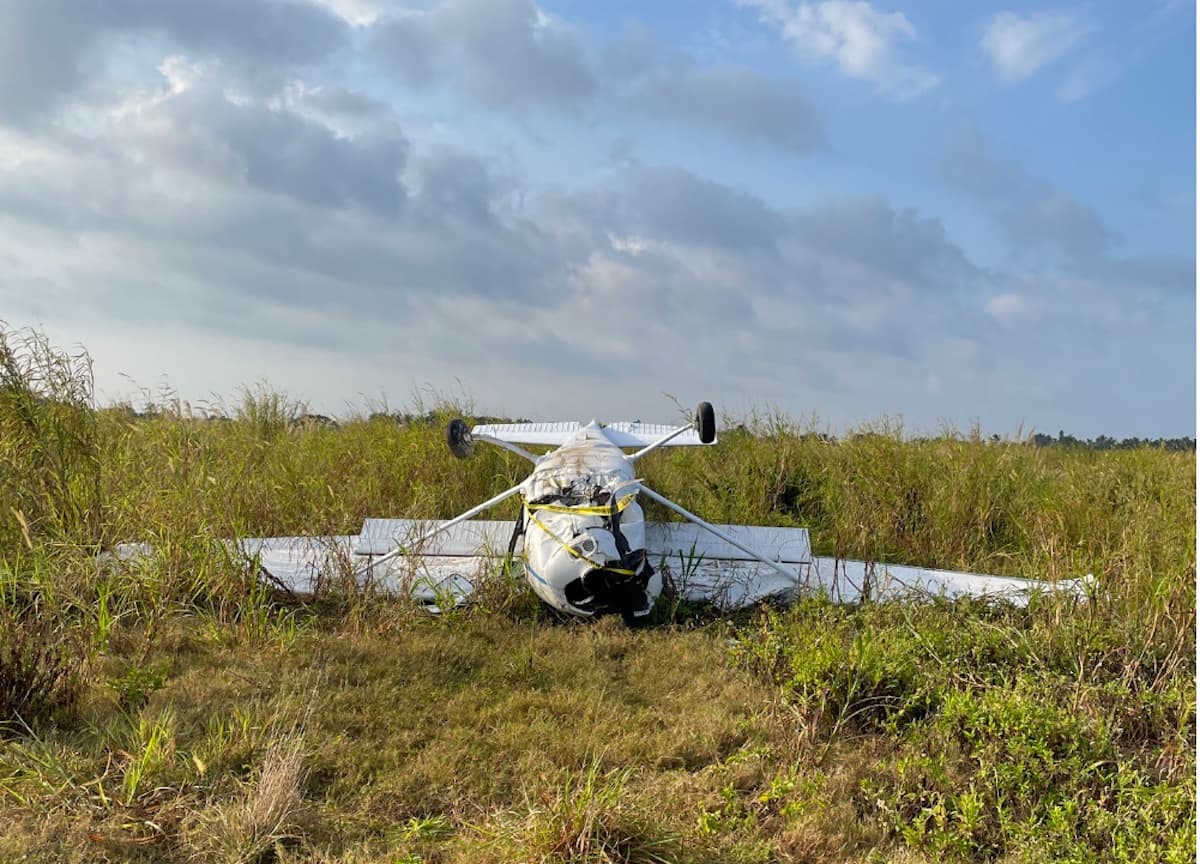
The flight was intended for a “gender reveal” near Homestead General Airport (X51) in Florida.
The pilot met his friend at X51, where the friend handed him and his passenger the reveal bottles and explained the procedure. They departed X51 and began searching for the location of the gender reveal.
The pilot said he was in slow flight at 300 feet AGL, looking for the house. When they found it, the passenger decided he did not want to open the Cessna 172’s window and release the reveal bottles. The pilot decided to cancel the reveal and depart the area.
During the climb-out, the engine did not respond, and the pilot made an emergency landing in a field. The passenger sustained minor injuries in the crash.
The FAA inspector who responded to the accident site reported that the fuselage was buckled. He added the airplane came to rest upside down in the field and that an adequate but undetermined amount of fuel was found in both fuel tanks. The cockpit fuel selector was found in the “Both” position. No contamination or obstructions were found in the fuel system.
A post-accident examination of the engine was conducted at an aircraft salvage facility. The engine remained attached to the airframe and there was impact damage to the propeller. The crankshaft was turned through by manually rotating the propeller. The engine turned freely through 360° with no binding or unusual noise evident. All cylinders showed compression and suction when the crankshaft was rotated. A lighted borescope was then inserted inside the cylinders. The pistons moved up and down normally and valve action was correct. There were no holes or damage to the pistons or valves.
The fuel strainer was opened. The screen was clean and unobstructed. The carburetor was examined and the fuel bowl was free of debris. The carburetor fuel inlet screen was clean and free of debris. All cockpit controls were connected and exhibited full travel when manipulated by hand.
The spark plugs were removed for examination. The electrodes were normal in wear and dark in color when compared to a Champion Check-a-Plug chart.
The magnetos were removed and tested by rotating with a power drill. Both magnetos produced spark when rotated.
At the conclusion of the examination no anomalies were noted that would have precluded normal operation of the engine.
The recorded temperature and dew point near the accident site was about 80°F and 71°F. On a carburetor icing probability chart, those temperatures were in the “serious icing — glide power” range. The pilot told investigators he did not use carburetor heat before the loss of engine power.
According to FAA Special Airworthiness Information Bulletin CE-09-35 (Carburetor Ice Prevention), pilots should be aware that carburetor icing does not just occur in freezing conditions: It can occur at temperatures well above freezing temperatures when there is visible moisture or high humidity.
Icing can occur in the carburetor at temperatures above freezing because vaporization of fuel, combined with the expansion of air as it flows through the carburetor (Venturi effect), causes sudden cooling, sometimes by a significant amount within a fraction of a second. Carburetor ice can be detected by a drop in RPM in fixed pitch propeller airplanes and a drop in manifold pressure in constant speed propeller airplanes. In both types, usually there will be a roughness in engine operation.
Probable Cause: A loss of engine power due to carburetor ice as a result of the pilot’s failure to use carburetor heat in conditions conducive to the formation of carburetor ice.
To download the final report. Click here. This will trigger a PDF download to your device.
This March 2024 accident report is provided by the National Transportation Safety Board. Published as an educational tool, it is intended to help pilots learn from the misfortunes of others.
The MS carb on most smaller engines has an option to add a carb temp gauge. It works off the thermocouple so it works without any electrical power.
I’ve have to use it after a start on a cold day here, while taxiing, until the oil has warmed the carb. usually 5-10 minutes taxiing to the runup area.
“the passenger decided he did not want to open the Cessna 172’s window and release the reveal bottles.”
I don’t know why I find this funny.
Sounds like a messed up mission from the get go!
48 years operating 0-320 and O-360 in Colorado, never used carb heat.
On my second or third lesson (1975), we’re around 2500msl at low cruise power best I can remember on a nice day, and the engine starts running rough. Still not fully confident of how the little Grumman America can fly with those little stubby wings, the rough engine quickly raised my anxiety level several notches. My instructor pulled the carb heat knob fully out, and in about 10-15 seconds, the engine was purring again. Never happened again.
A guy named Eric Blair had a few things to say about the corruption of language. He mentioned what the objective is. His pen name was George Orwell.
It was a warning, not an instruction manual.
Good one !
C172M poh – “Carburetor heat should be applied prior to any significant reduction or closing of the throttle”.